
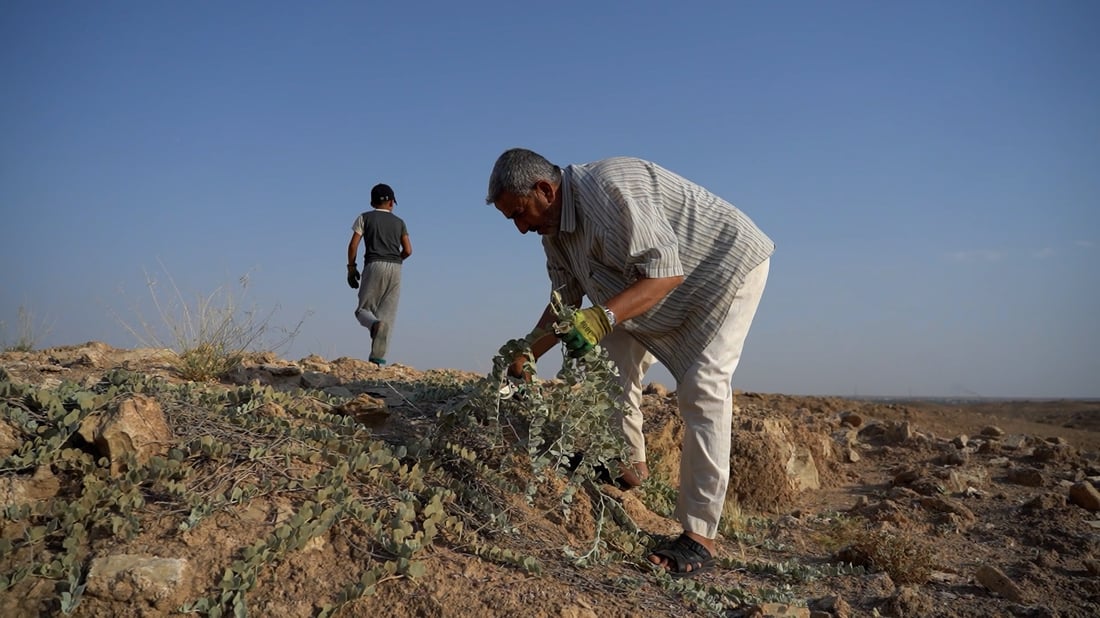
A man harvests wild caper plants from rocky desert ground near Hit in Anbar governorate. Photo: 964media.
Anbar
The desert plant that Hit pickles, and the man who sells it
ANBAR — Abdul Razzaq Hazim rides through Hit selling kubar, a thorny desert plant, and jars of the sour brine made from it — a staple in the western Anbar city and a trade his family has kept going.
The plant grows wild in rocky ground stretching from west of Ramadi toward al-Qaim near the Syrian border, an area known locally as al-Barraqa. Residents harvest the tender branches, green leaves and unopened flower buds, which are eaten cold as an appetizer, like Iraqi pickles, with bread, green onions, cucumbers and Armenian cucumbers. It appears in April and lasts through the summer. Hazim cuts it with scissors rather than pulling it up: “Uprooting it prevents it from reproducing in the future, and that is wrong in my view.”
The brine, known as kubar water, takes about three weeks. The plant is soaked for three days with the water changed daily to draw out the bitterness, then cut into pieces of five to 10 centimeters. “The plant is then packed into containers and coarse salt is added,” Hazim said. “The following day, we replace the water and add another amount of salt with seven dates, then seal the containers tightly for 21 days until it ferments.” Residents dip bread in the liquid and drink it in small quantities.
Customers buy it ready to eat or take the leaves and flowers to pickle at home. Hazim sells through agents in Hit’s Mualimeen and Jamiya neighborhoods, takes phone orders and delivers on his rounds. Large containers go wholesale to shopkeepers for 5,000 to 6,000 dinars (about $3.30 to $3.90) and reach consumers at about 8,000 dinars ($5.20); small ones sell wholesale at 900 dinars and retail at about 1,500 dinars ($1).
Hazim said kubar water was once central to daily life in Hit, served with hot bread, cucumbers and onions. He also described traditional uses for the plant, saying residents take it for joint pain, urinary sediment and colon complaints, and grind the dried leaves with henna to apply to painful areas.