
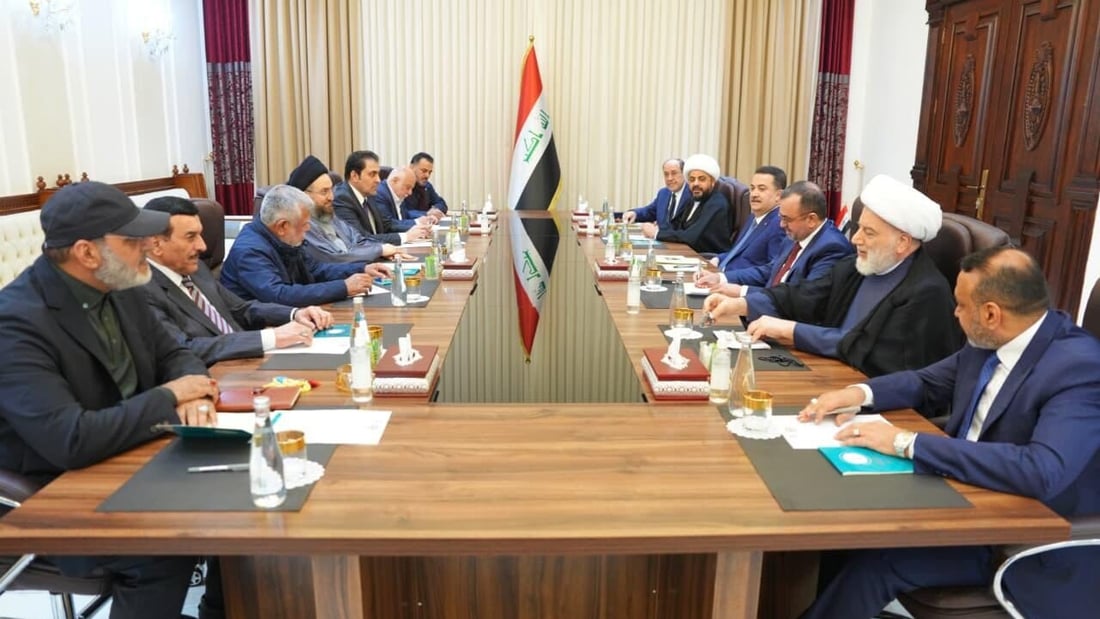
FILES: Members of the Shiite Coordination Framework meet in Baghdad on Feb. 23, 2026, during their regular session.
Coordination Framework urges Kurdish parties to settle presidency
BAGHDAD — The Shiite Coordination Framework on Monday called on the two major Kurdish parties to resolve the issue of the presidency, while making no reference to the nomination of Nouri al-Maliki in its latest statement.
The bloc, which includes Shiite parties backing the current Iraqi government, held its regular meeting No. 263 at the office of Sheikh Hammam Hamoudi on Feb. 23 to review recent developments.
In a statement issued after the meeting, the Coordination Framework said that the participants emphasized their “strong commitment to preserving the unity and cohesion of the Coordination Framework,” describing it as a continuation of honoring “the repeated trust granted to it by voters in the elections.”
The statement called on “the two major Kurdish parties to resolve the issue of the presidency in order to preserve national entitlements,” but did not address the ongoing debate over the nomination of former Prime Minister Nouri al-Maliki as part of the government formation process.
The presidency remains unresolved following the 2025 elections, with the Kurdistan Democratic Party and the Patriotic Union of Kurdistan continuing negotiations over a unified Kurdish candidate. Senior Kurdish leader Hoshyar Zebari said there is a “positive atmosphere” in talks between KDP leader Masoud Barzani and PUK leader Bafel Talabani, adding that the KDP asked the Coordination Framework “to leave the decision on selecting the president of the republic to the Kurds,” with Foreign Minister Fuad Hussein remaining its candidate.
Zebari also said it would be “difficult” for the next president to assign al-Maliki to form the government “unless the international situation changes,” pointing to external factors affecting the broader government formation process.
While the presidency was addressed in the statement, it made no mention of the stalled nomination of former Prime Minister Nouri al-Maliki, which has become a central obstacle in government formation. The Coordination Framework nominated Maliki following the 2025 elections, but his candidacy has faced growing internal debate and external pressure.
President Donald Trump warned four days after the nomination that Washington may halt support for Iraq if Maliki returns to power, and Iraq’s Foreign Ministry said a verbal message from U.S. officials included “a clear and explicit hint of the possibility of imposing sanctions on certain individuals and institutions” if the framework proceeds.
Efforts this week to arrange a meeting between Maliki and U.S. envoy Tom Barrack stalled, with differing accounts over whether Maliki declined or Barrack’s schedule did not allow it.
Barrack later wrote that “The necessity of effective leadership that aligns itself with the policies and practices of further stabilization for Iraq and the Iraqi people is key to our mutual goals.” Maliki has said he will not withdraw voluntarily and that any reversal of his nomination must come from the Coordination Framework itself.
The Coordination Framework also reaffirmed Iraq’s commitment to international resolutions, “particularly Resolution 833,” and its commitment to building strong relations with countries around the world, “especially neighboring states.”
It stressed Iraq’s right to safeguard its national entitlements and the rights of its people, “including the deposit of maritime boundary maps with the United Nations.”
On tensions between Iran and the United States, the Coordination Framework urged prioritizing dialogue and benefiting from what it described as the “positive negotiating climate in Geneva,” stating that “war produces only greater problems.”