
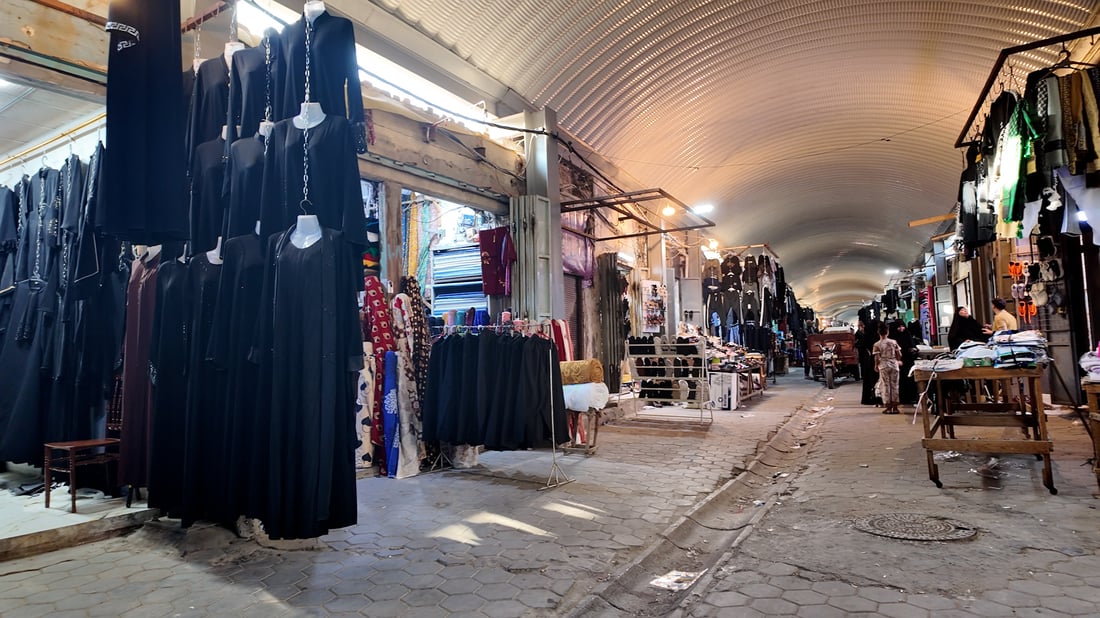
Clothing shops in a quiet Qalat Saleh market during the Arbaeen pilgrimage. Photo: 964media.
Shops face slowdown
Arbaeen pilgrimage cuts Qalat Saleh market activity by 70%
MAYSAN — Commercial activity in Qalat Saleh, a district in Maysan governorate in southeastern Iraq, has fallen by about 70% as large numbers of residents travel for the Arbaeen pilgrimage or volunteer with service processions, local shopkeepers told 964media.
Traders said streets and markets were nearly empty, with many young men working at processions and other residents traveling to take part in the religious observance. They expect business to recover gradually after the pilgrimage ends.
Arbaeen is a major Shiite Muslim religious observance marking the end of the 40-day mourning period following the anniversary of the death of Imam Hussein, the grandson of the Prophet Muhammad, at the Battle of Karbala in 680. Each year, millions of pilgrims travel to the holy city of Karbala, many on foot, while communities across Iraq organize processions and roadside stations offering visitors free food, water and accommodation.
“Commercial activity, whether in Qalat Saleh or across all southern cities, experiences a slowdown during the Arbaeen pilgrimage, which negatively affects trade in the district,” fabric shop owner Mohammed Qasim told 964media.
Qasim said the large number of processions draws many young people who compete to serve pilgrims, temporarily reducing the district’s population and weakening buying and selling.
Shop owner Mahmoud Sattar said most men had left for the pilgrimage, while many women remaining in the district generally did not visit the market without their husbands or older female relatives.
“On normal days, we used to sell nearly 100,000 dinars, but during this period sales do not exceed 25,000 dinars,” Sattar said. “How can rent and other obligations be covered?”
Another shop owner, Mohammed al-Kaabi, said the market was extremely quiet because residents were either traveling for the pilgrimage or operating processions to serve visitors.
He said the slowdown had affected nearly every trade, including herbalists, grocers, tailors, blacksmiths and carpenters, with work almost completely halted during the pilgrimage period.