
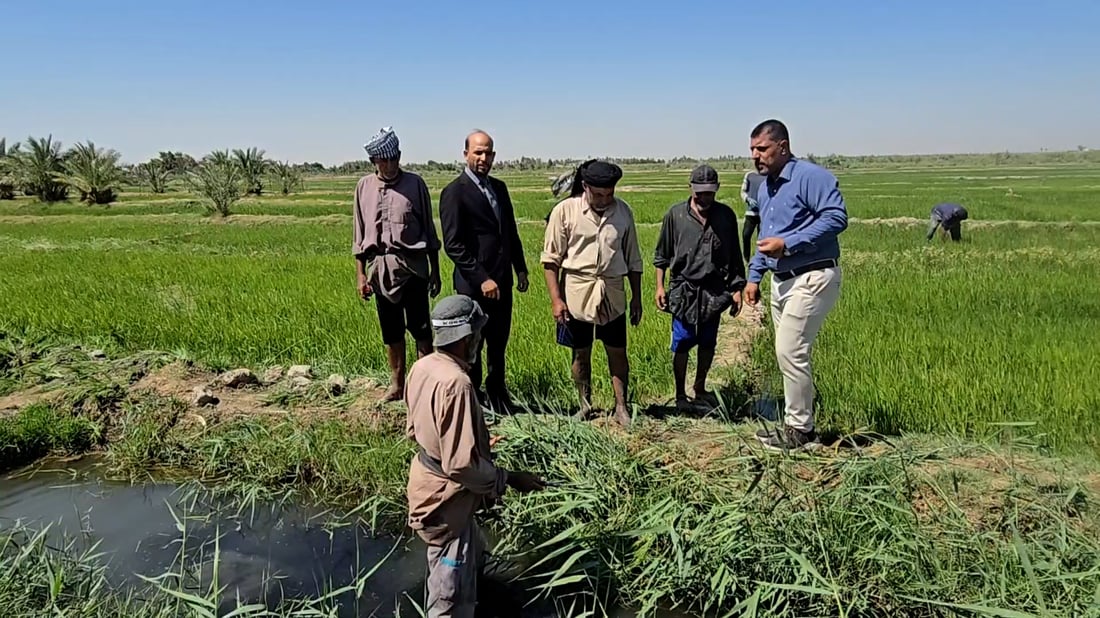
Dhi Qar farmers revive amber rice as water supplies improve
DHI QAR — Farmers in southern Dhi Qar governorate have resumed planting Iraq’s prized amber rice after improved water supplies secured a summer agricultural plan covering 10,000 dunams, following a season in which no cultivation plan was approved because of shortages.
Farmers in the Al-Amiyah area of Karmat Bani Said purchased seeds from Al-Mishkhab in Najaf governorate, the traditional center of amber rice cultivation, and planted long-grain and short-grain varieties in fields supplied by the Euphrates and Gharraf rivers.
Farmer Hussein Rahima Hantoush told 964media that “farmers have turned to planting fragrant long-grain amber and short-grain amber, with abundant water and a good plan allowing early cultivation.”
The farmers said careful cultivation and suitable local conditions could allow their crop to compete with production from Al-Mishkhab, a district about 30 kilometers south of Najaf that is widely associated with amber rice.
Amber rice is one of Iraq’s most valued traditional crops and is known for its strong aroma. It is commonly served at celebrations and other special occasions but requires large and continuous water supplies, making production highly dependent on government irrigation plans and river levels.
Ali Nasser Mohsen, director of the Karmat Bani Said agricultural division, said Al-Amiyah was particularly known for growing the variety previously associated mainly with Najaf.
“Dhi Qar farmers now grow this variety with high efficiency and can compete with Najaf in marketing and production,” Mohsen told 964media.
Farmer Hajim Rahima said cultivation had spread widely this year after farmers struggled last season with a lack of water, the absence of an agricultural plan and difficult living conditions.
“The lands in Al-Amiyah are suitable for rice, but not wheat and barley, and we planted two types — long-grain amber and short-grain amber — after purchasing their seeds from Al-Mishkhab in Najaf,” he said.
Rahima described the crop as strong because of farmers’ close attention and called on the government to provide the chemical fertilizer allocated under the agricultural plan.
Water shortages have sharply reduced amber rice cultivation in Najaf in recent years. Planting in Al-Mishkhab reportedly reached about 35,000 dunams in 2010 but fell to 466 dunams in 2022, while only about 200 dunams were planted at a research station in 2025.
Cultivation recovered in parts of Najaf in 2024, but farmers continued to report problems with irrigation allocations. This season, many Al-Mishkhab growers turned to jasmine rice, a variety similar to amber that uses less water and produces higher yields.
Farmers in Al-Mishkhab told 964media that true amber rice accounted for only a small share of planted land because of its high costs, sensitivity and heavy water requirements.
In Dhi Qar, water interruptions over the past three years directly affected farmers’ incomes because many families depend primarily on rice production, Mohsen said. The recent restoration of water supplies has brought cultivation and economic activity back to the area.
Ali Abdul Ridha, deputy director of Dhi Qar’s agriculture directorate, said this year’s summer plan authorized the financing and cultivation of 10,000 dunams of rice, divided equally between the Euphrates and Gharraf basins.
He urged farmers to follow the approved plan, comply with agricultural guidance and use modern irrigation methods, while calling for subsidized loans to help them purchase solar-powered systems for water pumps and submersible equipment.