
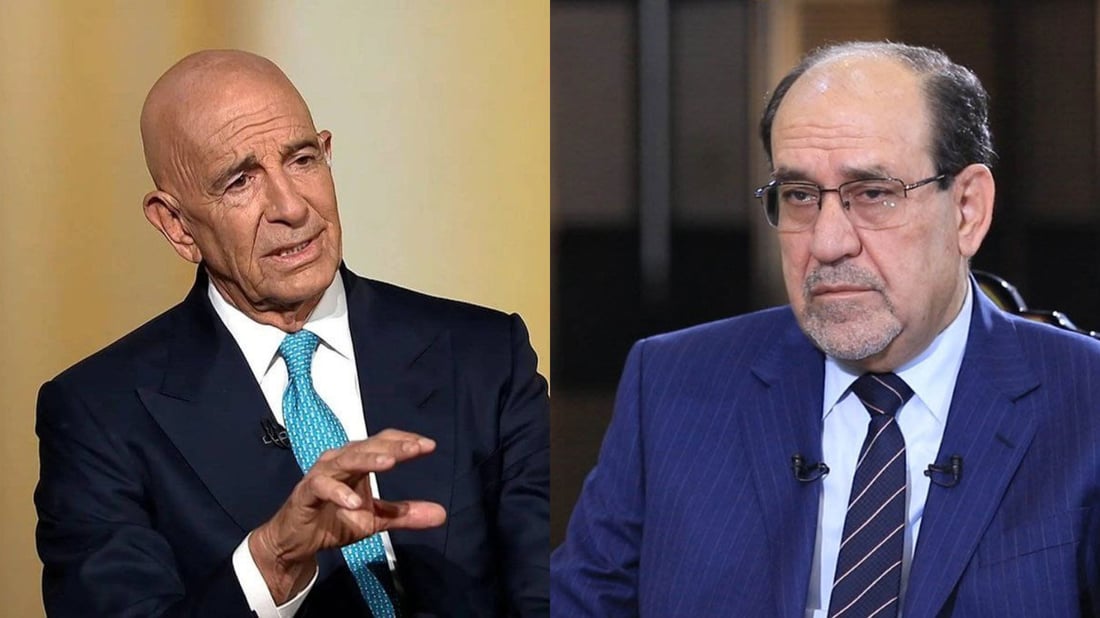
U.S. envoy Tom Barrack (left) and State of Law Coalition leader Nouri al-Maliki in a composite photo.
Maliki-Barrack meeting fails to materialize as pressure mounts to withdraw candidacy
BAGHDAD — Efforts to arrange a meeting between prime ministerial nominee Nouri al-Maliki and U.S. envoy Tom Barrack stalled late Sunday as political tensions intensified over calls to withdraw Maliki’s candidacy.
964media has learned that pressure to rescind Maliki’s nomination is growing. Prime Minister Mohammed Shia al-Sudani had offered to mediate a meeting between Maliki and Barrack, who arrived in Baghdad on an unannounced visit, as the premiership crisis deepened. Several political forces, including Asaib Ahl al-Haq and the Hikma Movement, have called for Maliki to step aside following a warning issued by President Donald Trump four days after his nomination.
Accounts differ over why the meeting did not take place.
Figures close to the State of Law Coalition said Maliki declined Sudani’s proposal to meet Barrack or engage with American officials. Coalition spokesman Aqeel al-Fatlawi said Maliki is awaiting “clarifications from the Iraqi ambassador in Washington, Nizar al-Khairallah,” regarding the U.S. position on his candidacy. According to this account, Maliki believes the message may have been influenced by internal and external actors and wants to verify the U.S. stance before meeting American officials.
A political figure familiar with Sudani’s mediation efforts offered a different account, saying “Barrack’s schedule did not allow for holding the meeting.” The figure said Barrack’s visit focused on regional tensions involving Iran and Lebanon, as well as discussions on a Gaza peace council, and that a meeting with Maliki “was not on Barrack’s agenda.” Barrack apologized for not holding the meeting, the figure added.
Barrack did meet Sudani. In a post published Monday, he wrote: “Fruitful meeting with Prime Minister Mohammed Shia al-Sudani discussing continued Iraqi goals and objectives to build a sovereign, stable, and prosperous future that aligns with @POTUS’s desire and plan for peace and prosperity in the region.”
He added: “The necessity of effective leadership that aligns itself with the policies and practices of further stabilization for Iraq and the Iraqi people is key to our mutual goals.”
A statement from Sudani’s media office said the meeting addressed bilateral relations, regional conditions and Iraq’s efforts to support stability, particularly in Syria.
Maliki has for weeks declined to attend Coordination Framework meetings or discuss scenarios involving his withdrawal. In his only interview on Feb. 3, he said he was nominated by the framework and would not step aside, stating that if the alliance wished to reverse course, it could withdraw his nomination itself.
Opponents argue Maliki should withdraw to avoid placing Shiite leaders in a position where they would be compelled to rescind his nomination under U.S. pressure. Supporters say any decision should come from the Coordination Framework rather than Maliki stepping back voluntarily.