
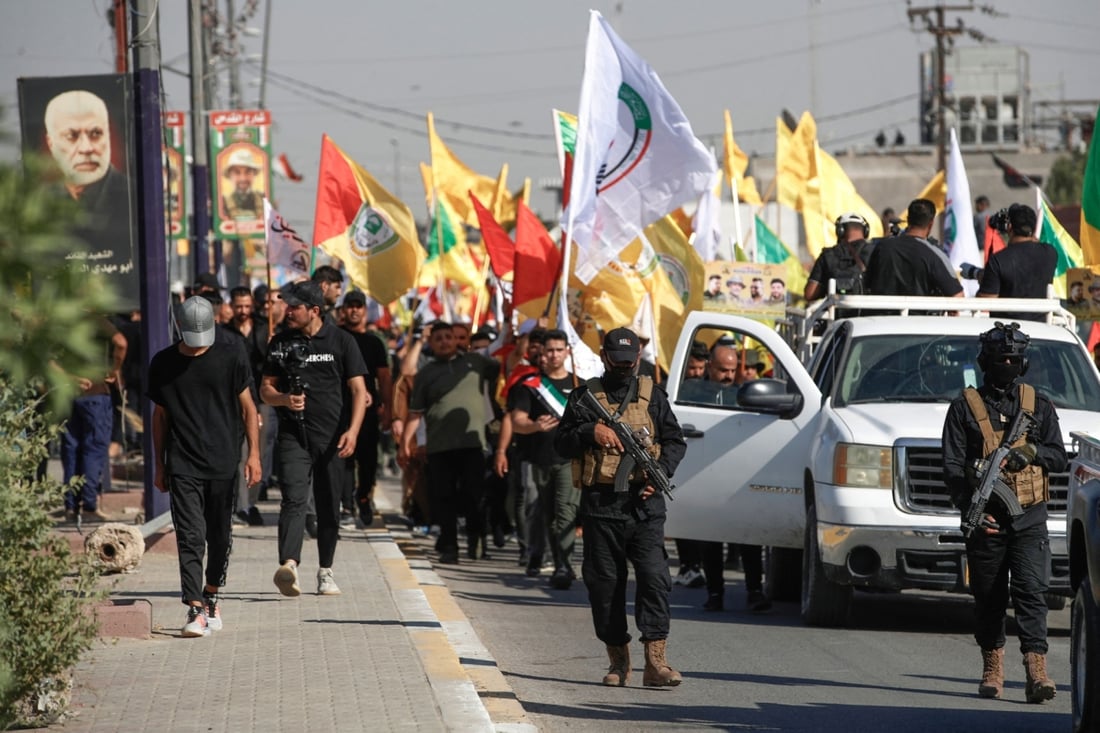
Armed members of Iran-backed Shiite factions walk alongside supporters carrying flags and portraits
Iraqi militia groups reject disarmament before end of foreign troop presence
BAGHDAD — The Iraqi Resistance Coordination Committee said Sunday it rejects any discussion of disarmament, including with the Iraqi government, until what it described as full national sovereignty is achieved and all forms of foreign presence end.
In a statement, the group said “the weapon of the resistance is a sacred weapon,” arguing it remains necessary “in a country where occupation still exists” and describing it as a safeguard for defending the land and religious sites. It said the armed factions had previously acted as “a strong shield” against the Islamic State group.
“We categorically reject any talk about it by external parties,” the statement said, adding that “dialogue regarding it, even with the government, will only take place after achieving full sovereignty for the country and freeing it from all forms of occupation and its threats.”
The statement listed factions it said represent the coordination, including Kataib Sayyid al-Shuhada, Kataib Karbala, Ansar Allah al-Awfiya, Harakat al-Nujaba, Asaib Ahl al-Haq and Kataib Hezbollah.
Addressing the next Iraqi government, the group called for prioritizing public services, combating corruption and ending “all forms and titles of foreign occupying presence on Iraqi land and in its skies.” It said the government should pursue legislation that preserves national dignity, including a service and retirement law for the Popular Mobilization Forces.
The Iraqi Resistance Coordination Committee is commonly used as a media label for an informal framework of Iran-backed Shiite armed groups that issue joint statements and adopt shared positions, without an announced leadership or fixed membership.
The dispute over disarmament has intensified in recent weeks. On Dec. 21, 2025, Supreme Judicial Council President Judge Faiq Zidan said leaders of armed factions had agreed to cooperate on restricting weapons to the state and thanked them for “responding to advice” and moving toward political engagement. Kataib Hezbollah later said it would not discuss giving up its weapons until foreign forces leave Iraq, insisting that “resistance is a right.”
Prime Minister Mohammed Shia al-Sudani said on Jan. 4 that limiting weapons to state authority is “an Iraqi decision and an Iraqi vision,” describing it as part of the government program and linking it to steps such as ending the international coalition’s mission and concluding the United Nations Assistance Mission for Iraq.
International attention has also focused on the issue. On Nov. 30, 2025, U.S. Special Envoy to Iraq Mark Savaya said Iraq has a “historic opportunity” to disarm non-state actors, warning that weapons outside state control threaten stability and economic growth. A Reuters report last April that several Iran-aligned groups were signaling a willingness to disarm under pressure was later denied by Kataib Hezbollah, which called the claims “false” and “fabricated.”