
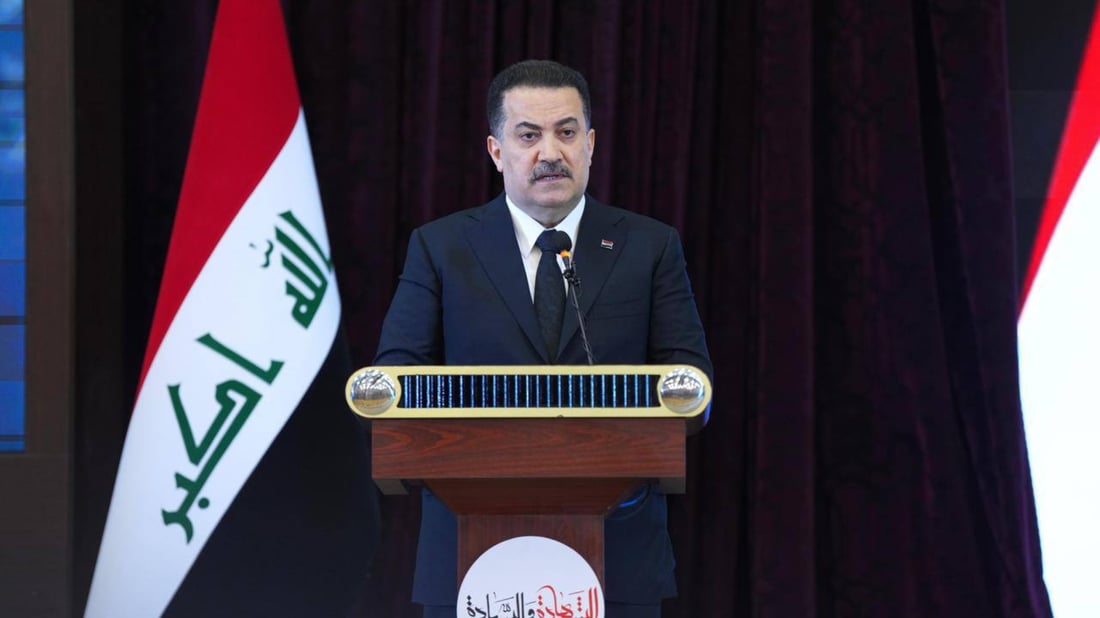
Prime Minister Mohammed Shia Al-Sudani speaks during a memorial ceremony in Baghdad marking the anniversary of the killing of Qassem Soleimani and Abu Mahdi Al-Muhandis.
Citing top cleric, PM Al-Sudani says limiting weapons to state is Iraqi decision
BAGHDAD — Prime Minister Mohammed Shia al-Sudani said Sunday that restricting weapons to state authority is an Iraqi decision made without foreign interference, describing the policy as consistent with guidance from the country’s top religious authority.
Al-Sudani made the remarks during a Popular Mobilization Forces memorial ceremony marking the sixth anniversary of the 2020 killing of what he called “the leaders of victory and their companions,” a reference to Iranian Gen. Qassem Soleimani and Popular Mobilization Forces deputy chief Abu Mahdi al-Muhandis, who were killed along with others in a U.S. drone strike near Baghdad International Airport in January 2020.
“Restricting weapons to the hands of the state is an Iraqi decision and an Iraqi vision, far from any foreign interventions or dictates,” al-Sudani said, adding that “implementing this vision was one of the most important items of the government program and is in line with the call of the supreme religious authority.”
“The government has been keen during its term to strengthen Iraq’s power, independence and sovereignty, and to protect it from every danger,” he said, pointing to what he described as steps to complete national sovereignty.
Al-Sudani said those efforts “resulted in an agreement to end the mission of the international coalition and transition to bilateral relations, and the handover of Ain Al-Asad base within the next few days.”
He said the killing of Soleimani and al-Muhandis was a loss for both Iraq and Iran. With their deaths, he said, “Iraq and the Islamic Republic of Iran lost two great leaders who devoted their lives to jihad and confronting terrorism,” adding that “their decisive participation in confronting the ISIS terrorist organization was one of the most important reasons for the historic victory.”
Al-Sudani described al-Muhandis as a leader who “gave everything he had for Iraq,” both during what he called the struggle against the former dictatorial regime and after its fall. He said al-Muhandis “used to advise fighters to preserve the lives of civilians abducted by terrorist gangs and did not differentiate between one citizen and another on the basis of religion, sect or component.”
He said Soleimani “provided support to the Iraqi government at the time and moved with Iraqi fighters across all fronts until the moment of declaring victory.”
Al-Sudani also pointed to the end of the United Nations Assistance Mission for Iraq as another sovereignty-related step. He said the government had completed “one of the most prominent files related to sovereignty,” referring to the conclusion of UNAMI’s mission.
In comments referring to the war that began on Oct. 7, 2023, al-Sudani said “the government of the occupying entity tried to drag Iraq into the arena of war and target it during the events of Oct. 7 and what followed, in order to implement its plan,” adding that “a strong and healthy Iraq represents the cornerstone of stability in the region.”
“We worked with all our effort, and in cooperation with sincere national forces, to protect our country from war and to continue its development and reconstruction in various fields,” al-Sudani said.