
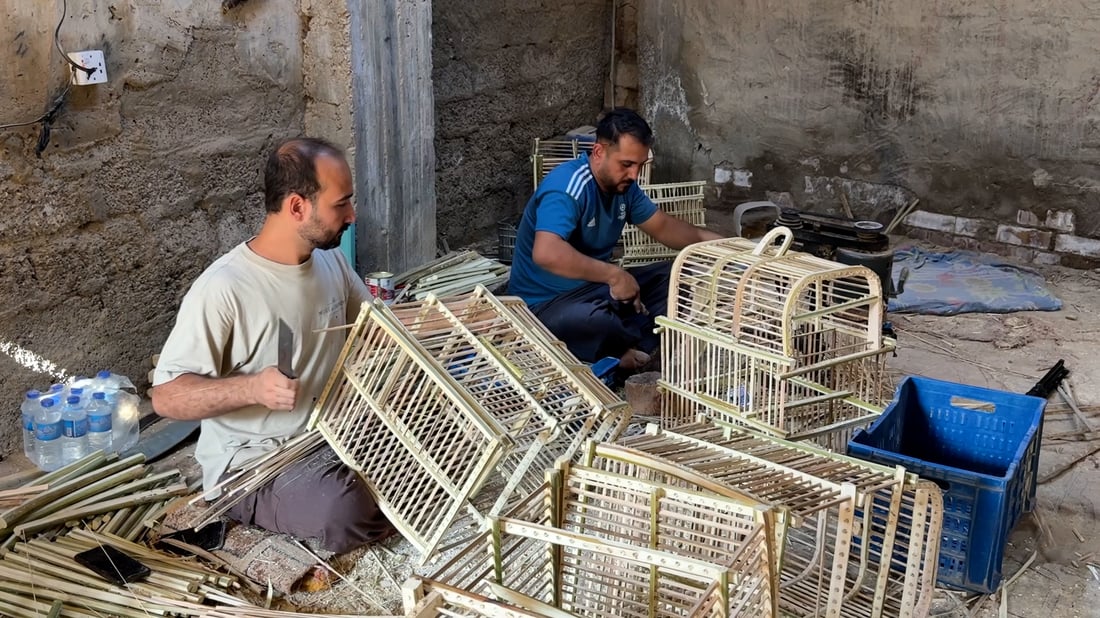
Artisans in Bahriz craft birdcages from palm fronds using traditional tools, a family trade that continues to attract bird owners across Iraq. The handmade cages are especially favored for bulbuls. (Photo by 964media)
Bulbul cage makers keep a palm-frond craft alive in Diyala
DIYALA – In a small workshop in Bahriz, cage maker Mustafa Falah continues a family craft rooted in heritage, building palm-frond cages for Iraq’s beloved bulbul bird. Locals say the bird refuses to sing in metal enclosures.
“The Iraqi bulbul only feels at home in a cage made from palm fronds, the way it was in its homeland,” Falah told 964media. “We learned this craft from our uncles around 2006, and they learned it from our grandparents.”
Falah and his brother use two types of material known as sheesh, thin rods made from palm fronds. “My brother uses Chinese sheesh, but I use Iraqi sheesh,” he said. “The fronds come from Bahriz orchards. We cut, shape, and drill the wood, then build the cage frame. One cage takes about half an hour to make.”
The cages come in three sizes: the large “double” costs 10,000 Iraqi dinars (about $7), the medium 7,000 dinars (about $5), and the small 4,500 dinars (about $3).
The palm-frond cage remains popular, especially among southern Iraqis. “People from Basra and Nasiriyah come in winter and buy many cages, loading them onto large trucks,” Falah said. “In summer, people from Baghdad visit. We also supply a shop owner in Baghdad with a large number of cages.”
Falah said the family plans to keep the tradition alive. “We will continue this profession and develop it with new designs and decorations,” he said.
Another craftsman, Saif al-Badrani, told 964media that while some artisans use Chinese sheesh for decorative cages, most prefer Iraqi material for its durability. “The Iraqi sheesh gives the cage strength and makes it last longer,” he said. “Some customers like the Chinese kind because it’s smooth and looks nicer, but it swells and gets damaged when it absorbs water. The Iraqi type has rough fibers and knots, but that makes it stronger.”
Al-Badrani said the Iraqi-made wooden cages are especially suitable for bulbuls. “They don’t harm the bird, unlike iron cages that can break its wings when it moves,” he said. “Wooden cages are also sturdier than metal ones, which can crack at the welded joints.”
He added that wooden cages offer more artistic variety. “Iron cages come in one standard shape, but wooden ones can be round, square, triangular, or even in a design we call ‘Abu al-Batikh,’ or the watermelon style,” he said with a smile.