
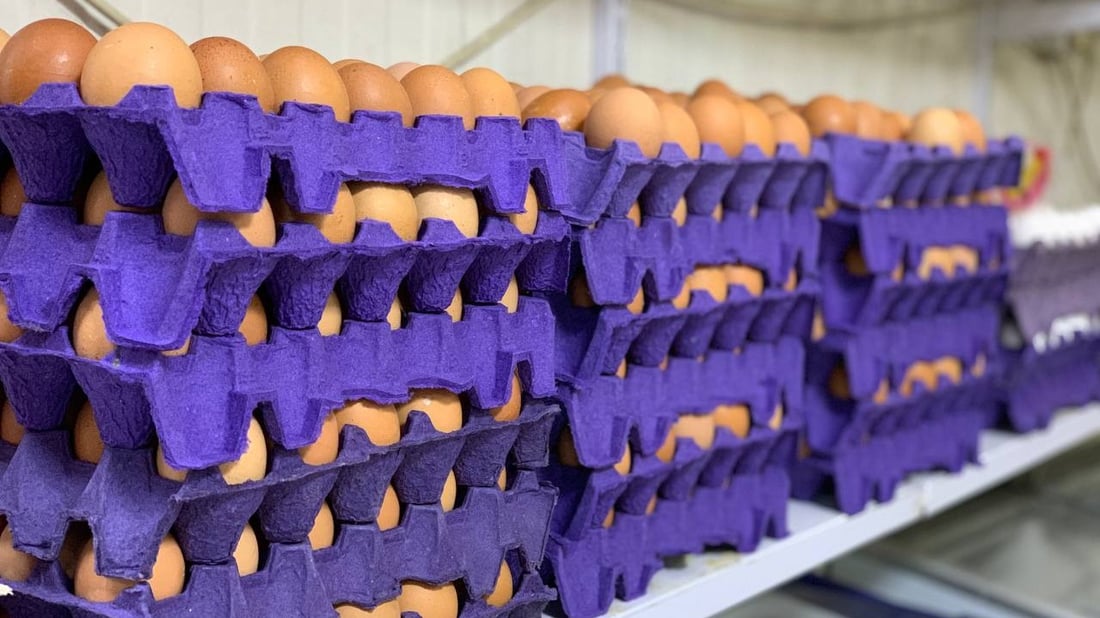
Brown eggs stacked in purple trays on display at a retail store.
Poultry investment encouraged
Iraq now reports 3 billion egg shortfall after May surplus figures
BAGHDAD — Iraq produces about 6 billion eggs a year against an estimated need of 9 billion, the Agriculture Ministry said Saturday, five months after it reported a surplus of 1.2 billion eggs the previous year.
Ministry spokesperson Qusay al-Hattab told the state-run Iraqi News Agency that the figures came from a study by the ministry’s Livestock Department. They leave a shortfall of about 3 billion eggs a year, with local production meeting roughly two-thirds of demand.
In early May, the ministry reported a surplus in 2025 output at 13.2 billion eggs against demand of 12 billion, blaming trader ‘speculation’ for soaring prices, while acknowledging it had authorized imports once a 360-egg box reached 70,000 dinars (about $46 at the time). It also asked for lower customs tariffs on livestock and other agricultural inputs to help producers expand. Days later, the trade minister chaired an emergency meeting on egg prices that fixed a tray of 30 eggs at 6,000 dinars (about $4).
Hattab did not explain the difference between those figures and Saturday’s. The Planning Ministry’s Statistics and Geographic Information Systems Authority put output at about 5.3 billion eggs in 2024, up 11.2% on 2023.
Hattab said the ministry was working with private investors to expand poultry production by easing feed imports, simplifying licensing and removing administrative obstacles facing existing projects, including the renewal of operating licenses.
He pointed to large poultry projects run by institutions affiliated with the Imam Hussein and al-Abbas shrines in Karbala, two of Shiite Islam’s holiest sites, and to projects in Diwaniyah, Anbar and Karbala’s desert areas.
Private investment was essential to raising local output, strengthening food security and balancing supply and demand, Hattab said. He added that the government would keep supporting private poultry projects to stabilize domestic food markets.
Egg prices have swung repeatedly alongside government efforts to protect local producers. A box peaked at 80,000 dinars (about $53 at the time) in May, and officials blamed hoarding and stepped up inspections at wholesale markets.
Producers say rising costs are squeezing them. Operators of the Marooj Wasit egg farm near Kut told 964media in February that power cuts, expensive fuel and cheaper imports from subsidized farms in neighboring countries were hurting their business. The farm produces about 1 million eggs every two days and runs eight generators.
Prime Minister Ali al-Zaidi on Oct. 8, a day after the dinar was devalued, postponed customs duties and taxes on imported eggs, chicken and livestock.