
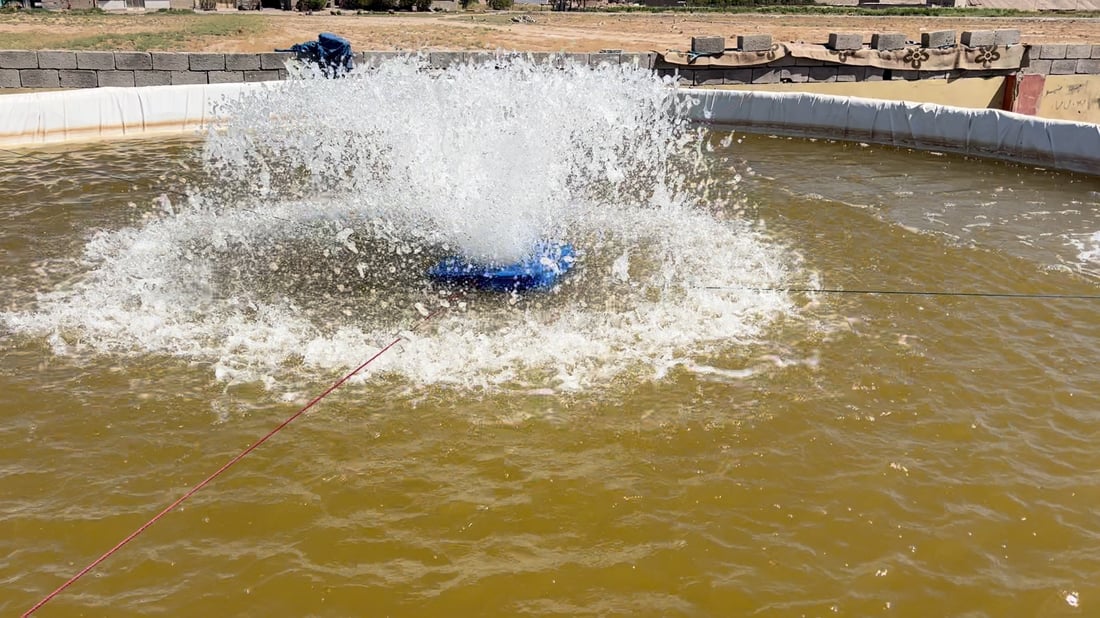
A closed fish pond in Daquq uses an aeration system to recycle water and support fish farming after open ponds were dismantled for excessive consumption. Photo by 964media.
Kirkuk
Daquq farmers adopt closed fish ponds after crackdown on water use
KIRKUK — Fish farmers in Daquq, south of Kirkuk, are shifting from traditional open mud ponds to closed, industrial systems after authorities dismantled hundreds of unlicensed ponds as part of water-saving measures.
Generations of farmers in the area, particularly in Mtij and Sanur villages, have made Daquq carp a favorite across Kirkuk and the Kurdistan Region. Farmers say the transition to closed ponds has been difficult, but necessary, as Iraq battles one of its worst droughts in decades.
Unauthorized ponds supplied by the Tigris, Euphrates, or illegal wells had proliferated in recent years, drawing repeated warnings from the Ministry of Water Resources. Officials said the ponds wasted water through evaporation and diverted supplies away from agriculture and drinking water. A campaign that began in 2023 cleared more than 850 ponds in Daquq by early 2024. Authorities now license only a small number of closed systems, which recycle water and consume less than open ponds.
“Daquq fish are very popular, especially in Kurdistan Region markets,” said farmer Burhan Kamal. “In past years we sold thousands of tons, known for their delicious taste. That quality comes from the feed we import from southern governorates, the fertile soil of Daquq, and the salinity of its water, which is free of sulfur and gas. Growth here is faster and production is abundant.”
Farmer Hirsh Ibrahim said he has seen both systems. “In my opinion, closed or intensive ponds are better than open ones. This is my second year, and I achieved more profit compared to mud ponds,” he said. “But fingerlings must reach about 250 grams in a mud pond before moving to a closed pond. When I put fingerlings directly in the closed pond, it failed.” He added that in his experience, closed ponds take about two months longer to reach full production.
Others see clear advantages. “These ponds are better because they consume less water, as it can be reused through filters,” said farmer Ahmed Daham, who is completing paperwork for a new facility. “The production cycle is shorter, one to two months, and we can add new batches every four months. Closed ponds also allow stocking fingerlings of different sizes.” Still, Daham requested small allocations of land for mud ponds to raise fry before transfer.
Daquq Water Resources Director Imad Rahmatallah Abdullah said the government has moved to eliminate all unlicensed ponds. “After the committee’s inspection, all owners of violating ponds were notified to fill and remove them,” he said. “More than 350 ponds were removed voluntarily, while the rest were cleared by enforcement committees. At the start of 2024 all ponds in Daquq were gone.” He said 21 to 23 ponds are now officially licensed.
“Daquq is one of the most important fish-producing areas,” Abdullah added. “Although I do not have an exact figure, production has always been very high.”