
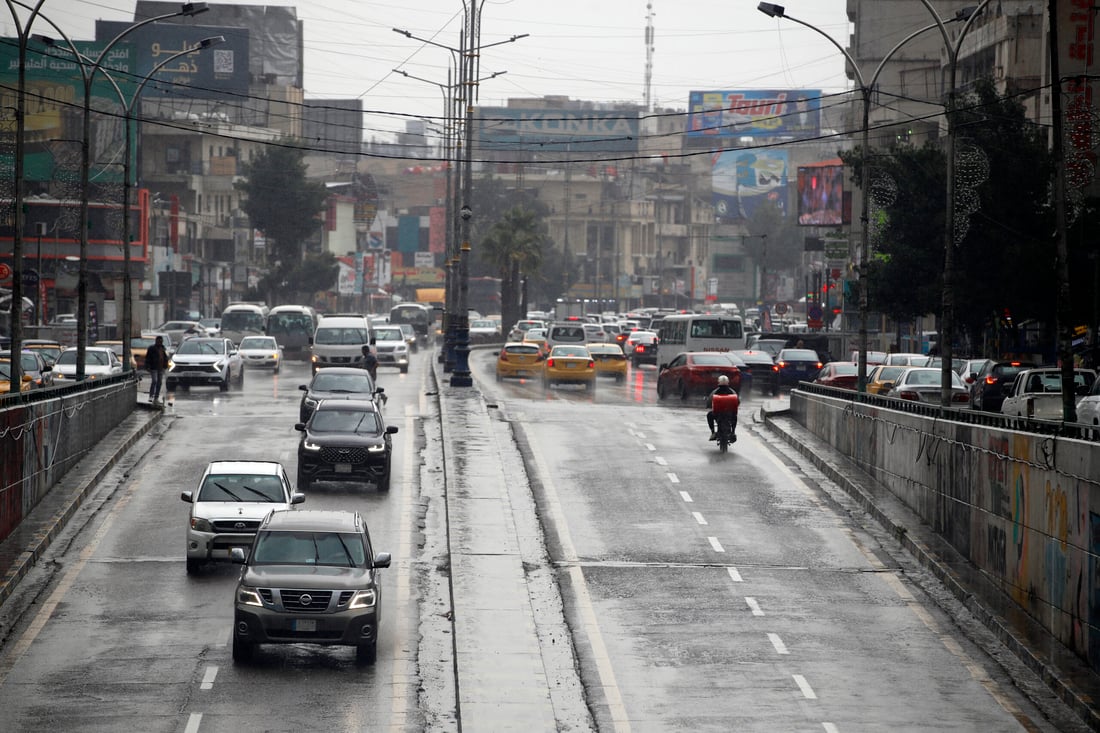
Cars drive along boulevard on rainy Baghdad day (Photo by AHMAD AL-RUBAYE/AFP)
'Recommendations'
Iraq considers artificial cloud seeding to address water shortage
BAGHDAD — Iraq is considering artificial cloud seeding to confront ongoing water scarcity, according to a statement from the Parliamentary Committee on Agriculture, Water, and Marshlands.
The committee, chaired by MP Faleh Al-Khazali, held a discussion session on Sunday, to explore the potential of artificial precipitation techniques. The meeting included university professors and experts in agriculture and the environment.
2025 marks one of Iraq’s most difficult years for water scarcity, driven by prolonged drought and reduced inflows from upstream countries, particularly Turkey, according to Minister of Water Resources Aoun Dhiab.
The committee said it had begun forming “a new technical committee under the Prime Minister’s Office to prepare actionable recommendations by drawing on the experiences of regional countries that have achieved positive results in this field.”
Cloud seeding, also known as artificial rain, is a weather modification method aimed at enhancing precipitation from clouds that might otherwise produce little or no rain.
The meeting focused on evaluating the effectiveness of cloud seeding and its suitability for Iraq’s environment. Experts presented technical details of the process and expressed willingness to assist legislative efforts through scientific recommendations to address gaps in current environmental laws.
Al-Khazali emphasized “the importance of benefiting from the experiences of regional countries that have adopted similar projects,” and called for continued coordination with relevant government entities. He also stressed the need for “forming a specialized technical team to develop a clear plan that includes practical solutions to strengthen Iraq’s capacity to address the escalating water crisis.”
The committee recommended practical steps to address the country’s water challenges, including “providing accurate technical recommendations to address the environmental and agricultural impacts of water scarcity.”
In April, Iraq’s Ministry of Transport held a technical meeting with representatives from Australian and German organizations to discuss launching a cloud seeding project aimed at mitigating the country’s worsening water shortages and climate challenges.
Iraq is among the five countries most vulnerable to climate change, according to the United Nations.
In July, rising temperatures and deepening drought conditions triggered a wave of public unrest across Iraq’s southern governorates. Years of mismanagement, infrastructure decay, and water scarcity have left many communities without reliable access to clean water or electricity.
Minister Dhiab stated that Turkey uses a system of dams along the Euphrates to generate hydroelectric power and transfer water between reservoirs before releasing it downstream, a process that has cut Iraq’s share by half, worsening the country’s water crisis. Dhiab added Iraq is continuing technical negotiations with Ankara to establish a clear framework for sharing responsibility during regional water shortages.
He also announced that Iraq is experiencing its worst drought in nearly a century, with national water reserves falling to just 8% of total storage capacity.
The European Union recently allocated €1.1 million in humanitarian funding to address the worsening water crisis in Basra, where residents face acute shortages and rising salinity.