
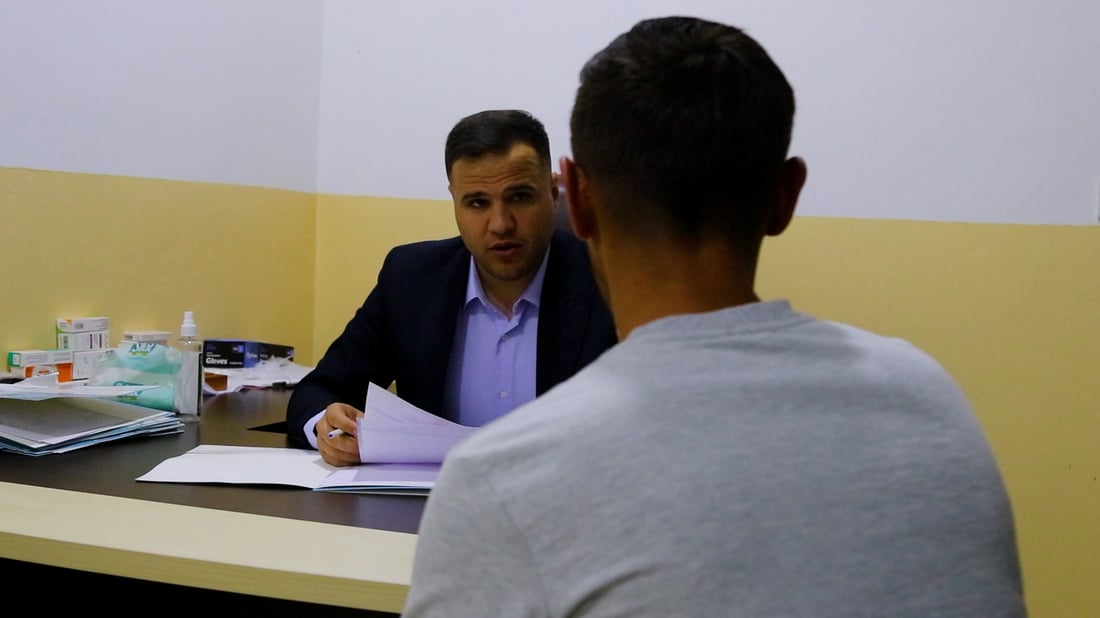
A psychiatrist meets with a patient during a consultation session at the new mental health clinic in Sinuni, established to support residents still coping with trauma from the ISIS assault on Sinjar — photo by 964media.
New mental health clinic in Sinjar offers care for community still coping with trauma
SINJAR — Specialists at the Hardan Medical Center in Sinjar say residents continue to experience “post-traumatic effects” from the war with ISIS, particularly within the Yazidi community, which endured severe atrocities. In response, doctors have brought together several disciplines from the University of Mosul to open what they describe as the first clinic of its kind in the district, offering structured psychological treatment and academic-standard therapy sessions.
Dr. Salam Nayef Porto, a psychiatrist, told 964media: “I am a senior resident doctor at Ibn Sina Hospital in Mosul and a board-certification candidate. I am a Yazidi from Sinjar and have worked with many organizations in the field of psychiatry, including international groups such as Doctors Without Borders and IUM, and local groups such as Hevy and Dark.”
He said the clinic was launched in cooperation with the administration of the Hardan Specialized Complex and is staffed by a specialist doctor, a senior resident doctor and a psychotherapist. “There was no such center in Sinjar, and there is a tragic need for mental health treatment, especially with Sinjar being far from centers in Duhok and Mosul,” he said.
The center opened about a month ago and operates every Friday from 9 a.m. to 4 p.m., receiving between 30 and 35 patients a week. “Patients are committed to their sessions, and we see joy and relief in their eyes after the opening of this center, which eases the burden of traveling outside Sinjar,” Dr. Porto said.
ISIS’s assault on Sinjar in August 2014 left the Yazidi community with deep and lasting trauma, after fighters carried out what the United Nations recognizes as genocide, killing more than 5,000 Yazidis and abducting thousands of women and children, many of whom were subjected to sexual slavery or forced indoctrination. The attack destroyed villages and revealed mass graves across the district, while about 360,000 Yazidis were displaced inside Iraq and more than 100,000 fled the country.
According to the International Organization for Migration, up to 80 percent of public infrastructure and 70 percent of civilian homes in Sinjar and surrounding areas were destroyed, leaving the community with enduring psychological scars and widespread loss.