
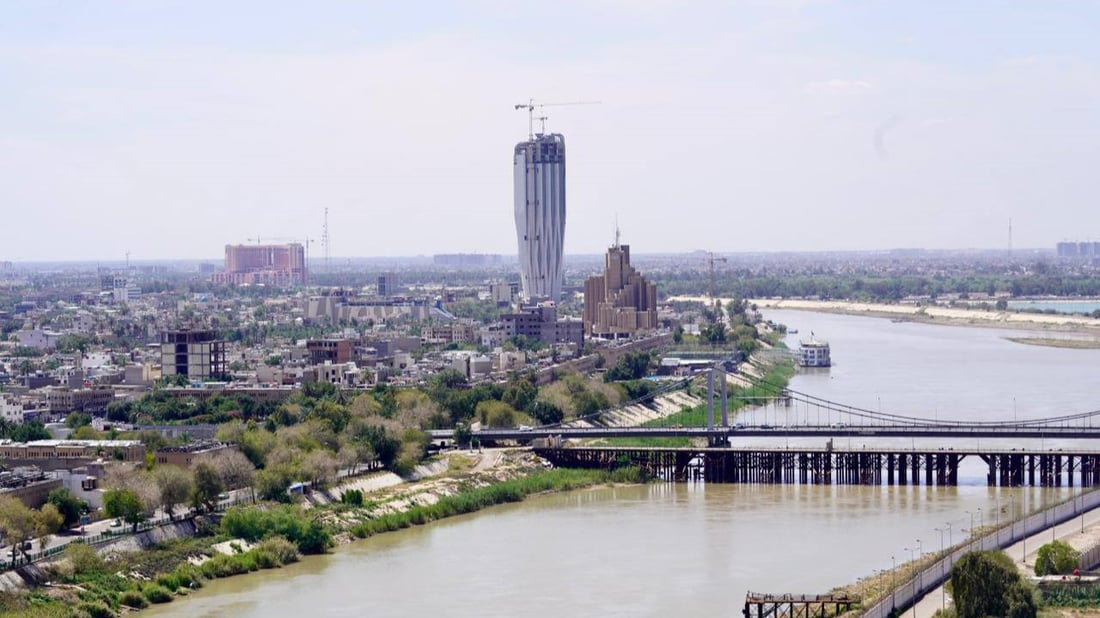
A view of central Baghdad
'Difficult' year
Iraq faces historic water shortage, but officials hope for relief with fall rains
BAGHDAD — Iraq is experiencing one of the worst water crises in its history, with national reserves falling below eight billion cubic meters, but government officials say a shift in weather patterns could offer some relief in the coming months.
Minister of Water Resources Aoun Dhiab said 2025 marks one of Iraq’s most difficult years for water scarcity, driven by prolonged drought and reduced inflows from upstream countries, particularly Turkey.
“This year, 2025, is one of the most difficult Iraq has faced in terms of water scarcity,” Dhiab told Al-Sabah, the state-run newspaper. “But forecasts show that September will be cooler, and there are expectations for rain in October. This will help reduce evaporation and may ease pressure on our water reserves.”
The ministry has halted agricultural activity for September and confirmed that major reservoirs — including Mosul, Darbandikhan, Dukan, Tharthar, Haditha, and Hamrin — have dropped below the critical eight billion cubic meter threshold needed to meet the country’s water needs for farming and domestic use.
Despite the severity of the shortage, Dhiab said the ministry has managed to maintain water supplies for essential purposes. “We’ve managed the available storage efficiently and ensured fair distribution between governorates,” he said.
Dhiab also discussed the challenges posed by upstream dam operations in Turkey, which has significantly reduced water inflows to Iraq. He said Turkey uses a system of dams along the Euphrates to generate hydroelectric power and transfer water between reservoirs before releasing it downstream, a process that has cut Iraq’s share by half.
Currently, Turkey is releasing about 350 cubic meters per second at the Syrian border, but only around 200 cubic meters per second is reaching Iraq’s Haditha Dam. On the Tigris, another 200 cubic meters per second is being released, with an additional 150 cubic meters per second added from Mosul Dam, for a combined total of 350 cubic meters per second across the basin.
Dhiab said Iraq is continuing technical negotiations with Ankara to establish a clear framework for sharing responsibility during regional water shortages.
In July, rising temperatures and deepening drought conditions triggered a wave of public unrest across Iraq’s southern governorates. Years of mismanagement, infrastructure decay, and water scarcity have left many communities without reliable access to clean water or electricity, especially in rural and low-income areas. The crisis has been compounded by declining river levels, increasing salinity in southern provinces, and a lack of investment in essential services, fueling frustration among residents and prompting renewed calls for accountability.