
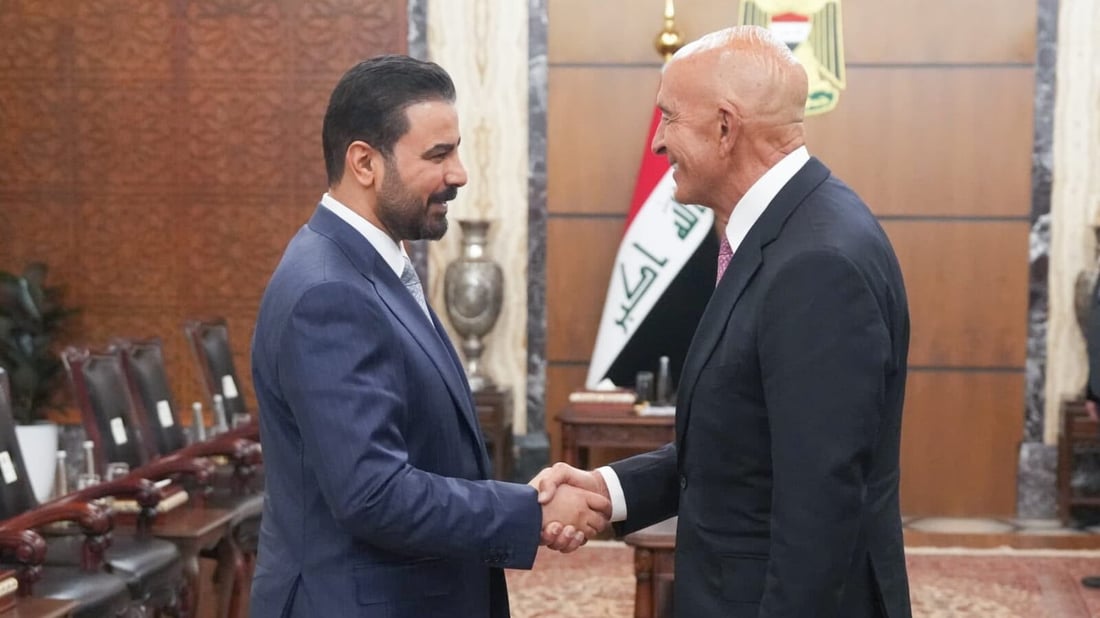
Iraqi Prime Minister Ali Falih al-Zaidi welcomes U.S. presidential envoy Tom Barrack during talks in Baghdad on June 16, ahead of a planned White House summit next month.
Media Monitor
Weapons issue is ‘an Iraqi file,’ government spox says of Barrack talks
BAGHDAD — Prime Minister Ali al-Zaidi’s recent meeting with U.S. presidential envoy Tom Barrack focused on security and economic cooperation, with the issue of restricting weapons to state control remaining “an Iraqi file” and unresolved cabinet posts left off the agenda, government spokesman Haider al-Aboudi said.
In an interview on Al Hadath TV, Aboudi said Barrack conveyed the White House’s wish to host al-Zaidi in Washington next month. “This visit, which will take place in mid-July, will carry in its official agenda the files of security, economy, shared relations and the Iraqi-American partnership,” he said.
Aboudi said weapons outside state control came up only in the context of measures already underway. “The weapons issue was present through a review of the Iraqi government’s procedures, and not, as some imagine, as an open file,” he said. He stressed the matter is being treated domestically: “This unregulated weaponry, the government deals with it as an Iraqi file, and it requires political approaches and procedural approaches.” The objective, he added, is not simply to collect arms. “Restricting weapons does not necessarily mean gathering weapons inside rooms or buildings. Restricting weapons means that the Iraqi state’s security decision becomes unified, and there will be no political directives controlling these weapons.”
Asked about reports of U.S. oversight of the process, Aboudi rejected the characterization. “This decision is the decision of Commander-in-Chief of the Armed Forces Ali al-Zaidi,” he said. “It carries a national significance after all Iraqi political forces agreed and authorized the government to address this file.”
The disarmament initiative gained momentum in early June after the Coordination Framework endorsed a plan to restrict weapons to state control and authorized Zaidi to implement it. A government committee including the Defense Ministry, Interior Ministry, Joint Operations Command and the PMF was formed to oversee the handover of weapons, equipment and military sites. Asaib Ahl al-Haq, Saraya al-Salam and the Imam Ali Battalions have backed the initiative, while Kataib Hezbollah, Harakat al-Nujaba and Kataib Sayyid al-Shuhada have rejected disarmament.
Aboudi said unresolved cabinet positions were not part of the talks. “The issue of ministries was not discussed because it is an internal Iraqi matter,” he said, adding the vacancies could be addressed after parliament resumes following its legislative recess. Zaidi was approved as prime minister on May 14 and took the oath on May 16. Nine of the government’s 23 ministries remain unfilled: parliament rejected nominees for planning, culture, construction and housing, higher education and interior, while votes on defense, labor, migration and youth and sports were postponed.