
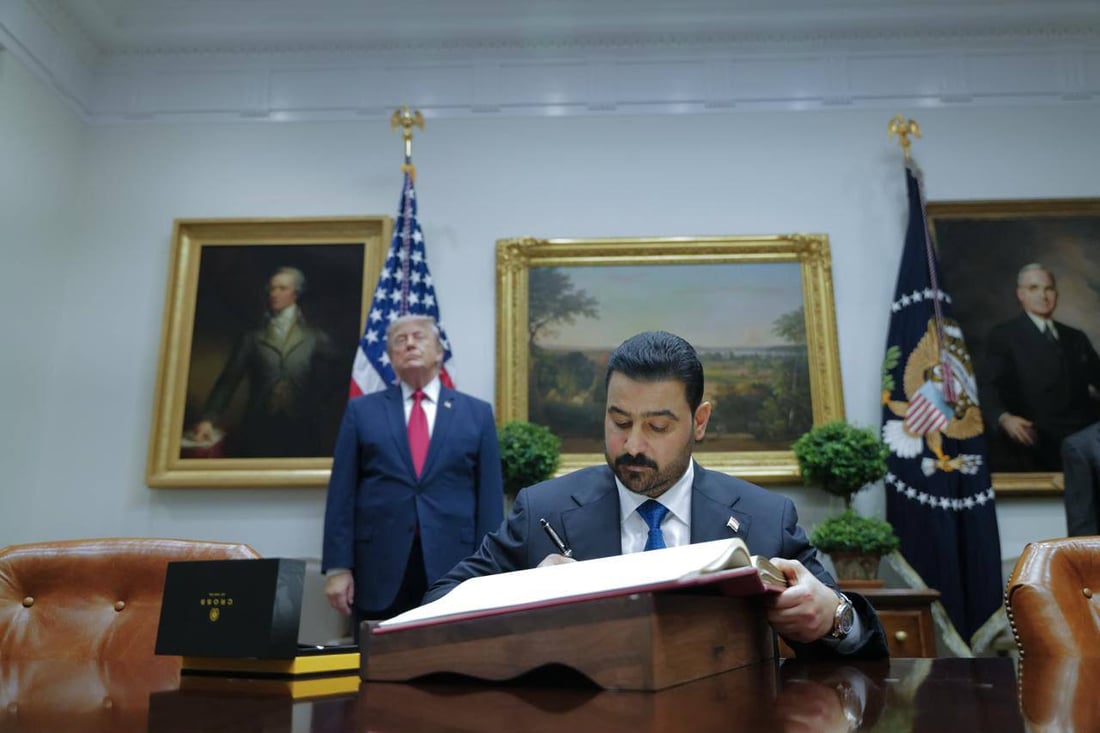
Iraq’s prime minister signs the White House guest book as the U.S. president looks on during his official visit to Washington, D.C., on July 14, 2026.
Zaidi pitches economic partnership in Washington as coalition winds down
NEWSROOM — Iraqi Prime Minister Ali Faleh al-Zaidi used his official visit to the United States to promote a new phase in Baghdad-Washington relations centered on investment, economic reform and long-term strategic cooperation, as the U.S.-led coalition’s military mission in Iraq approaches its scheduled conclusion.
According to statements from the prime minister’s media office and the spokesperson for the commander-in-chief of the armed forces, Zaidi’s meetings included talks with President Donald Trump, Defense Secretary Pete Hegseth, Treasury Secretary Scott Bessent, members of Congress, the head of the U.S. International Development Finance Corporation, former U.S. ambassadors to Iraq and representatives of American companies. Across the statements, the government presented the visit as an effort to move relations away from dependence on a foreign military presence and toward economic, commercial, technological and security partnerships based on Iraqi sovereignty.
Zaidi met Trump at the White House on July 14, where the two discussed bilateral relations, regional security, intelligence cooperation and opportunities for American companies in Iraqi development projects, particularly oil and energy. Zaidi said the purpose of the visit was to build a strong economic partnership, and that as the U.S. military presence under the coalition ends, it should be replaced by an economic presence through American companies and investment. He said relations should increasingly rest on commercial and people-to-people ties rather than a military partnership, and that Iraq needed a strategic partner of the United States’ stature to help address its economic and technological challenges. Trump, according to the Iraqi account, reiterated support for Zaidi’s government, highlighted Iraq’s importance in energy and the global economy and emphasized continued cooperation on stability and development.
Zaidi said the economic partnership and development plans would serve all parts of Iraq, including the Kurdistan Region in the same way as Basra, Anbar and other governorates. During the visit he described the Kurdistan Region as an “inseparable part” of Iraq, amid continuing political and financial disputes between Baghdad and Erbil.
Zaidi later held talks with Hegseth, where the two sides reviewed security and military relations ahead of the coalition mission’s scheduled conclusion on Sept. 30. In a July 15 statement, Sabah al-Numan, spokesperson for the commander-in-chief, said the two sides agreed to continue intelligence exchanges supporting counterterrorism operations and to strengthen coordination against terrorist support networks and safe havens. Numan said the talks covered expanded military training, the development of Iraq’s armed forces across all branches and increased technical and digital cooperation on security equipment and armaments, to be carried out while safeguarding Iraqi sovereignty.
Zaidi then ordered the formation of a committee to negotiate the future framework of security and military relations with the United States, directing it to ensure any arrangement reflects “the parameters and requirements of Iraqi sovereignty” and upholds the full authority of Iraq’s armed forces throughout the country. The statement said Iraqi forces were capable of protecting the country’s territory and airspace. Zaidi has separately pledged to bring weapons under state control and disarm armed factions operating outside official security institutions by Sept. 30, linking that to the end of the coalition mission.
Meeting Bessent, Zaidi said Iraq was entering a new phase aimed at building a sovereign state free from corruption and supported by a sustainable economy, identifying anti-corruption and restricting weapons to state authority as central priorities. He said Iraqis would see results during the coming year, particularly in energy and investment, and outlined plans to restructure the banking and insurance industries alongside changes to taxation and customs. Bessent, according to the Iraqi statement, expressed support for shifting the relationship from military engagement toward investment and economic growth, and said Washington was prepared to help Iraq overcome barriers to development and set a timeline for reforms. The delegation separately sought U.S. support for Baghdad’s request for a larger oil production quota within OPEC, citing the financial demands of post-war reconstruction.
Zaidi also met Ben Black, chief executive of the U.S. International Development Finance Corporation, to discuss financing for Iraqi infrastructure and development, reviewing possible cooperation in energy, transportation, agriculture, services and reconstruction, and how to move proposed projects from planning toward implementation. Zaidi emphasized Iraq’s digital transformation, saying the government wanted to diversify the economy through integrated digital government platforms, expanded electronic payment systems, national data centers and investment in artificial intelligence and cybersecurity, and called for greater participation by U.S. companies. Black said the DFC was prepared to enter the Iraqi market through financing partnerships, contribute to the Iraqi Development Fund and support partnerships between American companies and Iraqi projects.
Energy ran through the visit. Officials held discussions with Chevron on possible investments in Iraq’s energy sector, and Baghdad sought U.S. diplomatic support for plans to import natural gas from Turkmenistan as it tries to diversify supplies and address electricity shortages.
At the Capitol, Zaidi met House Foreign Affairs Committee Chairman Brian Mast and Republican and Democratic members of the committee for talks on economic reform, security cooperation, banking-sector development and opportunities for U.S. companies. He reaffirmed his government’s commitment to strengthening Iraqi security forces and ensuring no weapons remained outside state control, described Iraq’s foreign policy as balanced and said the government was working to create an environment conducive to foreign investment. Committee members expressed support for stronger political and economic ties, including expanded investment and financing partnerships, and emphasized Iraq’s role in regional stability.
Zaidi also met a group of former U.S. ambassadors to Iraq, telling them Baghdad wanted balanced and sustainable ties based on mutual interests and respect, and highlighting his government’s priorities of strengthening the rule of law, combating corruption, consolidating security and advancing economic reform.
The visit produced several declarations of intent, but the official statements did not provide detailed financing figures, binding investment agreements or a finalized framework for the future security relationship. Its success will depend on Baghdad’s ability to deliver on the commitments Zaidi promoted: placing all armed groups under state authority, completing banking and customs reforms, reducing corruption, securing foreign investment and creating credible conditions for U.S. companies to operate throughout Iraq.