
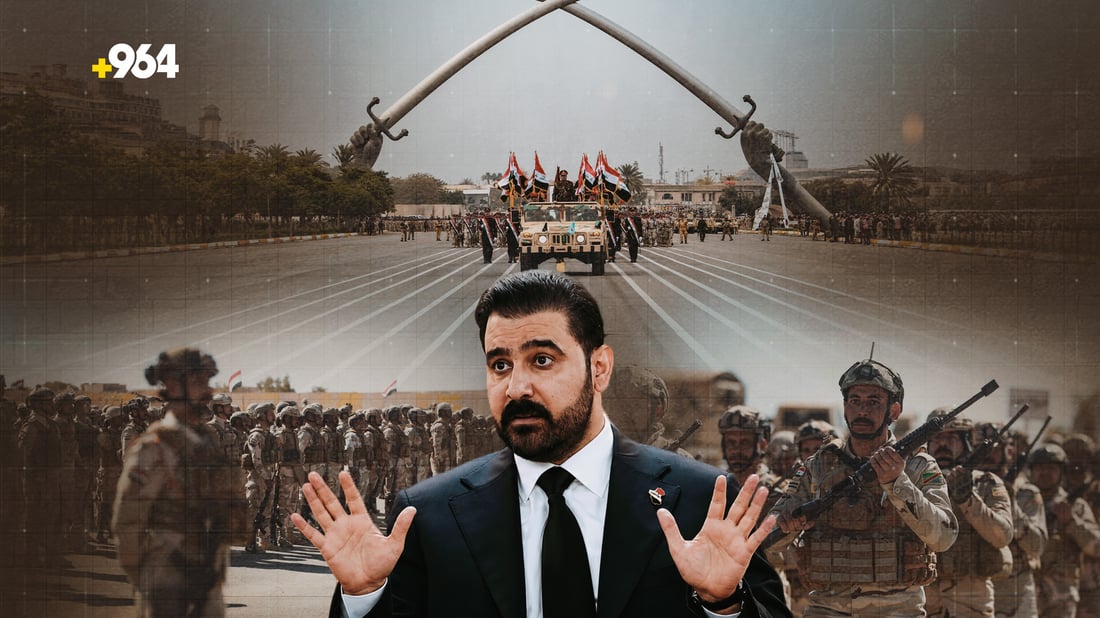
A 964media illustration depicts Prime Minister Ali al-Zaidi against Iraqi military formations as the government prepares broad spending cuts affecting defense and other ministries.
Austerity
Iraq to halve spending across ministries and departments from Sunday
BAGHDAD — Iraq will halve what the government spends on everything but wages from Aug. 10, cutting more than 1.5 trillion dinars (about $1.1 billion at the official rate) a month in the deepest reductions of their kind since the sanctions imposed after 1990, financial and parliamentary sources told 964media.
Spending on contracts, supplies, maintenance, transport, food services and other running costs will fall from about 3 trillion dinars a month, or $2.3 billion, to under 1.5 trillion. Ministries will have to give up about half their monthly allocations for these, with contracts taking the deepest cuts. “The largest part of the amount to be saved will come from contracts,” a Finance Ministry source said, adding that some would be scaled back, pushed later or renegotiated. From Sunday, funding requests will be checked more closely, official travel and delegations will largely stop in favor of video calls, and rents, administrative costs and any purchase that can wait will be reviewed.
The sums do not go far against the wage bill they are meant to protect. Officials have put monthly salary obligations at between 8 trillion and 10.8 trillion dinars, or $6.1 billion to $8.2 billion. The proposed monthly saving is a fraction of the salary bill.
Some spending will keep its funding, the Finance Ministry source said: food rations, medicines, the Iranian gas that runs the power stations, and interest on the public debt. Contracts that cost the treasury nothing directly, including investment deals and projects paid for outside the federal budget, can go ahead.
The cuts will hit some ministries harder than others. Those that spend heavily on contracts, purchases and new projects have more to give up, while ministries running daily services will be more protected, a member of parliament said. “Health, electricity, water and municipal service sectors will require different treatment because part of their spending is linked to operating facilities that cannot be stopped, such as medicines, medical supplies, energy, maintenance and fuel,” the lawmaker said.
The Defense Ministry faces some of the hardest choices. It has about a million people across the armed forces and supporting security units, all of whom have to be fed, fuelled and equipped every day. Military staff were paid before most other government employees, but an army officer said the cuts had raised concerns about arms and supply contracts that were ready to sign. “Personnel salaries represent the highest priority for the military institution to prevent any departure from service or decline in job stability,” he said. “The food and equipment file comes immediately after salaries in terms of importance, particularly with directives issued to review and reduce several contracts.” Cutting spending without alternatives, he said, “could leave the institution facing difficult choices, particularly because a large part of these expenses cannot be stopped or postponed for long periods.”
The plan comes after salary delays that left some public employees waiting 45 days or more. July pay went out in stages from July 28, with security institutions and the Popular Mobilization Forces covered before many civilian bodies, and university staff protested in Basra and Kirkuk.
Health Minister Abdul Hussein al-Mousawi said suppliers had stopped some deliveries after the state pharmaceutical company Kimadia received about 15% of the money it was allocated.
Few in Baghdad agree on what to do next. Parliamentary Finance Committee member Jamal Kocher wants the Central Bank to create money, economist Mustafa Hantoush wants a 10 trillion dinar borrowing law, or $7.6 billion, and the prime minister’s financial adviser Mazhar Mohammed Saleh wants lower-priority projects put off and more collected in tax, customs and border revenue.