
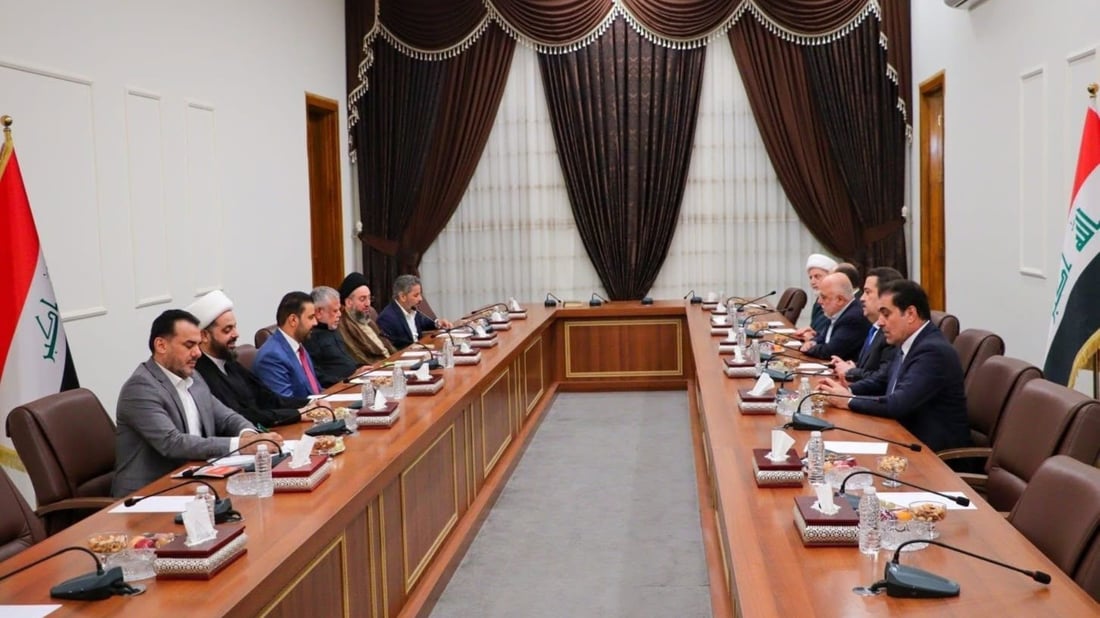
FILES: Iraqi political leaders attend a Coordination Framework meeting in Baghdad
Political figures deny factions behind Saudi attack, without agreeing who was
BAGHDAD — Iraqi political figures involved in the talks over armed factions’ weapons say the factions were not behind the drone attack on Saudi Arabia, though they disagree about who was, with claims ranging from an unnamed disruptive party to Ukraine.
Four of the factions in the negotiations — Kataib Hezbollah, Harakat al-Nujaba, Kataib Sayyid al-Shuhada and Ansar Allah al-Awfiya — had no role in it, said Hussein al-Sheihani of the political bureau of Sadiqoun, the political wing of Asaib Ahl al-Haq. “There is another party that carried out this attack, and it will be revealed,” he said, calling Iranian participation in the investigation necessary. He said crossings between Maysan and Iran had been closed along with Maysan’s boundaries with neighbouring Iraqi governorates, describing the measures as routine.
The attack was “a breach of what the Coordination Framework committee tasked with reaching understandings with the armed factions has been doing to calm the situation and settle the issue of regulating weapons,” said Bilal al-Nasiri of the State of Law Coalition. Someone was trying to derail the talks and push the government toward confrontation, he said: “There is clearly a disruptive party, but what is its name? What are its orientations? We have no information.” He called some of the government’s measures excessive, particularly the border closures that stranded travellers on both sides. He said several publicly identified factions were negotiating with the committee, and that talks were also under way with others not named.
Ali al-Fatlawi of the Awfiya Movement, part of the Reconstruction and Development Alliance, blamed Ukraine. “The latest strike on Saudi Arabia was carried out by Ukrainian groups,” he said. “They do not necessarily have to be Ukrainians inside Iraq; they are Iraqis, but with Ukrainian funding.” He said it was retaliation for Iraqis fighting alongside Russian forces, and offered no evidence.
Ukraine has rejected a similar claim before. National Security Adviser Qasim al-Aboudi told Dijlah TV in July that authorities had uncovered cells working for Kyiv: “We arrested a group of people — they are few — and they admitted that they work for Ukraine. They targeted some Iraqi facilities with shelling.” Ukraine’s foreign ministry rejected “the unfounded and unsubstantiated allegations” on July 28, saying no facts supported them, that it learned of the accusations from a live broadcast rather than through official contacts, and that it was “unacceptable and irresponsible for a senior official of a friendly state” to speak without an evidentiary basis.
The government has said the drones came from Maysan governorate, near the Iranian border, and has since found a drone launch platform inside Iraqi territory. It closed three crossings with Iran and dismissed the Maysan Operations commander, later removing the police chief and referring the governorate’s security agency heads for investigation. Saudi Arabia said it would hold off retaliating at Prime Minister Ali al-Zaidi’s request. The Badr parliamentary bloc accused the government of unjustified haste in accepting the Saudi account.
Zaidi said in Washington in July that there would be no justification for armed factions after Sept. 30. His security adviser Qasim al-Araji said last month that the date marks the start of talks rather than a deadline, and Nouri al-Maliki said this month that disarmament was no longer the term being used.