
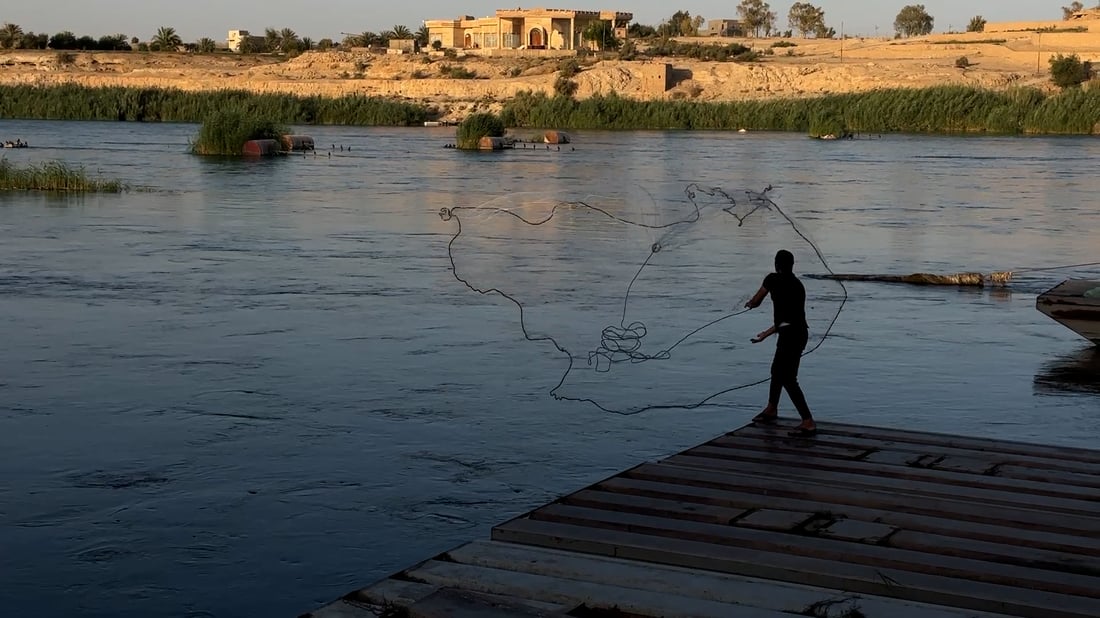
A man casts a fishing net into the Euphrates River near Haditha. Photo by 964media
Anbar environment authority sues sewerage directorate over Euphrates pollution
ANBAR — Anbar’s Environment Directorate has filed a lawsuit against the Anbar Sewerage Directorate over the continued discharge of untreated wastewater into the Euphrates River, as authorities step up efforts to address pollution of one of Iraq’s main water sources.
Qais Najih Abd, director of the Environment Directorate, told the Iraqi News Agency on Wednesday that his teams are running intensive inspections “to monitor all activities causing pollution in the Euphrates River,” under directives from the environment minister to protect water resources and safeguard public health. Technical teams inspected areas along the river to identify facilities releasing polluted wastewater and assess compliance with environmental rules.
“The campaigns targeted factories near the river and vehicle washing stations, as well as sewage stations that discharge liquid waste into the Euphrates without undergoing the necessary treatment processes,” Abd said.
The inspections led to legal action against several violators, including the provincial sewerage authority. “We imposed fines on the Anbar Sewerage Directorate and filed a lawsuit against the department because of the continued discharge of untreated liquid waste into the Euphrates River, due to the danger this poses to the environment and citizens’ health,” Abd said.
Abd said the directorate had formally notified the Anbar provincial government, which has set up a committee to investigate the causes of pollution, carry out field inspections and act against violators. The provincial government is also expanding treatment infrastructure, with plants under development in Ramadi, Fallujah and Hit, and another under construction in Habbaniyah.
The Euphrates, with the Tigris, forms the historic river system of Mesopotamia and is a primary source of drinking water and irrigation for millions of Iraqis. In recent years it has come under mounting pressure from reduced upstream flows, prolonged drought, untreated sewage, industrial discharge and agricultural runoff, with low flows during droughts leaving the river less able to dilute pollutants.
In June, officials in Najaf announced similar measures after saying treatment plants there were operating beyond design capacity, allowing untreated or partially treated wastewater to reach the Euphrates. The Environment Ministry has called for sewage treatment plants in all Iraqi cities, saying better treatment infrastructure could recover more than two billion cubic meters of wastewater a year.