
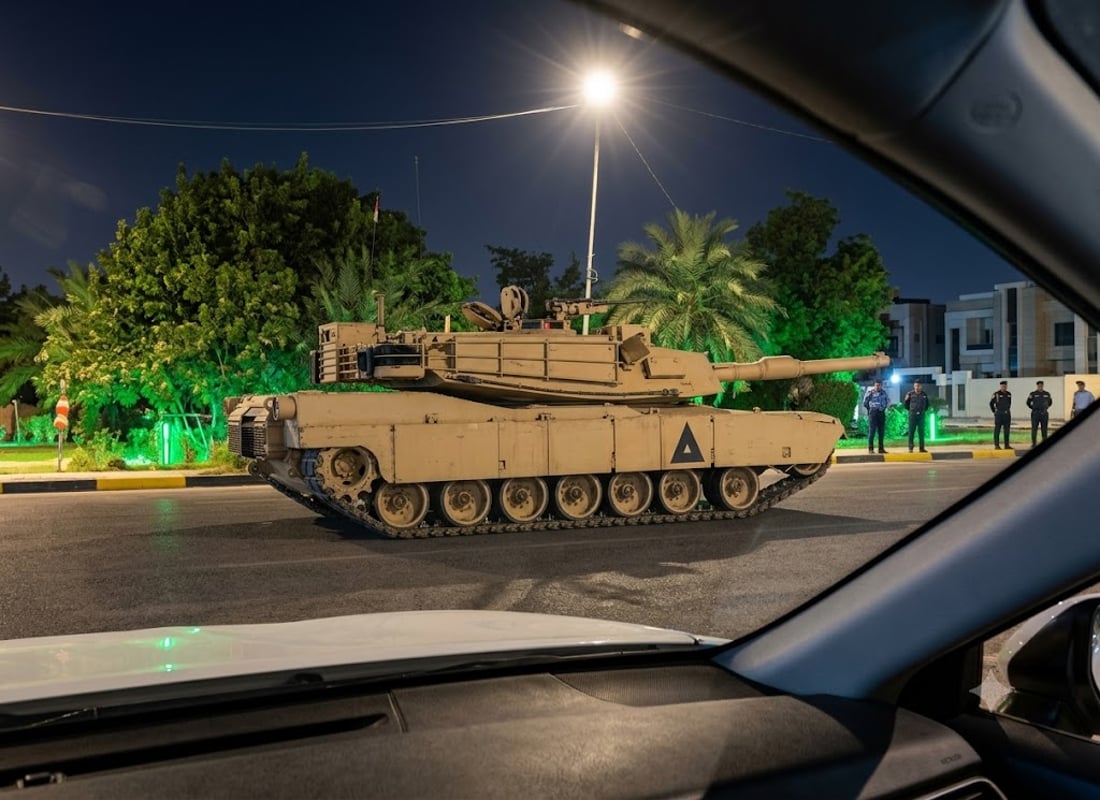
An Iraqi Army tank is deployed inside Baghdad’s Green Zone during the pre-dawn anti-corruption operation on June 28, 2026
Media Monitor
Ex-lawmaker says Zaidi governs free of electoral calculation
BAGHDAD — Former Iraqi lawmaker Hussein Arab has claimed Prime Minister Ali al-Zaidi not seeking another term is therefore making decisions without electoral or partisan considerations.
In an interview on Al Rasheed TV aired Wednesday, Arab said Zaidi is not affiliated with any political party and is not planning to run again. “He is not thinking about pleasing political leaders or making populist decisions to win voters’ support,” Arab said. He added that the prime minister is backed by the judiciary, tribal leaders and the public, and that no political party stands behind him.
Zaidi took office in May with no party of his own, nominated by the Coordination Framework after months of deadlock among the established blocs. His profile fit a recurring pattern in Iraqi politics, in which rival blocs settle on a compromise prime minister without an independent base rather than a figure who could build one. His predecessor, Mohammed Shia al-Sudani, was chosen on similar terms but went on to form his own movement and assemble the largest bloc in the last election, straining ties with many figures that that helped installed him. Zaidi has said he will not run in the next election or form a party.
Addressing the government’s plan to restrict weapons to state control, Arab said the Oct. 1 deadline remains unchanged. “Nothing is above the law,” he said, describing the recent anti-corruption campaign as evidence the government is implementing its policy.
Arab said foreign forces are expected to have left Iraq by that date and added that while “the armed factions are our brothers,” no weapons would remain outside the framework of the security forces and the Popular Mobilization Forces. He also said the United States and Gulf countries want an Iraqi government “free of armed factions.”
The weapons control initiative gained momentum in early June after the Coordination Framework endorsed a plan to restrict weapons to state control and authorized Zaidi to implement it. A government committee including the Defense Ministry, Interior Ministry, Joint Operations Command and the PMF was formed to oversee the handover of weapons, equipment and military sites. Asaib Ahl al-Haq announced a committee to separate its forces from the PMF, Saraya al-Salam transferred security responsibilities in Samarra to state forces, and the Imam Ali Battalions said they would place their weapons under government control. Officials have said heavy weapons, including tanks, artillery, missiles and drones, will be moved to state storage before redistribution to the armed forces. Kataib Hezbollah, Harakat al-Nujaba and Kataib Sayyid al-Shuhada have rejected disarmament, arguing their weapons remain necessary as long as U.S. forces are in Iraq.
On parliament, Arab said lawmakers should not all be viewed as corrupt. “There are parliamentary figures who represent honesty and integrity, returned to their previous jobs after their terms ended, and have not faced any theft-related accusations,” he said.
The remarks come after Iraqi authorities seized another 25 billion dinars (about $18.9 million at the official rate), $1 million and about 5 kilograms of gold in the corruption case against former Deputy Oil Minister Adnan al-Jumaili, the Supreme Judicial Council said Monday, bringing the total recovered in the investigation to 127 billion dinars (about $96 million at the official rate) and $24 million.
The case has expanded quickly since Jumaili’s detention over alleged financial irregularities in the oil sector. Security sources familiar with the investigation have said interviews with Jumaili produced more than 100 names, though not all face arrest warrants or proceedings. The inquiry also formed the basis for “Dawn Strike,” the operation inside Baghdad’s Green Zone in which Counter Terrorism Service units and army forces carried out coordinated raids on current and former officials. Zaidi has called the campaign the first phase of a broader effort.