
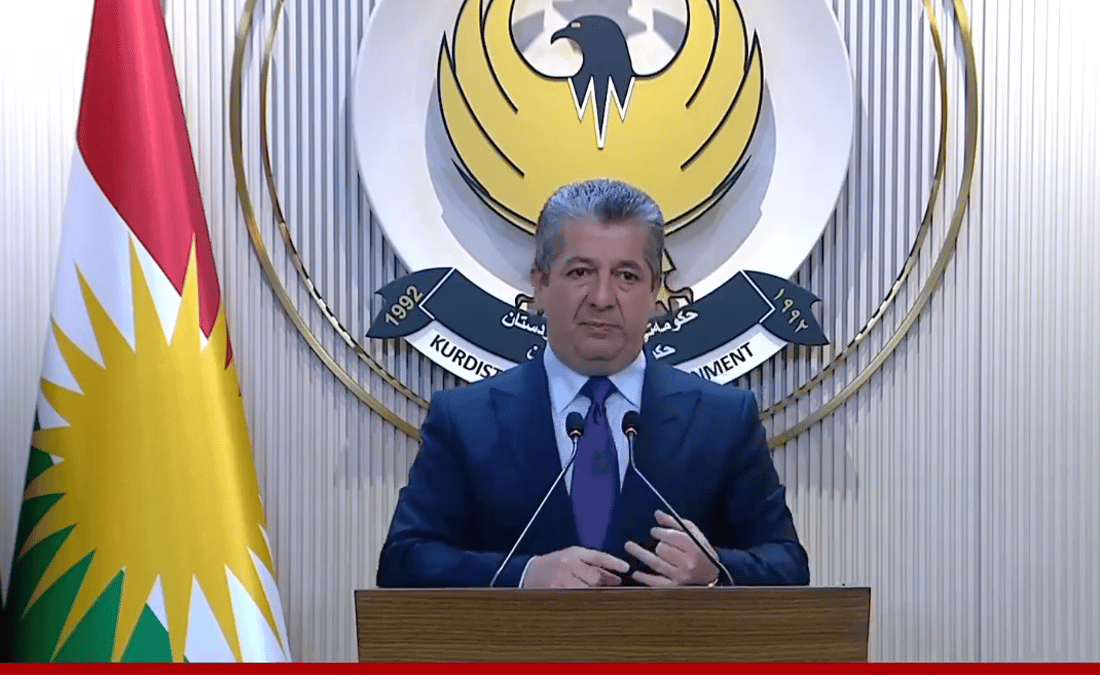
KRG Prime Minister Masrour Barzani
National dialogue welcomed
Masrour Barzani tells envoys Baghdad uses corruption fight as a pretext
ERBIL — Kurdistan Region Prime Minister Masrour Barzani told foreign diplomats in Erbil on Thursday evening that Baghdad was using the fight against corruption as a pretext to violate the Region’s rights and did not believe in federalism.
Hours earlier in Baghdad, Prime Minister Ali al-Zaidi told three Kurdish opposition blocs in parliament that federal troops would be deployed on Iraq’s borders, not inside cities. That evening, Iraqi border guards closed the Pshta crossing with Iran and sent its staff home, an official at the crossing told 964media.
Masrour Barzani met ambassadors, consuls general, envoys and other diplomats and representatives of UN agencies in the Region, the Kurdistan Regional Government said in a statement.
“If Baghdad’s decision-makers truly mean the rule of law, Iraq is full of corruption, theft and unlicensed weapons. Let them root those out,” Masrour Barzani said.
He said the Region had always helped the federal government fight corruption and illegal activity, was ready to cooperate further and hoped illegal activity would be rooted out across Iraq. The measures and decisions recently issued in the name of the commander-in-chief of the Iraqi armed forces against the constitutional rights of the people of Kurdistan “are not constitutional, and we reject them,” he said.
“We support rooting out corruption and the theft of natural resources across Iraq, and we will offer every cooperation. But on the pretext of fighting corruption, attempts are being made to violate the rights of the people of Kurdistan and to undermine the Kurdistan Region as an entity, which is unacceptable,” he said, according to the statement.
Iraq’s political system was built on federalism after 2003, and under the constitution the Region is a constitutional and legal entity, Masrour Barzani said. But decision-makers in Baghdad wanted to treat the Region with a centralist mindset, he said.
The constitution must be carried out as a whole, not only the parts that suit those in power, he said. He pointed to Article 140, which has gone unimplemented for years, and to Kirkuk and what he called the other “Kurdistani areas” outside the Region’s control, meaning the disputed areas that Kurdish parties regard as part of Kurdistan. Article 140 called for normalization, a census and a referendum in Kirkuk and the other areas disputed between Baghdad and Erbil by the end of 2007. The census and referendum have never been held.
The dispute with Baghdad is not only about salaries and the budget but about the rights of the people of Kurdistan, what he called their “just cause,” and respect for the Region’s constitutional status, he said. The people of Kurdistan would defend their constitutional rights with all their strength and would never give them up, and the Region was ready to settle the disputes through dialogue and negotiation, he said.
Earlier on Thursday, Masrour Barzani told reporters in Erbil that the Kurdistan Democratic Party and the Patriotic Union of Kurdistan were both ready for talks. Supreme Judicial Council President Faiq Zaidan has called a national dialogue for Dec. 1.
Wherever there was an opportunity for dialogue, they would take part, Masrour Barzani said. He said he believed every party to the dispute had been invited and hoped the talks would produce an agreement that served the country and was in line with the constitution.
Zaidan proposed the dialogue on Wednesday at a meeting of Iraq’s four top leaders with Zaidi, President Nizar Amedi and Parliament Speaker Haibat al-Halbousi, who welcomed it. It is to bring together the parties concerned and any other party that could help resolve the constitutional crisis between the federal government and the KRG, Zaidi’s media office said. On Thursday, the PUK’s bloc in parliament and Deputy Speaker Farhad Atrushi of the KDP backed the initiative.
Masrour Barzani also thanked the people who joined Thursday’s rallies for showing their opposition to Baghdad’s decisions peacefully and praised the part young people played in them. Large crowds rallied at Erbil Citadel on Thursday morning, and smaller rallies were held in Duhok, Zakho and Soran.
Asked about the Federal Supreme Court’s ruling on Wednesday, he said the official institutions concerned would prepare a legal response. There were legal grounds to answer it, he said, but he did not set them out or say when a response would come.
In Baghdad, Zaidi met Rebwar Karim, head of the National Stance Movement’s bloc; Muthanna Amin Nader, head of the Kurdistan Islamic Union bloc; and Ahmed Hama Rashid, head of the Komal bloc, his media office said. The three parties are in opposition in the Region.
“There are those who want to drag our Kurdish people into the oil smuggling crisis to protect their influence, their money and their private accounts from legal prosecution,” Zaidi said, according to the statement. The Region’s revenues went to certain groups instead of being shared with the Iraqi people, and some wanted the country’s borders to stay full of gaps, he said.
“So our army, which includes all communities, will be on the borders and not inside the cities,” he said. The government understood the special status of the Region, “which was formed through the struggle and sacrifices of the Kurdish people,” he said. He did not name the groups he accused or offer evidence.
Zaidi said there would be no retreat from plans to restrict weapons to the state, fight corruption, pursue smuggling and protect the country’s wealth.
In a joint proposal to Zaidi, the three blocs rejected military escalation and decisions imposed by force. They called for the Region’s crossings to be run jointly under a single federal customs and tariff policy, reorganized within two months and linked to a shared electronic monitoring system. They accepted that the federal border guards are responsible for Iraq’s international borders but said border security should be kept apart from political disputes and from the Region’s internal affairs.
Under the proposal, the Region’s oil would be sold only through the State Oil Marketing Organization, or Somo, with production and costs checked by a joint technical and financial committee. The Region would hand over oil and revenues, and Baghdad would guarantee its share of the budget and cover verified costs. The blocs also asked that salaries, pensions and welfare payments be kept out of the dispute and that the Region’s residents pay the same official prices for fuel and electricity as the rest of Iraq.
They called for the constitution to be carried out in full, Article 140 included. They also asked for opposition parties to get a monitoring role over oil, the crossings and public money.
Zaidi’s media office did not mention the proposal, and the blocs did not say whether he had accepted any of it.
At Pshta, a force of Iraqi border guards, all Kurds, arrived at about 5 p.m. and closed the crossing, the official said. The staff were allowed to finish their work, then sent home and told not to come back, and the crossing will stay closed indefinitely, the official said.
Pshta, also known as Sartak, is a semi-official trade crossing where trucks carry a limited range of goods. Iraq and Iran have discussed making it an official international crossing.
The Border Forces Command said on Thursday that it had begun carrying out Zaidi’s order to close all unofficial crossings, which the KRG has rejected.
KRG spokesperson Peshawa Hawramani said in a statement on Thursday that balance and peace in Iraq begin with respect for the constitution and for the Region’s federal status, not with weakening the Region’s forces. Article 121 of the constitution recognizes the Peshmerga as the Region’s protection force, and any military movement inside the Region must fall within that force’s responsibility, he said. Article 121 makes a regional government responsible for setting up and organizing the region’s internal security forces, including “guards of the region,” but does not name the Peshmerga.
Talks with Baghdad would succeed only when all sides respected the Kurdistan Region as a federal, constitutional region within Iraq, Hawramani said.
The Finance Ministry said on Thursday that the 2027 budget was ready but gave no total. Its statement did not mention the Region’s share, on which Baghdad and Erbil have reached no final agreement.
In Baghdad on Thursday, Zaidi also told European Union ambassadors that his government would enforce federal authority over borders and oil. He cited the Federal Supreme Court ruling issued Wednesday at his request, which said federal powers over borders and border crossings extend into the Kurdistan Region and that the Region’s authorities have no jurisdiction outside the territory they ran on March 19, 2003. Two of the court’s members dissented.
Zaidi’s orders, issued on Tuesday after an inquiry into suspected oil smuggling at the state-owned North Oil Company, put every border crossing in the Region under federal control. They bar the KRG from issuing oil export permits without the federal Oil Ministry’s approval and tell the ministry to take over federal oil fields in Diyala, Kirkuk, Salah al-Din and Nineveh governorates that are under the KRG’s security control. Baghdad has given no timetable for the handover of the crossings.
Kurdish leader Masoud Barzani and Kurdistan Region President Nechirvan Barzani rejected the orders on Tuesday, and on Wednesday the KRG cabinet called them a violation of the constitution and said they showed that Baghdad wanted to return Iraq to centralized rule.