

Iraq reopens its own oil pipeline to Turkey after more than a decade
BAGHDAD — Iraq on Tuesday resumed pumping crude for export through the old Iraq-Turkey pipeline, the federal government’s own line from Kirkuk, at an initial 120,000 barrels a day, Oil Minister Basim al-Abadi said.
Exports through the line will rise gradually to 500,000 barrels a day, Abadi said, after maintenance, rehabilitation and technical and operational tests were completed. He did not say when the higher rate would be reached. He said the route would add export capacity and revenue, and that crude exported through the north could be sold without price discounts.
The line runs from Kirkuk to Fishkhabur, on the Turkish border in Duhok governorate, where it links to the Turkish network leading to the Mediterranean port of Ceyhan. It had not carried exports since 2014, after repeated attacks during the Islamic State group’s occupation of parts of northern Iraq. Its return gives Baghdad a northern export route it controls, alongside the Kurdistan Region’s pipeline.
The Region’s pipeline, built by the Kurdistan Regional Government, began carrying crude in late 2013 and is run by the Kurdistan Pipeline Company. Since March 18, it has also carried crude from Kirkuk’s fields under a deal between Baghdad and the KRG, after the U.S.-Israeli war with Iran disrupted shipping through the Strait of Hormuz.
In mid-March, as the two sides argued over the Region’s line, Baghdad pushed to export Kirkuk crude through its own pipeline instead. Hayan Abdul Ghani, then oil minister, said crews were testing the last 100-kilometer section. Later that month, Abadi, then a deputy oil minister, said sabotage had kept the federal line from ever reaching its design capacity of about 1.5 million barrels a day. He put the capacity of the Region’s pipeline, built in 2014, at 900,000.
Exports through the Region’s line have grown since. Baz Karim Barzanji, head of the Erbil-based energy company KAR Group, a shareholder in the pipeline company, wrote on X on Oct. 31 that they had doubled from 250,000 to 500,000 barrels a day.
The ministry did not say whether Tuesday’s 120,000 barrels a day add to those shipments or replace Kirkuk crude now sent through the Region’s line.
Both lines feed the Turkish system to Ceyhan, which runs under a one-year agreement Iraq and Turkey signed on Aug. 1 with a minimum of 750,000 barrels a day. It replaced the decades-old Iraq-Turkey pipeline agreement, which expired at the end of July.
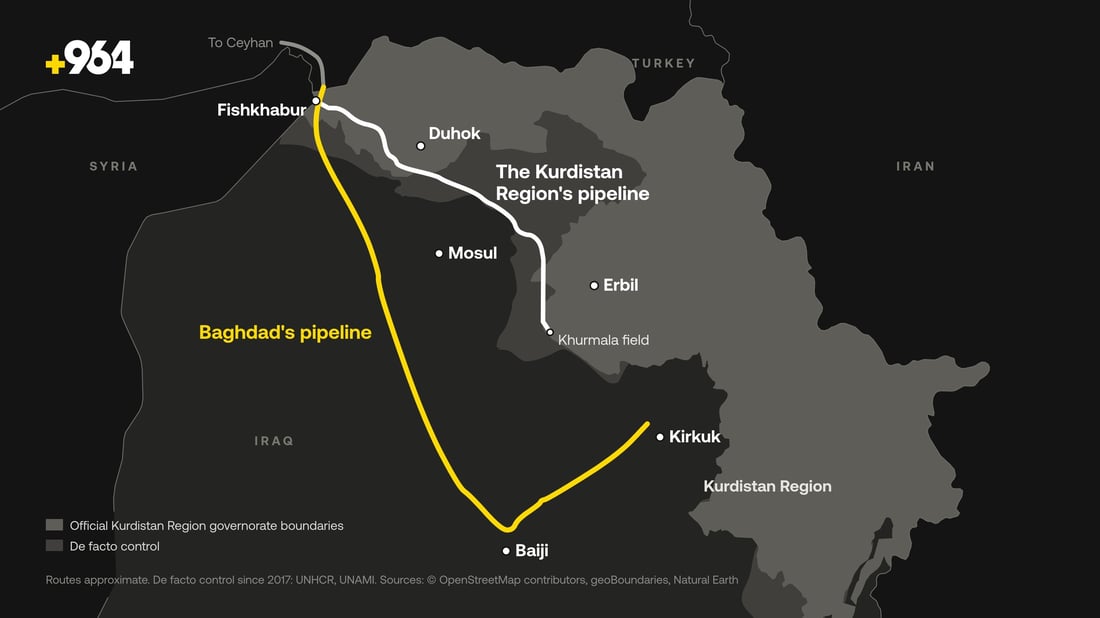
Turkey halted Iraqi flows to Ceyhan in March 2023, after the International Chamber of Commerce in Paris ruled that Ankara had breached the old agreement by letting the KRG export oil without Baghdad’s consent. Exports through the Region’s line resumed on Sept. 27, 2025.
The restart came days after oil leaking from the Iraq-Turkey pipeline near Zummar, northwest of Mosul, reached the Tigris River and led Nineveh’s water directorate to shut its plants across the governorate on Friday. Abadi’s statement did not mention the leak.
Iraq has looked for new export routes since the regional war disrupted shipping through Hormuz, its main outlet, from Feb. 28. Exports fell from more than 99 million barrels in February to 18.6 million in March. Abadi said they had recovered to more than 3.4 million barrels a day in October.
On Nov. 5, Prime Minister Ali al-Zaidi promised to remove every obstacle to a planned pipeline to Mediterranean and Red Sea ports. Abadi has described the Mediterranean line as one branch of a network from Basra to Haditha in Anbar, with one line on to Syria’s port of Baniyas and another north to Fishkhabur. The government has not announced a cost, financing or construction timetable.