
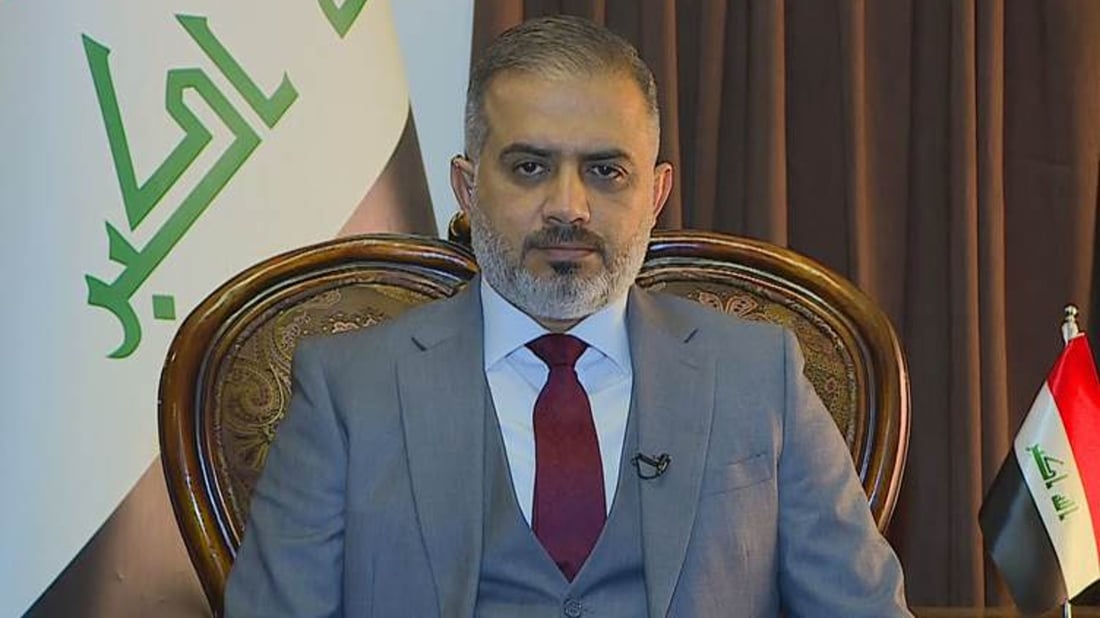
Iraqi lawmaker Yousif al-Kalabi
Iraq’s oil smuggling losses reach billions, MP says, urges pipeline monitoring
BAGHDAD — Sensors to monitor Iraq’s 10,000 kilometers of oil pipelines would cost about $200 million, a small sum next to the billions of dollars lost to smuggling, a lawmaker investigating oil smuggling said Monday.
Yousif al-Kilabi, a State of Law Coalition lawmaker who sits on parliament’s committee investigating oil smuggling and on its Finance Committee, told the state-run Iraqi News Agency that the sensors would cost no more than 350 billion dinars. He put that at $200 million; at the official rate it is about $230 million.
“What is the value of $200 million compared with smuggling operations estimated in the billions?” he said.
The sensor proposal was first made in 2019, but its recommendations were never carried out, Kilabi said.
He also said smuggling in the Rabia area of Nineveh governorate, on the Syrian border, ran to about 5,000 to 10,000 barrels. He did not say over what period, and 964media could not verify the figure.
Kilabi called Prime Minister Ali al-Zaidi’s dismissal of the director general of pipelines and other officials two days earlier a good step. He said he fully backed the government’s efforts against smuggling and that the government had begun carrying out parliament’s decisions.
Zaidi on Saturday relieved nine security and oil officials, among them Babil’s police chief, the Popular Mobilization Forces commander in Babil and the director of the Oil Ministry’s Oil Pipelines Company. He ordered everyone accused of smuggling referred to the courts. The government has not named the officials or the accused.
The dismissals followed findings by a government committee Zaidi set up Wednesday. The committee confirmed information in a Federal Intelligence and Investigations Agency report on oil smuggling and the existence of oil refineries, and found cases of manipulation, said Sabah al-Numan, spokesperson for the commander-in-chief of the armed forces.
The report, which began circulating Nov. 9, alleges that oil is drawn from a pipeline in Jurf al-Sakhar, in northern Babil, through an unauthorized opening and carried away in tanker trucks. The agency is an Interior Ministry body.
Parliament Speaker Haibat al-Halbousi on Wednesday ordered a committee of lawmakers to investigate the report, along with intelligence on oil smuggled from the Kirkuk fields and the Kurdistan Region through Iran to Afghanistan.
The Energy Police, the Interior Ministry force that guards oil infrastructure, said pipeline breaches had fallen to zero in December 2025. It credited thermal cameras and drones that watch pipeline routes. Its current director general, Lt. Gen. Hamid al-Husseini, told INA on Friday that modern sensors and checks on old valves had recently caught several attempts to tap pipelines in Basra.
Iraq’s government on Sunday named Kataib Hezbollah as the party behind the smuggling in Jurf al-Sakhar. It said security forces would soon retake the area, which it said the Iran-aligned faction controls. “The party involved in the smuggling is the party that holds the ground, and that is Kataib Hezbollah,” government spokesperson Haider al-Aboudi told presenter Yasser Amer on Al-Rasheed TV.
“Jurf al-Nasr will soon return to the authority of the security forces,” Aboudi said, using the area’s official name. He did not say when or how.
Kataib Hezbollah denied smuggling oil from Jurf al-Sakhar on Sunday and accused Zaidi’s office of spreading “fabricated reports.”
The PMF is the state-sanctioned umbrella of mostly Shiite armed groups formed in 2014 to fight the Islamic State group. Kataib Hezbollah has brigades in the PMF, and the United States designated it a terrorist organization in 2009. Jurf al-Sakhar was officially renamed Jurf al-Nasr in 2014 after Iraqi forces and allied armed groups recaptured it from Isis.