
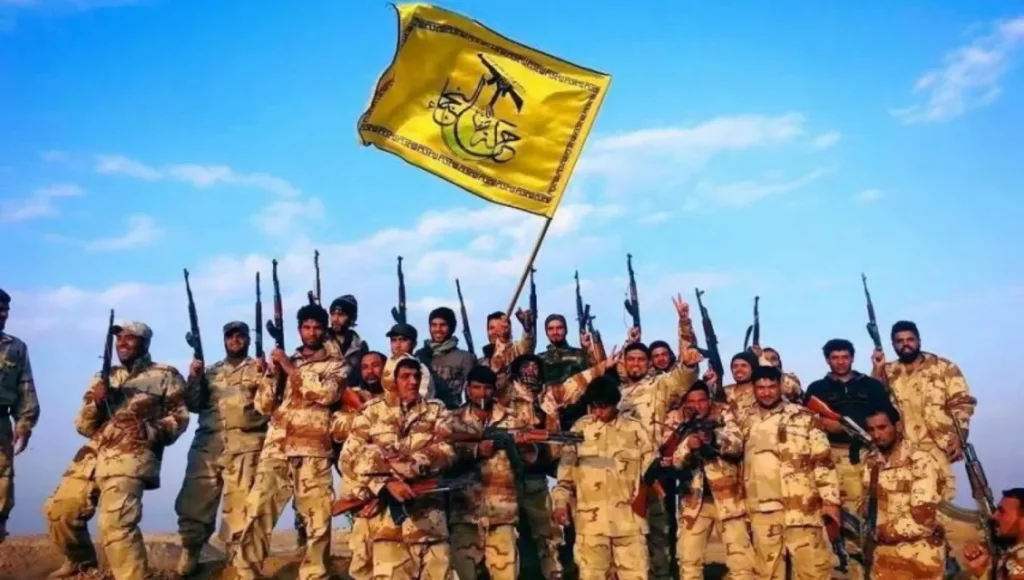
Fighters from Nujaba pose in military uniforms, raising their weapons and a yellow flag bearing the group’s emblem.
Iraqi factions sort shared arsenals before state handover, sources say
BAGHDAD — Iraqi armed factions have begun returning weapons stored in one another’s depots, so that groups agreeing to hand their arsenals to the state are not left answerable for weapons owned by groups that refuse, sources told 964media.
Some weapons have already changed hands, an informed source told 964media on condition of anonymity. Preparations for the government’s plan to restrict weapons to the state showed that parts of the arsenals did not belong to a single faction, the source said. Some weapons belonged to one group but sat in another’s warehouses, some were shared and some were registered under more than one formation.
“Some factions that have agreed to surrender their weapons do not want to bear responsibility for weapons belonging to other factions that reject the project. Therefore, discussions have begun to return these weapons to the groups that own them,” the source said.
Factions that reject the plan are in turn trying to recover their stockpiles from groups that have agreed to take part, the source said. Some factions have agreed to give up their weapons, while others still refuse.
Plans to merge brigades of the Popular Mobilization Forces have also drawn objections from commanders, including inside the Badr Organization. The PMF is the state-sanctioned umbrella of mostly Shiite armed groups formed in 2014 to fight the Islamic State group.
A shipment of Grad rockets, a Soviet-designed truck-launched artillery rocket, seized last week in Latifiya, south of Baghdad, belonged to a group taking part in the handover and was being moved to a group still negotiating over its weapons, the source said.
The rockets were bound for Jurf al-Sakhar in northern Babil governorate, an area officially renamed Jurf al-Nasr in 2014, where factions still in talks about joining the plan are deployed, according to the source.
Government spokesperson Haider al-Aboudi said in a televised interview that the Intelligence Service and the army had seized a truck carrying 35 rockets, foiling what he said was an attack. Armed groups outside Iraq’s armed forces would face the law, he said. He did not say who was moving the rockets or what their target was.
The newspaper Al-Mada reported Sunday that three PMF members had been arrested with 35 rockets in Latifiya. No official statement on the arrests has been published.
Plans to restructure the PMF include merging several brigades into others, another source told 964media. The source said “the move has begun to raise objections within some brigades whose commanders believe they have a combat history and military presence dating back to the earliest battles against Isis and cannot be treated in the same way as formations established later.”
Some of those brigades include well-known fighters from the hardest battles against Isis and helped found the PMF, the source said. Their commanders question the criteria for merging them into formations that may be smaller or were set up after the group’s defeat.
The clearest case, according to the source, is the proposed merger of the 10th Brigade with the 22nd Brigade “within the Badr Organization,” after commanders of the 10th Brigade sent “a strongly worded letter to Hadi al-Amiri expressing their reservations about the move.” Amiri leads Badr, a member of the Coordination Framework, the ruling alliance of Shiite parties.
Merging and redeploying brigades is also complicated by where formations are deployed, their ties to different factions and the links some brigades have to particular areas, with commanders and fighters bound by organizational relationships going back years, the source said. “This makes relocating them to other areas or merging them into different formations more complicated than simply issuing administrative orders,” the source said.
In August, sources told 964media that a government committee was weighing proposals to break up PMF units built around factions. The proposals included moving fighters between brigades through a digital system, putting army officers in command posts, retiring older commanders, changing deployment areas and introducing new uniforms and ranks. More than 20 PMF brigades are affiliated with Badr, the sources said then.
Mansour al-Buaiji, a lawmaker from former Prime Minister Mohammed Shia al-Sudani’s Reconstruction and Development Coalition, said in late October that Prime Minister Ali al-Zaidi was working to replace officials in 50 government posts and might extend the changes to the PMF.
Zaidi has set a timetable for the factions’ weapons that runs to June 30, 2027: a 90-day suspension of attacks from Sept. 30, followed by a six-month handover to the state. Kataib Hezbollah, an Iran-aligned armed faction that the United States designated a terrorist organization in 2009, said on Sept. 30 that it was not bound by any timetable. Harakat al-Nujaba has also refused to hand over its weapons, and Kataib Hezbollah has since stepped up its accusations against Zaidi and his government.