
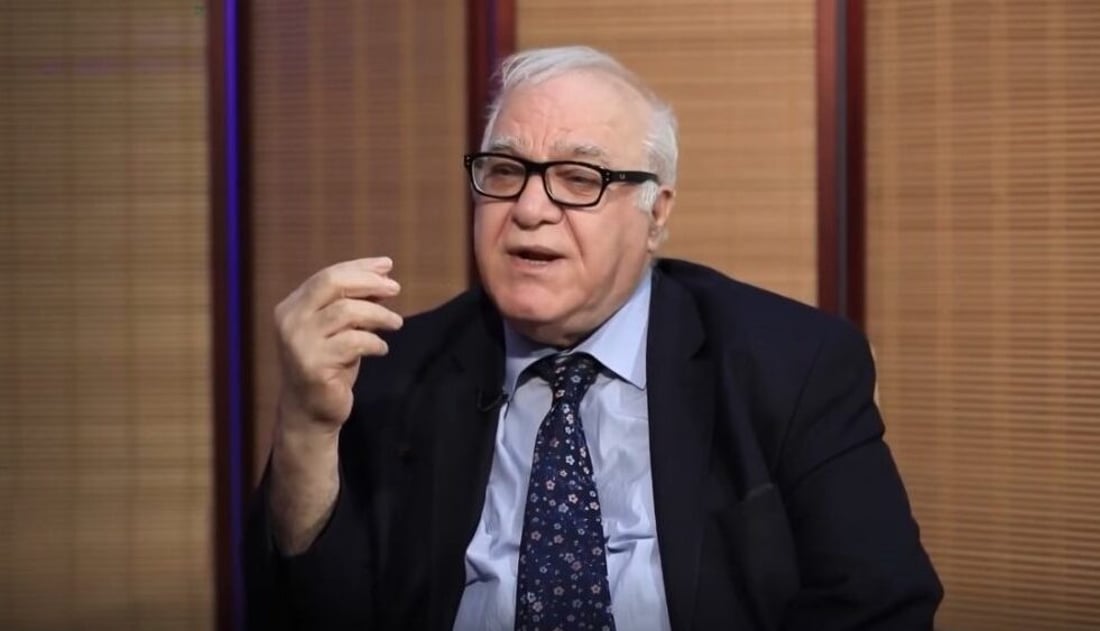
Prime Minister’s financial adviser Mazhar Mohammed Salih
Media Monitor
Oil, not loans, should cover Iraq’s running costs, PM adviser says
BAGHDAD — Covering Iraq’s basic running costs from oil revenue is a priority at this stage, the prime minister’s financial adviser, Mazhar Mohammed Salih, said Tuesday, adding that rising oil prices and exports were bringing public finances closer to that goal.
“The financial break-even point depends on spending ceilings, and under the current difficult circumstances and geopolitical tensions, the financial break-even point for the operating budget is a priority at this stage,” Salih told the state-run Iraqi News Agency.
Those essential costs include salaries, wages, pensions, social welfare payments, money owed to farmers and contractors, electricity maintenance and municipal services, he said. “Oil revenues that cover these essential operating expenditures bring public finances closer to the break-even point, particularly amid the exceptional pressures facing the Iraqi economy,” he said.
Higher export volumes alongside higher prices bring in more revenue and strengthen the government’s ability to meet its commitments, Salih said. Any savings should go to the government’s spending priorities without resorting to borrowing, he said.
“The general budget represents financial estimates, while oil revenues are recorded monthly and may rise in some months and decline in others,” Salih said. “Therefore, attention should be given to average annual revenues and their ability to cover expenditures throughout the fiscal year.”
He said savings from fiscal and monetary measures could help absorb the new public-sector hiring. Prime Minister Ali al-Zaidi ordered on Oct. 24 that contract employees be made permanent, along with daily wage workers, and that 120,000 new posts be created in the 2027 budget.
Oil and non-oil revenues covered only 76% of spending on salaries and welfare in the first seven months of 2026, economist Nabil al-Marsoumi wrote in early October. Revenues totaled 39 trillion dinars (about $30 billion at the time) against 51 trillion in salary and welfare spending, he wrote. He put the overall deficit for the period at 29 trillion dinars.
Salih said in August that the state needs 7.7 trillion dinars (about $5.8 billion at the time) a month for salaries and payments reaching an estimated 40 million people.
Oil makes up about 90% of budget revenue, which leaves public finances exposed to energy markets and regional developments, Salih said Tuesday. Brent crude, the global benchmark, traded at about $91 a barrel on Tuesday, down from more than $113 at the close on Oct. 30.
The draft 2027 budget relies on borrowing, according to Marsoumi, who said in an interview on Oct. 29 that it carries a deficit of 43 trillion dinars (about $28 billion at the official rate). He said 5 trillion dinars from the account of Iraq’s oil-for-infrastructure agreement with China appears in the draft both as investment spending and as deficit financing, which could make the deficit look like 38 trillion.
Foreign loans would cover 16 trillion dinars (about $11 billion) of that, from 18 Arab and foreign lenders including Saudi Arabia, Kuwait, China, Germany and France, he said. The rest would be borrowed at home: 15 trillion from the Central Bank of Iraq, 5 trillion through bonds and 2 trillion from state-owned banks.
Government spokesperson Haider al-Aboudi denied on Oct. 30 that Iraq planned to borrow the 16 trillion dinars from other countries, saying higher oil exports made it unnecessary. He did not say how else the deficit would be financed.
Marsoumi also said the government had borrowed 20 trillion dinars since shipping through the Strait of Hormuz was disrupted, and put external debt at about $13 billion, within what he described as safe limits. Mahmoud Dagher, an adviser to the Central Bank governor and the bank’s spokesperson, gave a lower figure for external debt, $8 billion to $10 billion, in a televised interview in October. He said domestic debt had reached 117 trillion dinars (about $77 billion at the official rate) after budget deficits from 2023 through 2025.
The draft assumes exports of 4 million barrels a day at $58 a barrel, against about 3 million now, Marsoumi wrote on Facebook on Nov. 1. “Oil revenues are built on a barrel that does not exist,” he wrote. Oil Minister Basim al-Abadi has given a higher export figure: more than 3.4 million barrels a day in October.
Iraq has had no budget law this year. Since the three-year law covering 2023 to 2025 expired, spending has been governed by the one-twelfth rule, under which monthly spending is capped at one-twelfth of the previous year’s actual current spending while there is no budget law.
Zaidi set aside the cabinet’s Tuesday session for the draft so that it could be approved and sent to parliament, his spokesperson said Saturday. The draft will reach parliament on Nov. 15, a month after its legal deadline, Finance Committee chair Uday Awad said on Oct. 26.