
Erbil wants 14.14%
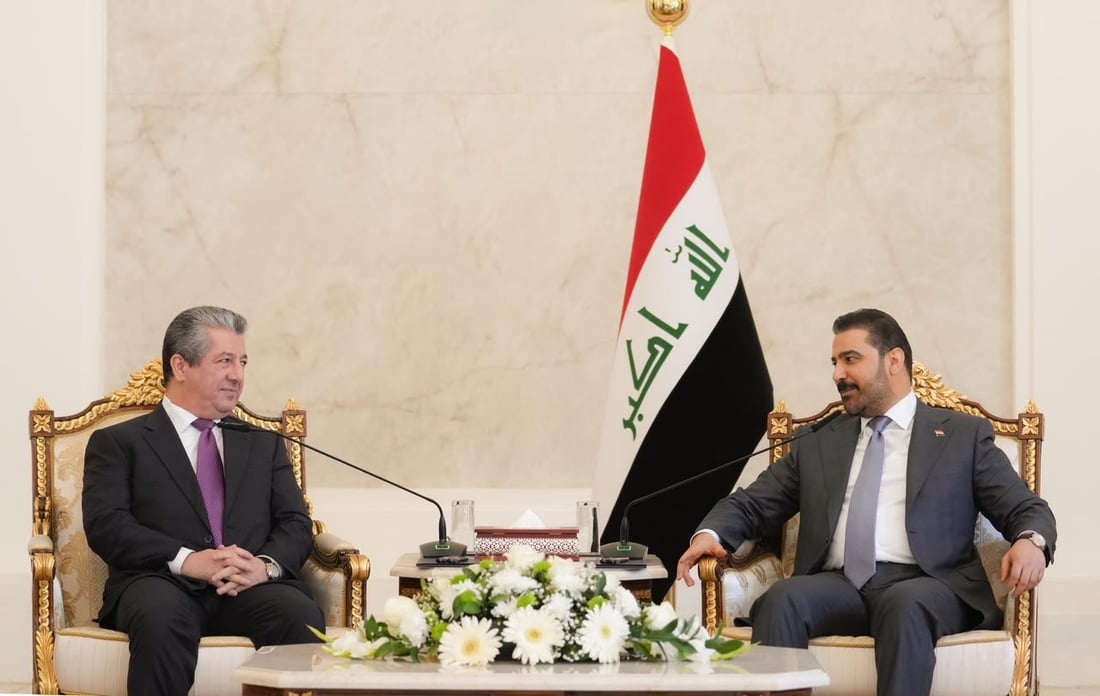
Zaidi and Masrour Barzani discuss Kurdistan budget share and oil law in Baghdad
BAGHDAD — Prime Minister Ali al-Zaidi and Kurdistan Region Prime Minister Masrour Barzani agreed in Baghdad on Monday to work out ways to settle disputes between the federal government and the Region under the constitution, Zaidi’s office said.
The two leaders discussed the Region’s share of the 2027 federal budget, the management of oil fields, oil and non-oil revenue, salaries for Kurdistan Region employees and the oil and gas law, which they said should be passed quickly, the office said in a statement. The meeting came a day before a cabinet session that Zaidi set aside for the draft 2027 budget.
They also condemned the attack on the Khor Mor gas field late Sunday and said oil facilities and infrastructure must be protected and steps taken to stop such attacks from happening again, the statement said. The attack on the Sulaymaniyah governorate field, which fuels most of the Region’s power stations, cut nearly 3,000 megawatts of generation, a KRG Electricity Ministry spokesperson told 964media.
Both sides stressed that Kurdistan Region employees must keep being paid on a par with other Iraqi state employees, according to the statement. They discussed how the Region’s budget share should be set under the constitution, and how the federal and KRG finance ministries would organize and coordinate revenue. On the oil and gas law, they said passing it would help resolve disputes over oil production and exports and over how the country’s oil wealth is managed.
Zaidi told the delegation that oil production would rise to 7 million barrels a day in 2030 and 10 million in 2032, including the Region’s fields, which the statement put at about 1 million barrels a day. Last week Zaidi linked a new pipeline to a 10 million-barrel target his government had set for 2030. Opec+ has set Iraq’s production quota at 4.431 million barrels a day through December.
The statement did not say whether the Region’s 1 million barrels a day is current output. In late August, Kamal Mohammed, the KRG’s acting natural resources minister, put the Region’s production at 200,000 to 250,000 barrels a day.
Masrour Barzani arrived in Baghdad on Monday with a senior delegation for meetings with Zaidi and with the leaders of political parties, the Kurdistan Regional Government said. The KRG said the talks would focus on the Region’s share of the draft budget and on securing its constitutional and financial rights and dues.
The draft has been with the cabinet since Sept. 27 and is due in parliament on Nov. 15, a month after its legal deadline, Finance Committee chair Uday Awad said on Oct. 26.
Erbil wants the draft changed first. The KRG wants the Region’s share based on 14.14% of Iraq’s population, the figure it takes from the 2024 census, and rejected a federal figure of 12.68% in September, according to KRG cabinet statements. On Oct. 28, the KRG cabinet asked the federal cabinet not to let the bill go to a vote in its current form.
A KRG negotiating team reached Baghdad on Sunday, a day ahead of Masrour Barzani, and met the Ministerial Council for Economy, chaired by Deputy Prime Minister Mohammed Ali Tamim. They discussed salaries and pensions in the Region, its oil production and sovereign spending, the centrally held items deducted before the Region’s share is calculated, Tamim’s office said in a statement. The KRG team included the Region’s natural resources minister and several Iraqi lawmakers, it said.
Zaidi told Kurdistan Democratic Party lawmakers on Nov. 3 that his government would guarantee salaries for Kurdistan Region employees on a par with state employees in other ministries and governorates.
Kurdistan Region salaries are paid from the federal budget in exchange for the KRG handing over oil and non-oil revenue. A 2025 arrangement required the KRG to deliver 230,000 barrels of oil a day to the State Oil Marketing Organization, or Somo, and 120 billion dinars (about $79 million at the official rate) a month in non-oil revenue.
Masrour Barzani leads an outgoing cabinet. The Region has had no new government since its Oct. 20, 2024, parliamentary election, and the Patriotic Union of Kurdistan said Thursday it was quitting the KRG. On Monday, Kurdish leader Masoud Barzani called on the PUK to sit down with the KDP, settle their disputes and end the Region’s political crisis, in a message published by his office.
Zaidi received Masrour Barzani in Baghdad on May 23, nine days after parliament approved his government, for talks on border crossings, customs and oil companies operating in the Region.