
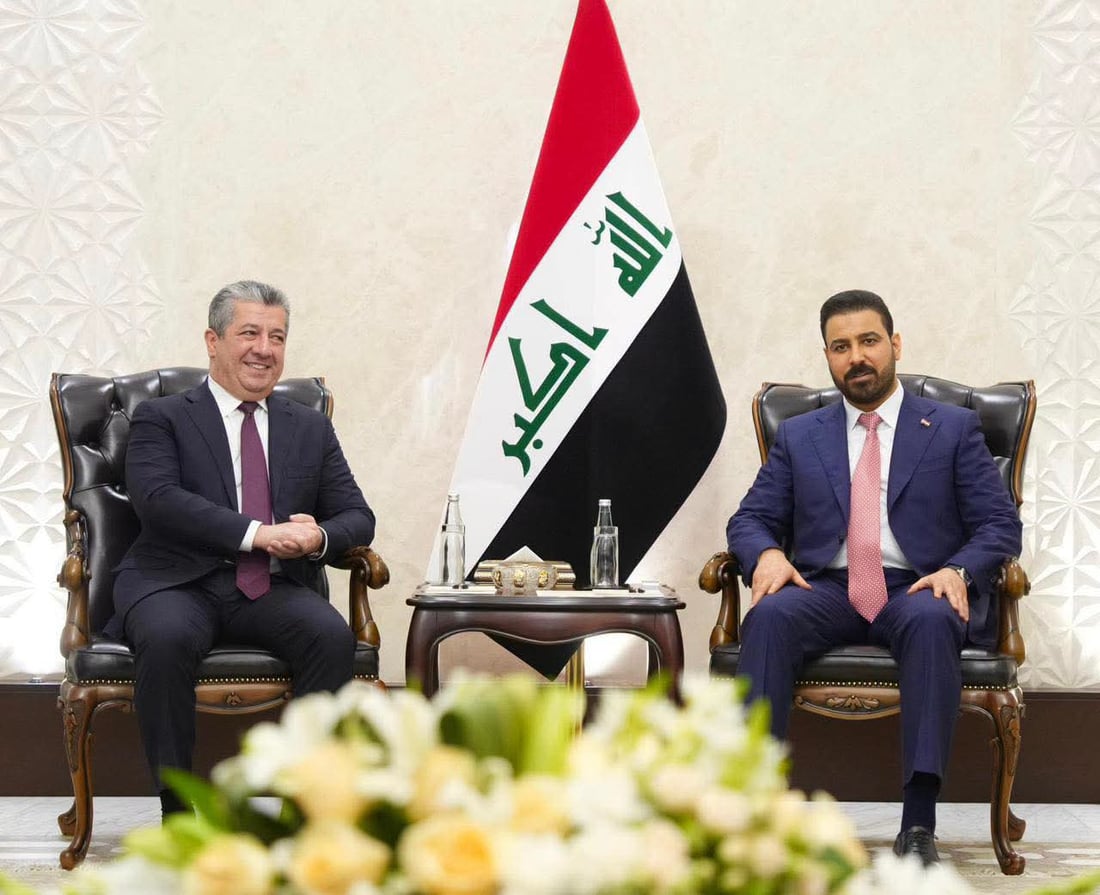
(The prime minister’s media office)
Al-Zaidi, Barzani discuss ‘coordination’ between federal, KRG governments
BAGHDAD — Iraqi Prime Minister Ali Al-Zaidi met Saturday with Kurdistan Region Prime Minister Masrour Barzani and an accompanying delegation to discuss political and technical issues between Baghdad and Erbil, according to a statement from the prime minister’s media office.
The meeting reviewed the overall situation in Iraq and addressed technical matters related to border crossings, implementation of the ASYCUDA customs system and oil companies operating in the Kurdistan Region, the statement read.
Both sides stressed “the importance of coordination and cooperation” between the federal government and the Kurdistan Regional Government to resolve technical issues and remove obstacles in accordance with the constitution and the law.
“Al-Zaidi affirmed the government’s commitment to resolving all outstanding issues in line with its vision to serve citizens from all components of Iraqi society, stressing that all Iraqis are partners in this country and that the objective is to reach understandings that serve the interests of Iraq and its people,” the statement added.
Earlier this month, Al-Zaidi met with Kurdistan Region President Nechirvan Barzani to discuss government formation and the broader political situation, with both sides stressing the importance of forming “a national government that represents the various components of Iraqi society.”
Key outstanding issues between Baghdad and Erbil, including the federal budget, oil exports and the region’s authorities, are typically revisited during government formation negotiations.
In late April, Iraq’s Border Ports Commission held a meeting with federal and regional representatives aimed at unifying customs procedures between federal authorities and the Kurdistan Region, focusing on tariff alignment and the rollout of a shared electronic system.
Efforts to unify customs procedures follow years of differences between federal and regional systems, including variations in tariff application at border crossings that have led to trade disruptions and delays. Previous attempts to enforce unified tariffs and clearance procedures have highlighted the impact of inconsistent regulations on traders and supply chains.