
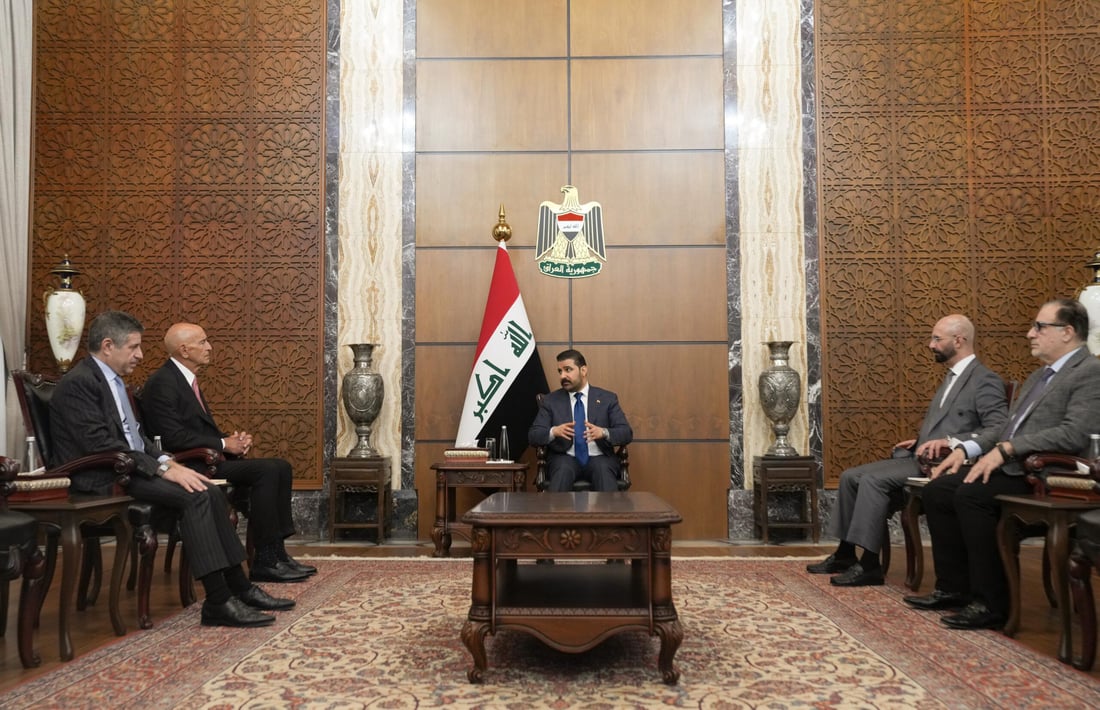
US envoy Tom Barrack meets Iraqi Prime Minister Ali al-Zaidi in Baghdad on Nov. 5, 2026.
Diplomacy
US envoy Barrack says Iraq is choosing ‘sovereignty over dependency’
BAGHDAD — Iraq under Prime Minister Ali al-Zaidi is choosing “sovereignty over dependency,” U.S. envoy Tom Barrack said after meeting him in Baghdad on Thursday, pledging deeper economic and commercial ties between the two countries.
Barrack, the U.S. special presidential envoy to Iraq and Syria and ambassador to Turkey, also met Supreme Judicial Council President Faiq Zaidan on Thursday, alongside U.S. Chargé d’Affaires Steven Fagin. The visit came on the day Zaidi told President Donald Trump in a phone call that Iraq would not let its territory be used for attacks on neighboring countries.
“The Middle East is a Rubik’s Cube. Every side touches every other, turn one face and you move the rest. No single country, and no outside power, solves it alone,” Barrack wrote in a statement posted on X after meeting Zaidi.
The region comes together only when its nations turn the pieces themselves, he wrote, adding: “Iraq is doing exactly that. Under Prime Minister Al-Zaidi, it is choosing sovereignty over dependency, investment over stagnation, and partnership over proxy.”
The United States was proud to stand with Iraq by deepening economic and commercial ties and opening the door to American companies and Iraqi talent, Barrack wrote. The two had also discussed lowering regional tensions and containing crises, a responsibility that belongs first to the region’s own countries, he said.
“America is a partner in it, not a substitute for it,” he wrote. “A sovereign, prosperous Iraq, anchored in a region that takes responsibility for its own stability, is good for Iraqis, good for their neighbors, and good for the United States.”
Zaidi and Barrack discussed relations between Iraq and the United States, ways to develop the partnership and closer economic and investment cooperation that would serve both countries’ interests and support Iraq’s development, the prime minister’s media office said in a statement received by 964media. The meeting also covered regional developments, the challenges to the region’s security and stability and the importance of stepping up diplomatic efforts to ease tensions, contain crises and keep conflicts from spreading, it said.
Zaidan and Barrack followed up on the results of talks on strengthening judicial ties with U.S. counterpart bodies, the council said in a statement. It did not name the U.S. bodies or say when the earlier talks took place.
In his own post on the meeting, Barrack said strong institutions and the rule of law build confidence, which he called the foundation for investment, stability and lasting prosperity. “Security opens the door. Confidence brings investment. Prosperity makes peace endure,” he wrote.
Neither the prime minister’s office nor the council said whether anything was agreed, and neither mentioned the plan to bring armed factions’ weapons under state control. In September, Barrack said Washington and Baghdad had agreed that the process would be complete by June 30, 2027. The ruling Shiite Coordination Framework endorsed the deadline on Oct. 19, but some armed factions, including Harakat al-Nujaba, have said they will not hand over their weapons.
Barrack was last in Baghdad on Oct. 12, when he met Zaidi and Zaidan. The council said at the time that he and Zaidan had discussed developing legal and judicial ties between the two countries.
During Zaidi’s July visit to Washington, Iraqi government bodies and companies signed 48 agreements and memorandums with U.S. firms in oil, electricity, industry, technology and finance. The government has not published the texts or said how many are binding contracts.
Also on Thursday, Zaidi met ExxonMobil’s regional representative, Mohammed al-Amin, to discuss raising Iraq’s crude production. At a separate meeting with a consortium of U.S. and multinational companies, he pledged to remove every obstacle to a planned pipeline carrying Iraqi crude to the Mediterranean and the Red Sea.