
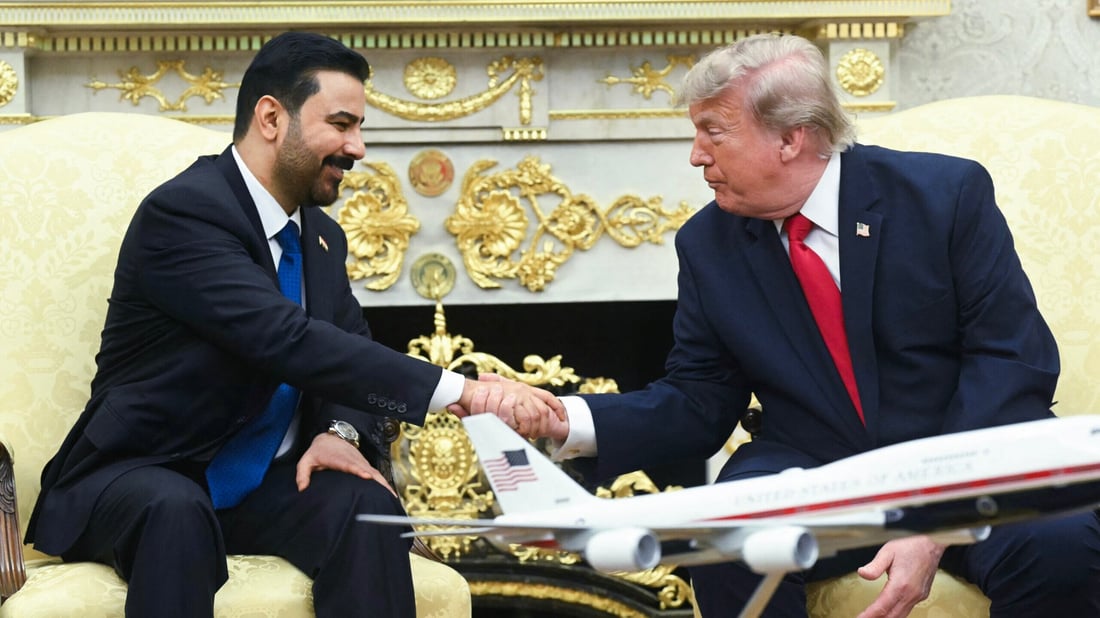
U.S. President Donald Trump meets Iraqi Prime Minister Ali Al-Zaidi at the White House in Washington, D.C., July 14, 2026.
Iraq announces 48 agreements with US companies during Washington visit
NEWSROOM— Iraqi government agencies and private companies signed 48 agreements, memoranda of understanding and other cooperation arrangements with U.S. companies across the oil, electricity, industrial, technology and financial sectors, the Prime Minister’s Media Office said Saturday.
The office said the agreements were signed under the patronage of Prime Minister Ali Al-Zaidi and were intended to establish a “framework for economic and financial cooperation” between Iraq and the United States. It did not publish the full texts of the agreements or identify all 48 signatories.
The announcement followed a U.S.-Iraq business gathering in Washington at which U.S. companies signed agreements and partnerships with the Iraqi government valued at about $60 billion, according to The Associated Press. Those arrangements covered energy, health care, communications and infrastructure.
The Prime Minister’s Media Office said Iraq’s oil and electricity ministries, their affiliated public companies and other government bodies signed cooperation and partnership arrangements with ExxonMobil, KBR, GE Vernova, Shell and Halliburton.
The statement did not specify which projects were assigned to each company, the financial value of the individual agreements or whether they were binding contracts. Agreements described as memoranda of understanding generally record an intention to cooperate and may require technical studies, financing arrangements and final contracts before work begins.
Several of the announced deals concern Iraq’s effort to increase energy production and develop export routes that do not depend entirely on Persian Gulf terminals. Iraq also signed a memorandum of understanding with Syria to develop a crude oil export pipeline linking Iraqi oil fields to Syria’s Mediterranean port of Baniyas. The Iraq’s oil ministry said the project will be carried out by a consortium comprising U.S. companies Chevron and TI alongside Qatar’s UCC.
The office said the Communications and Media Commission signed an agreement with Starlink to introduce the company’s satellite internet services in Iraq. Starlink, a subsidiary of SpaceX, provides internet access through a network of orbit satellites.
Former Prime Minister Mohammed Shia Al-Sudani met in December 2025 with a delegation from SpaceX’s Starlink, joined by U.S. Chargé d’Affaires in Iraq Joshua Harris, to review final procedures for granting satellite-internet licenses and to explore future cooperation in Iraq’s telecommunications sector.
The Prime Minister’s Office also listed a separate cooperation agreement with Halliburton, a U.S. company that provides drilling and other oil field services.
A memorandum of understanding was also signed between Keysight Technologies and representatives of Iraq’s private sector, the statement said. Keysight produces electronic testing and communications equipment, but the office did not identify the Iraqi companies involved or the proposed project.
The government also announced an agreement with PepsiCo and two agreements with Frito-Lay that it said would support agricultural development. PepsiCo owns Frito-Lay, which manufactures snack foods, but the statement did not specify whether the agreements involve local production, crop purchases, processing facilities or supply-chain investment.
The Prime Minister’s Office said agreements were also concluded with KBR, UOP, Polaris, and the Association of Energy Engineers.
The Prime Minister’s Office described the 48 arrangements as a step toward a more developed economic partnership between Iraq and the United States. It did not state how many were final contracts, how many were nonbinding memoranda or when the projects would enter implementation.
The memorandum of understandings and deals came amid Zaidi’s visit to Washington, where he held talks with President Donald Trump at the White House and met Defense Secretary Pete Hegseth and Treasury Secretary Scott Bessent. Those discussions focused on expanding economic cooperation and U.S. investment, security cooperation and Iraq’s transition after the planned conclusion of the U.S.-led coalition mission in September.