
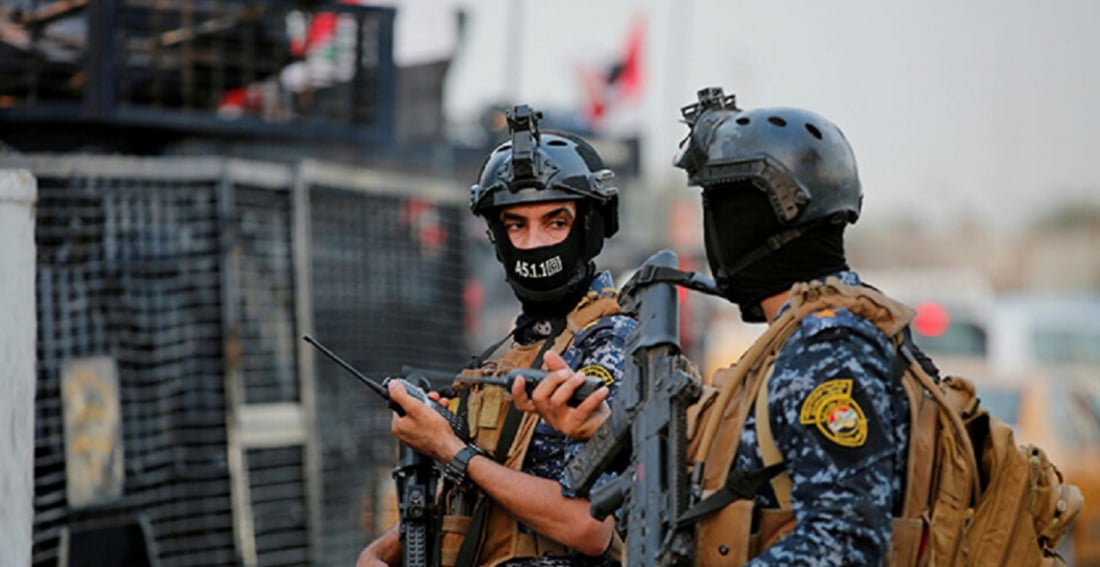
Members of Iraq's security forces
ISIS attacks in Iraq rose from two in July to 10 in September, report finds
BAGHDAD — The Islamic State group carried out 21 documented attacks in Iraq between July 1 and Oct. 14, more than half of them in Kirkuk governorate, according to an investigation by the fact-checking platform Sahih Iraq, which also found that much of the engagement with several pro-ISIS accounts on X came from Saudi Arabia.
Attacks rose from two in July to four in August and 10 in September, with five more in the first two weeks of October, the report said. Kirkuk accounted for 12 of the 21, or 57%, including six of September’s 10 and four of October’s five. An Iraqi Army brigadier general and a warrant officer were killed in Kirkuk on Oct. 14 by an explosive device left at a bombed ISIS hideout, and two soldiers were killed on Oct. 4 by an ISIS device north of the Anbar town of Rawa. Prime Minister Ali al-Zaidi, as commander-in-chief, ordered the armed forces to their highest level of combat readiness on Oct. 13.
Sahih Iraq monitored six X accounts between Oct. 9 and 15 that promoted ISIS, called for the return of its self-declared “caliphate” and stoked sectarian division. Using the social media monitoring tool Talkwalker, it found that Saudi Arabia accounted for 77.1%, 85.9% and 77% of engagement with three of them. Two accounts that listed Europe as their location were posting from Saudi Arabia, the report said. Engagement with another came from Iraq, and the tool produced no location data for the sixth. The investigation found no sign of coordination among the accounts, such as synchronized campaigns, shared hashtags or consistent messaging.
In the editorial of its Al-Naba newsletter, issue 568, dated Oct. 8, ISIS portrayed the U.S.-led coalition’s withdrawal as proof that it had failed to destroy the group and vowed to keep fighting inside and outside Iraq.
The report cited earlier warnings from Kurdistan Democratic Party leader Masoud Barzani, who said in a televised interview three days before the withdrawal was completed that ISIS could return as it did after U.S. forces left in 2011, and from Iraqi intelligence chief Hamid al-Shatri, who said in January that ISIS’s ranks in Syria had grown to about 10,000 fighters from an earlier estimate of 2,000.
An unnamed specialist in militant groups quoted in the report attributed the concentration of attacks in Kirkuk to its rugged terrain, high ground and caves linked to the Hamrin Mountains, which offer hiding places and routes into Erbil, Sulaymaniyah, Salah al-Din, Diyala and Nineveh. But security forces were far better prepared than in 2014, the specialist said, and ISIS was struggling to keep its supply lines open. “We are not in the same position we were in 2014, nor is the organization the same as its brutal version back then,” the specialist said. “The security forces are now in a much better position in terms of combat and intelligence capabilities.” ISIS would probably step up its attacks slightly, the specialist said, but a return to 2014 was not expected.
Zaidi formally declared the end of the coalition’s mission on Sept. 30, saying Iraq now takes full responsibility for its security, and the last U.S. and coalition forces left Erbil Air Base that day. The Islamic State group seized large parts of northern and western Iraq in 2014 and was territorially defeated in 2017, and has since operated through sleeper cells and small units, particularly in desert and rural areas.