
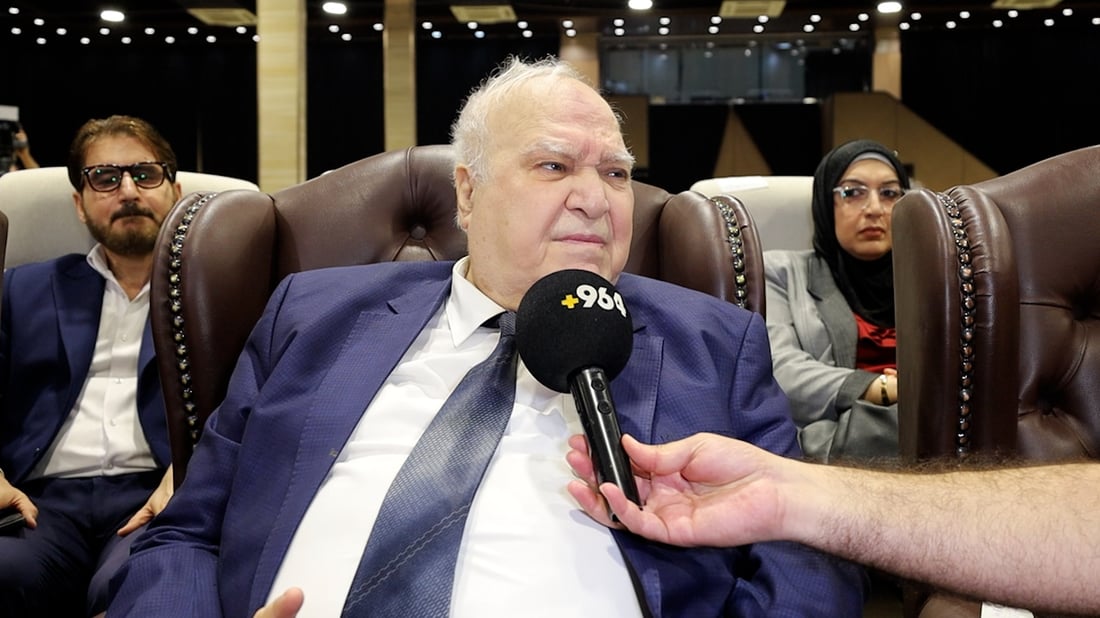
Mazhar Mohammed Saleh, financial adviser to Iraqi Prime Minister Ali al-Zaidi, speaks to 964media on the sidelines of the Conference on Trade, Economy and Social Responsibility in Baghdad on Oct. 17, 2026.
Staff transfers planned
New ministries will cost nothing extra, PM’s financial adviser says
BAGHDAD — Iraq’s new ministries will need no extra spending or new hiring, because the government will staff them with surplus employees from existing ministries, Prime Minister Ali al-Zaidi’s financial adviser, Mazhar Mohammed Salih, said Saturday.
“The government is very sensitive about this issue,” Salih said on the sidelines of the Conference on Trade, Economy and Social Responsibility, referring to the cost of the expanded cabinet. Parts of the public sector already have more staff than they need, and they will be redistributed according to their qualifications, he said. “We have surplus employees and capabilities within the Iraqi state, so we will redeploy these resources and do not need any additional financial allocations for the newly established ministries.” Only two ministries are involved, he said, and no new staffing structures will be created. The new deputy prime ministers will also receive no extra allocations, he said. “The financial situation cannot bear any further additions.”
Parliament approved 11 ministers and three deputy prime ministers on Oct. 15, including three new posts: Mohammed Sahib al-Darraji as minister of digital economy and governance, Ali al-Dakhili as minister of tourism and antiquities, and Mohammed Samaan as minister of state for minority affairs. Salih did not say which two ministries he meant. The deputies are Mohsen al-Mandalawi, Laith al-Khazali and Mohammed Tamim; a vote on the Kurdistan Democratic Party’s nominee, Faris al-Barifkani, was postponed. Before the vote, Zaidi said the deputies would receive no salaries, allowances or additional staff, though questions remained about their responsibilities and constitutional powers.
Revenues covered only 76% of salaries and welfare in the first seven months of 2026, leaving a gap of 29 trillion dinars, according to figures published in early October. Salih has said the government needs about 7.7 trillion dinars (about $5.1 billion at the official rate) a month for salaries, pensions and social protection payments that directly or indirectly support an estimated 40 million Iraqis.
The monetary authorities are also developing a system to link licensed exchange companies electronically and track their trading, Salih said. “There is an intention by the monetary authority to link licensed exchange companies to a system similar to a stock exchange, showing their actual sales, purchases and transaction volumes,” he said, adding that violations were already being monitored. “Any violation of the law exposes its perpetrator to legal and judicial accountability.” Government spokesperson Haider al-Aboudi said on Wednesday that the government and the Central Bank planned to bring the parallel-market dollar rate down to 1,550 dinars.