
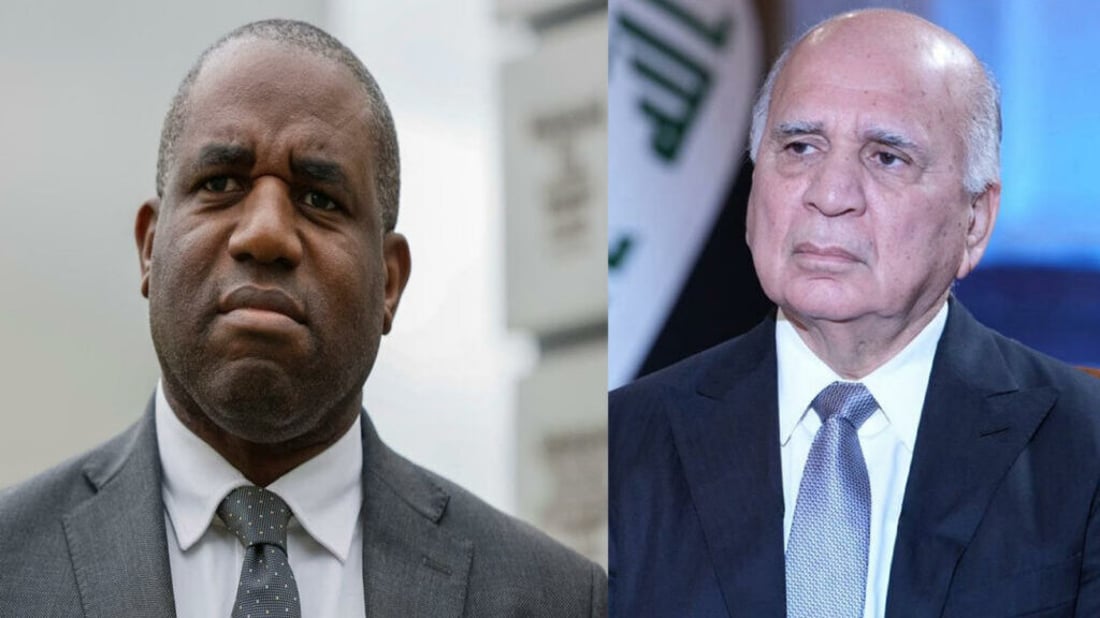
Iraq's FM Fuad Hussein (right) speaks with British Foreign Secretary David Lammy (left) during a phone call on June 16, 2025, to discuss ongoing Israel-Iran conflict. (Photo: Ministry of Foreign Affairs)
Monitor
Iraq, UK urge de-escalation as Israel-Iran conflict enters fourth day
BAGHDAD — Iraq’s Foreign Minister Fuad Hussein spoke by phone with British Foreign Secretary David Lammy on Monday to discuss the ongoing Israel-Iran conflict.
According to a statement from Iraq’s Ministry of Foreign Affairs, both officials emphasized the urgency of de-escalation, with Lammy affirming the importance of “controlling the situation and preventing interference by what he described as ‘armed groups’ in the ongoing conflict,” the ministry said.
Lammy stated that the UK is not involved in any military operations and is actively coordinating with France, Germany, and the United States to align diplomatic positions. He underscored the importance of returning to negotiations on the nuclear issue and warned of the dangers associated with attacks on U.S. or British forces in the region, regardless of the actor responsible.
Hussein warned of severe consequences if hostilities continue. “In this war, there is no winner,” Hussein was quoted to say, cautioning that an expansion of the conflict, particularly to the Strait of Hormuz, “could lead to a global economic crisis.”
Statement from Iraq’s Ministry of Foreign Affairs:
Deputy Prime Minister and Foreign Minister Fuad Hussein received a phone call on Monday, June 16, 2025, from British Foreign Secretary David Lammy. The call included discussions on the rapidly evolving regional developments and ways to avoid escalation.
The British minister affirmed his country’s support for Iraq’s stability and the need to keep it neutral from any attacks or conflicts, emphasizing the importance of controlling the situation and preventing interference by what he described as “armed groups” in the ongoing conflict.
He clarified that Britain had not participated in any military operations and that it is in ongoing communication with France and Germany to coordinate positions, as well as consulting with the United States on developments in the war.
Minister Lammy also stressed the need to return to the negotiating table regarding the nuclear program, warning of the dangers of any attacks on U.S. or British forces stationed in the region, regardless of the perpetrating party.
He added that the United Kingdom sees diplomatic solutions as the only way to avoid further escalation, praising Iraq’s role in this regard despite its sensitive geographical position and the complexities of the regional situation.
For his part, Fuad Hussein expressed his thanks to his British counterpart for the communication, stressing the importance of the British role in calming the situation, whether through European trilateral cooperation (Britain, France, and Germany) or coordination with the United States.
The Foreign Minister noted that the continuation of the war would lead to serious consequences for the region and the world, explaining that “in this war, there is no winner,” and that its continuation could cause major economic crises, especially if it extends to the Strait of Hormuz, which could lead to a global economic crisis.
Fuad Hussein confirmed that Israel continues to violate Iraqi airspace, and that these breaches represent a flagrant violation of Iraq’s sovereignty and international law. He emphasized the need for the international community to take serious steps to stop these violations and work toward containing the conflict.
Minister Lammy, in turn, pointed out that closing the Strait of Hormuz would create a severe economic crisis for Britain and Europe and would lead to rising inflation levels. He affirmed the need for joint efforts to avoid further deterioration and to exit this crisis through political and diplomatic solutions.