
Kataib Hezbollah still holds heart of Jurf al-Sakhar, paper says
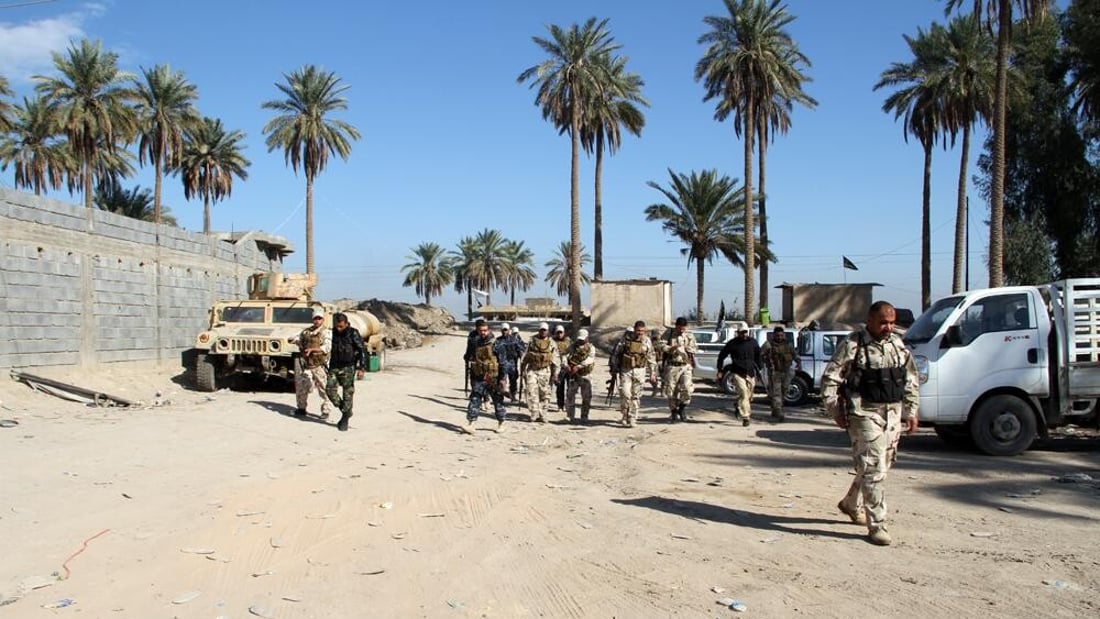
BAGHDAD — Kataib Hezbollah still controls the center of Jurf al-Sakhar five days after government forces moved in, the Baghdad daily Al-Mada reported Wednesday, citing unnamed sources.
964media could not verify the report and found no response to it from the government or the Popular Mobilization Forces, the umbrella of mainly Shiite armed groups that is part of Iraq’s security forces. Officials have said the Iran-aligned faction’s three brigades are being replaced and will be gone within a month. Documents obtained by 964media showed that the plan Prime Minister Ali al-Zaidi approved puts central Jurf al-Sakhar under Federal Police control.
According to the paper’s sources, no government force has entered the town center or the villages of Abd Wais, Farisiya, Hujair and Fadhiliya, the area they call the “Kataib Hezbollah square.” Instead, more Kataib Hezbollah fighters have arrived there, presented as members of the PMF’s 72nd and 79th brigades, the formations the government named to take the faction’s place, the paper reported.
The two brigades are indirectly tied to Kataib Hezbollah, the sources said, and the takeover was used to add more than 2,000 of the faction’s fighters to the PMF’s official rolls under the two brigades’ names. The fighters had until now been paid from the faction’s own budget, the sources said. On the rolls, they are paid by the Popular Mobilization Commission, the state body that runs the PMF, and gain institutional cover and official immunity.
Lt. Gen. Saad Maan, head of the Public Relations and Government Communication Authority at the commander-in-chief’s office, said Saturday that the 72nd and 79th brigades would take the place of the faction’s brigades. Sabah al-Numan, spokesperson for the commander-in-chief of the armed forces, said the same day that the forces’ sectors would be extended to cover all of Jurf al-Sakhar.
The army’s deployment was smaller than the government’s announcement suggested, according to the paper’s sources. Only the 38th Brigade of the 10th Division deployed, in the northwest of Jurf al-Sakhar, toward the Anbar border near Amiriyat al-Fallujah and along the canal linking Lake Habbaniyah with Lake Razzaza, west of Karbala, they said.
The sources described the Federal Police as the only force in direct contact with the Kataib-held area, which they attributed to years of mutual trust between the two. Its 16th Brigade, which had been in Jurf al-Sakhar, withdrew and the 17th and 11th brigades took over the same positions, without seizing new sites or entering areas the faction runs, they said. Maan said Monday that the Federal Police held three checkpoints and had deployed along more than 30 kilometers of the road through Fadhiliya toward Karbala.
The Counter-Terrorism Service has no real presence inside the area beyond its Karbala regiment at the Hamiya camp in Musayyib district, which lies outside Jurf al-Sakhar, the sources said. The joint command running the operation is also based outside the area, they said.
The sources also said the faction used the announced pullout for a large military maneuver, moving equipment to western Anbar and setting up new positions in western Anbar and western Karbala in case fighting between the United States and Iran resumes. Its main positions inside Jurf al-Sakhar are working as normal, they said.
Drawing on the same sources, the paper suggested that the pullback could be a tactical move that lets the factions redeploy while pressure shifts toward the Kurdistan Region, where Iran has for years sought to curb armed Iranian Kurdish opposition groups. Iran has repeatedly struck those groups’ camps in the Region.
The report came a day after Zaidi ordered the federal government to take over every border crossing in the Kurdistan Region and barred the Kurdistan Regional Government from approving oil exports without the federal Oil Ministry, following an inquiry into oil smuggling. Kurdish leaders rejected the orders.
Abdulsalam Barwari, a former Kurdistan Democratic Party member of the Kurdistan Region’s parliament, told Al-Mada that campaigns against the Region had recurred since 2003, rising and falling with the politics of the day. Events in other governorates are often tied to the Region as if they were part of the same problem, he said.
The attention on Jurf al-Sakhar and the findings of the investigations there could push those who benefited from the old situation to create new focal points as a distraction, Barwari said. Their message might be that even if oil smuggling and theft are proved in Jurf al-Sakhar, the same problems exist elsewhere, he said.
Barwari called Zaidi’s remarks on keeping weapons in the state’s hands and its control of Iraqi territory general and positive, with nothing in them to cause concern. But what some websites, analysts and social media activists were publishing showed hostility to federalism and to Kurds, he said, and a wish to use the political situation since the Kurdistan Region’s parliament resumed work to stoke disputes.
Some of that rhetoric talks of going into the Region and imposing control on it as if it were land outside Iraq, he said. He recalled that in 2017, when the army and the PMF entered Kirkuk after the Region’s independence referendum, he had compared their handling of the city to an army occupying another country, a remark that drew wide criticism.
Barwari urged the press and observers to wait for the investigations’ findings. Iraq’s constitution is clear in enshrining the federal system, he said, and he did not believe political elites, even those who reject federalism, had any real plan to get around it.
The smuggling cases have also turned political in Najaf. Lawmaker Abdul Hadi al-Hasnawi said Tuesday that the land where a pipeline tap was found belonged to Harakat al-Nujaba, another Iran-aligned faction, and not to his brother, a tribal emir arrested in the case. Nujaba said it would sue the MP.
The standoff in Jurf al-Sakhar began after an Interior Ministry intelligence report circulated Nov. 9 alleging that oil was being drawn from pipelines in the area and carried away in tanker trucks. Kataib Hezbollah, which has held the northern Babil area since Iraqi forces and allied armed groups recaptured it from the Islamic State group in 2014, denies smuggling oil. The area was officially renamed Jurf al-Nasr in 2014, and its residents are still displaced.