
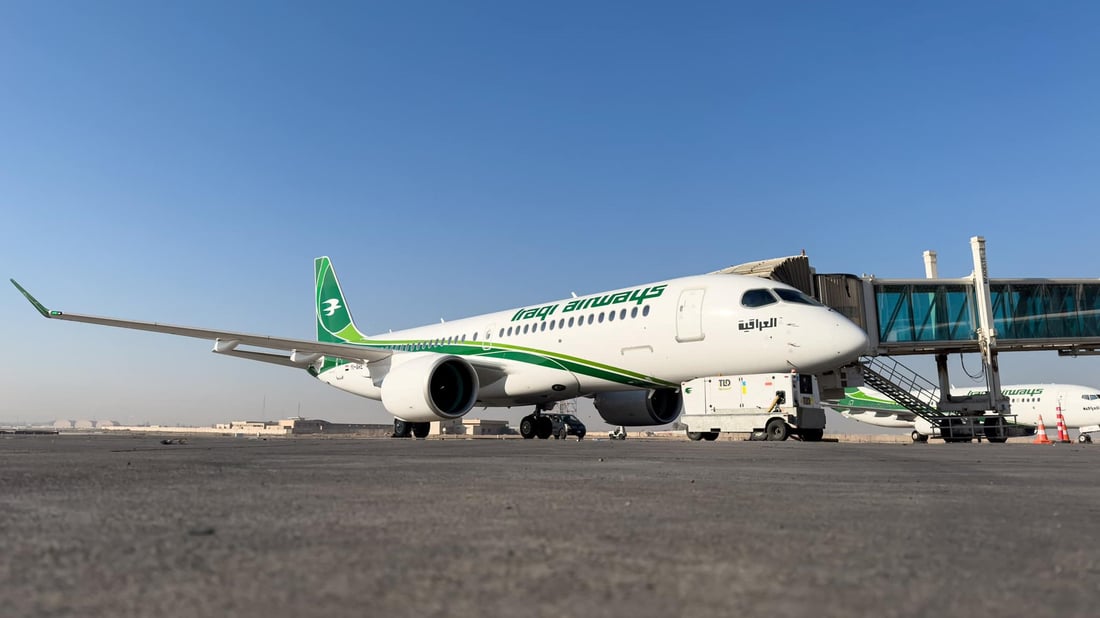
FILES: An Iraqi Airways aircraft is seen on the tarmac at an airport in Iraq, parked at a boarding gate during routine ground operations.
Iraqi Airways says Iran flights will restart in October
BAGHDAD — Iraqi Airways said Tuesday it will resume flights to and from Iran in October, starting from Najaf, under an exemption from U.S. sanctions, a day after the state news agency reported the service had already restarted. Iranian airlines remain unable to operate at Iraqi airports.
The exemption followed efforts and “direct guidance” from Prime Minister Ali al-Zaidi and follow-up by Transport Minister Wahab al-Hassani, the airline said, and staff were preparing aircraft and completing requirements. “The launch will be from Najaf International Airport after completing the necessary regulatory requirements,” it said, without giving a date. Iraqi Airways had stopped flying to Iran in early March as a precaution when the regional war began.
The Iraqi News Agency reported on Monday that Iraqi Airways had resumed flights between Najaf and Iranian airports. Government spokesperson Haider al-Aboudi said the same day that Zaidi’s talks with the Trump administration had secured permission for Iraqi Airways alone to carry passengers between the two countries, and reports on the talks said the exemption could initially run for 30 days. Iraq’s ambassador in Tehran said on Monday that Najaf would receive Iranian flights within 24 hours.
How the halt began is still disputed, and there are now four accounts. An official said on Sept. 23 that private ground-handling companies had stopped servicing Iranian aircraft for fear of sanctions, and another said the day before that the Foreign Ministry had told the Transport Ministry to halt support. When Najaf suspended all Iran flights on Friday, the airport cited “official directives from relevant authorities” and an airport source said the order came from the prime minister’s office. Aboudi said on Monday that “no decision was issued by the Iraqi government to ban Iranian aviation.”
The fourth came from Badr bloc lawmaker Hamed al-Mousawi, who said Najaf Governor Youssef Kanawi personally called the airport director and ordered him not to receive Iranian aircraft, without approval from the Transport Ministry or the prime minister. “The governor, with this decision, put us in a major crisis without permission from the Transport Ministry or the prime minister,” he told I News TV. The Transport Ministry had opposed a full suspension and asked the prime minister for a formal decision, he said, and when the Foreign Ministry instructed it to halt all Iranian flights and Iraqi Airways services to Iran, it refused and waited for the prime minister, who gave no such order. Mousawi also cited a Sept. 20 letter from the Civil Aviation Authority to the prime minister’s office on applying what he called an “economic outcast” policy to Iranian airlines, which he said referred to a Sept. 17 meeting at the authority with a U.S. Treasury representative and a U.S. government air transport official. 964media has not seen the documents. The governor has not responded.
The halt stranded dozens of Iraqis at Mashhad airport, many of whom had travelled for treatment, study or pilgrimage. Iraq’s ambassador in Tehran puts the number of Iraqi students in Iranian institutions at about 100,000, while Iran’s science minister gives more than 50,000 at universities. Najaf travel agencies said Iranian airlines accounted for about 90% of their business. Iran said its pilgrims were still reaching Iraq overland.
The political reaction has been loud. Asaib Ahl al-Haq leader Qais al-Khazali said Iraq was taking part in an “unjust blockade” of Iran, and its most senior office-holder, First Deputy Speaker Adnan Faihan, threatened an extraordinary session of parliament. A lawmaker from former Prime Minister Mohammed Shia al-Sudani’s bloc accused Zaidi of doing whatever Washington asks. Supporters of Iran protested in Basra and Kufa, Harakat al-Nujaba called a sit-in at Najaf airport, and a Kataib Hezbollah security official said the group could move to close Iraq’s crossings with neighbouring countries if restrictions on Iranian aviation continue after Oct. 1.
The U.S. Treasury sanctioned 27 Iranian airlines on Sept. 8, and Treasury Secretary Scott Bessent said they would be effectively shut out of international aviation from Sept. 23.