
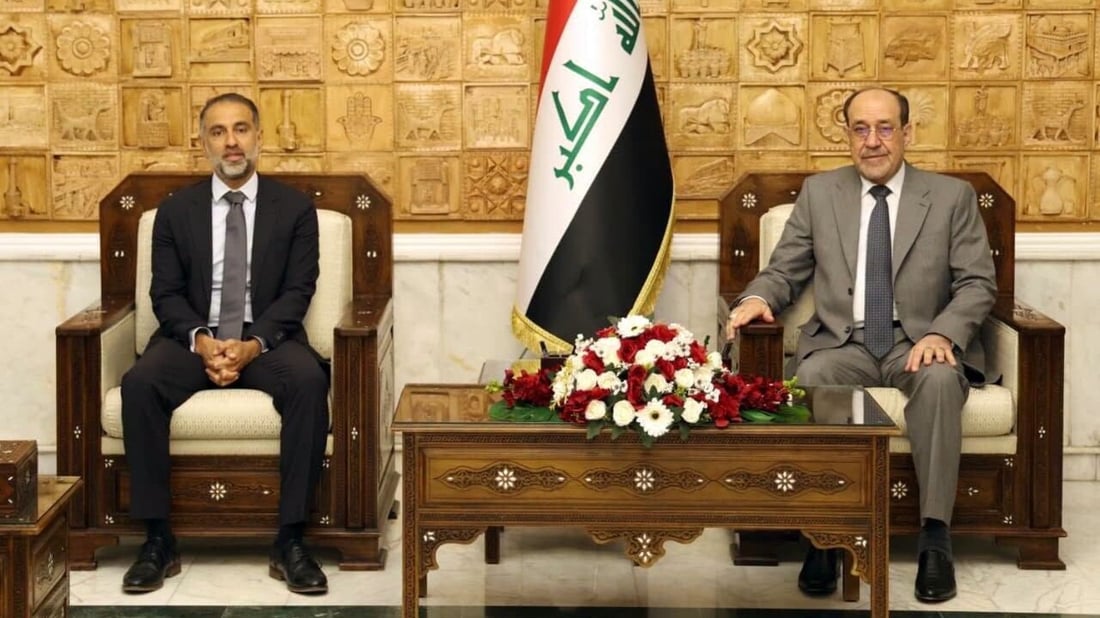
(Photo: Nouri Al-Maliki’s office.)
Maliki says whoever launched the Saudi attack will face the law
BAGHDAD — Nouri al-Maliki said anyone found responsible for the drone attack on Saudi Arabia launched from Iraqi territory would be held to account “regardless of the party standing behind it,” in a meeting with the British ambassador.
The investigative committee formed by Prime Minister Ali al-Zaidi is continuing its work and its findings are awaited, the State of Law leader told Irfan Siddiq, according to his office. The government had begun holding security commanders and officials accountable for shortcomings, he said, and “any party proven to be involved in the attacks will be held accountable under the law, regardless of the party standing behind it.” Iraq seeks good and balanced relations with all countries, respects their sovereignty and rejects anything that could threaten its neighbours or harm its regional and international relations, he said.
That is a firmer line than many other Shia political forces. The Badr parliamentary bloc accused the government of unjustified haste in accepting the Saudi account before technical investigations were complete, and the Islamic Resistance in Iraq denied involvement and said Baghdad was relying on no reliable evidence. Other political figures involved in the weapons talks say the factions were not responsible without agreeing who was.
Maliki said armed faction leaders had responded to the committee formed by the Coordination Framework, the first indication of a reply from the groups refusing to disarm, and called for a comprehensive and balanced approach soon. Security matters should be handled through state institutions and the law while avoiding confrontation or internal war between the government and the factions, he said, with domestic stability a national priority, and there was a willingness on all sides to keep weapons under state control through dialogue, understandings and guarantees.
The government has said the drones came from Maysan governorate, near the Iranian border. It closed three crossings with Iran, dismissed the Maysan Operations commander and later the police chief, and referred the governorate’s security agency heads for investigation. Saudi Arabia said it would hold off retaliating at Zaidi’s request.
Zaidi said in Washington in July that there would be no justification for armed factions after Sept. 30, when the coalition leaves. His security adviser Qasim al-Araji has since said the date marks the start of talks rather than a deadline, Maliki said this month that disarmament was no longer the term being used, and Harakat al-Nujaba said the Framework had dropped the call to restrict weapons to the state in favour of regulating them.