
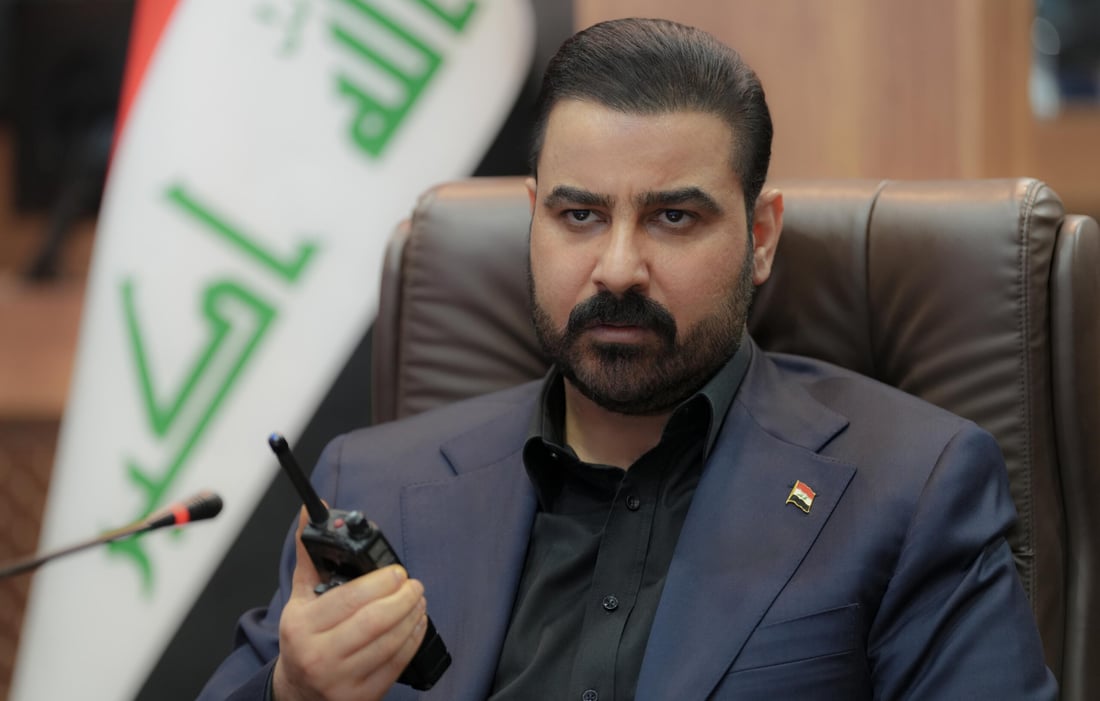
Iraqi Prime Minister Ali Al-Zaidi holds a handheld radio during a meeting,
Fallout spreads
Iraqi PM sacks Maysan security leadership after drones hit Saudi pipeline
BAGHDAD — Prime Minister Ali al-Zaidi dismissed Maysan’s police chief on Saturday and ordered the heads of all security agencies in the governorate removed from their posts and referred for investigation, a day after the government said the drones that struck a Saudi oil pipeline were launched from there.
Zaidi ordered “the dismissal of the Maysan governorate police chief from his position” and “the transfer of the directors of the security agencies in the governorate to administrative command and their referral for investigation,” said Sabah al-Numan, spokesperson for the commander-in-chief, citing recent security breaches in the governorate. It was Numan who said on Friday that the drones had been launched from Maysan, which borders Iran, after which Zaidi dismissed the commander of Maysan Operations and formed an investigative council to identify those responsible and pursue legal action.
The Islamic Resistance in Iraq denied responsibility, calling the accusations “an honor we do not claim” in a statement dated Sept. 12 and saying it was surprised by “the Iraqi government’s haste in adopting these claims without relying on reliable evidence or tangible investigations.” It offered to take part: “We declare our readiness to participate in any government investigative committee for the purpose of establishing the truth, instead of being drawn behind suspicious narratives.” The group said the accusations were diverting attention from Yemen, where it said Saudi forces had suffered successive defeats, and warned against “malicious Zionist-American schemes that seek to drag Iraq into crises that serve only its enemies.”
Saudi Arabia said several drones launched from Iraqi territory hit its East-West pipeline in the Riyadh and Medina regions on Friday, causing injuries and material damage. Riyadh said it would not retaliate at this stage after Zaidi asked for time to prevent further attacks, while retaining the right to take all necessary measures to protect its sovereignty, citizens and infrastructure. The Iraqi government condemned the attack and said Iraqi territory and airspace would not be allowed to serve as a launch point against other countries.
Baghdad closed the Shalamcheh, Shib and Mandali crossings with Iran, leaving dozens of families and travellers stranded at Shalamcheh in Basra, and kept Zurbatiyah and Mundhiriya open to passengers. Basra International Airport is operating normally, its director Ali Abdul Redha said, rejecting reports that flights had been suspended. The Gulf Cooperation Council called for firm measures to stop Iraqi territory being used against neighbouring states, and Foreign Minister Fuad Hussein spoke with his Saudi counterpart Prince Faisal bin Farhan, with both agreeing to maintain coordination.
Muqtada al-Sadr told his supporters not to be drawn into “provocation and sedition,” in a message relayed by his associate Saleh Mohammed al-Iraqi. “They want to cover their wrongdoing by dragging you into sedition, so do not be an aid to the corrupt or to those who want to undermine the safety of great Iraq,” it said. “Preserve your unity and your homeland, and leave them wandering blindly in their transgression.” The statement named nobody and did not mention the attack. In July he was explicit, blaming what he called rogue militias for giving other countries a pretext to strike Iraq and renewing his demand that weapons be restricted to the state.
Saudi Arabia struck Iraq the last time this happened. After Riyadh accused Iran-aligned Iraqi militias of drone attacks on its oil facilities in late July, U.S. and Saudi aircraft hit PMF sites across Baghdad, Wasit, Nineveh, Basra, Kirkuk, Karbala and Diyala on July 29, killing at least 20 members and wounding 32. The Islamic Resistance in Iraq denied responsibility then too, and the factions later postponed a planned response against Saudi Arabia and U.S. bases after an appeal from Badr Organization leader Hadi al-Amiri. Riyadh also said in May that it intercepted three drones entering its airspace from Iraq, after which Baghdad opened an investigation and said its own air defences had not detected them.
This article has been updated