
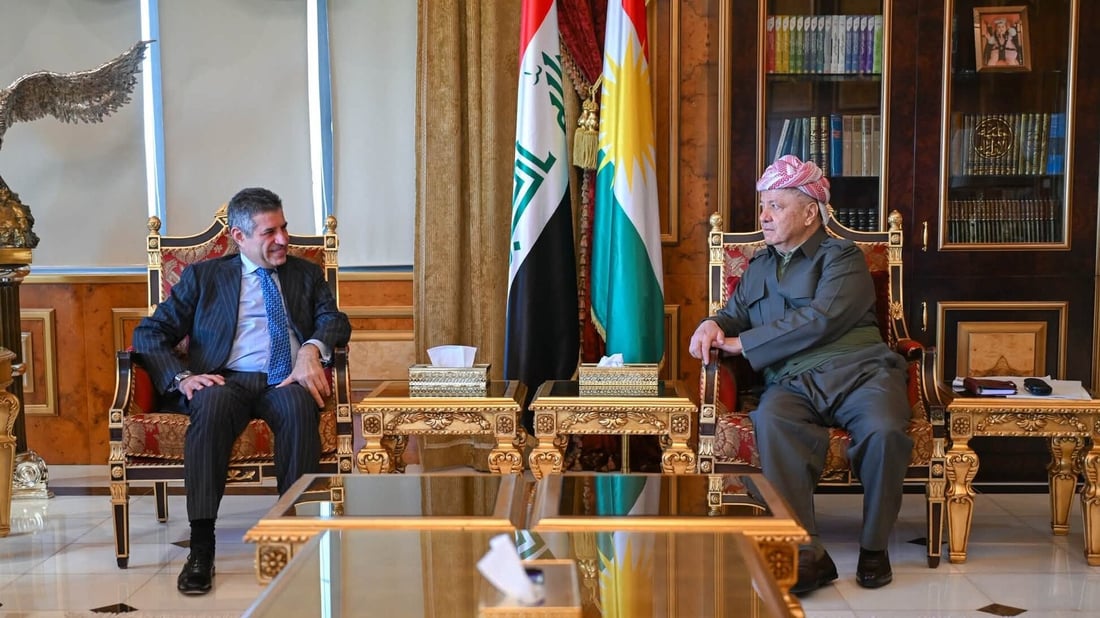
(Photo: Barzani Headquarters)
US envoy says Washington backs an Iraq with no arms outside state authority
ERBIL — The United States supports an Iraq in which militia forces are not armed outside the formal authority of the government, the American chargé d’affaires told Masoud Barzani, in the first explicit statement of Washington’s position since he returned to Baghdad this month.
Steven Fagin said this would provide an opportunity for political and economic stability, according to a statement from the Kurdistan Democratic Party leader’s office, which received him at Pirmam on Monday. A “threat to Iraq’s security is a threat to all sides,” he said, and Iraq and the Kurdistan Region could work together on it. He said the United States supports both in maintaining security, stability and the economy, and called for coordination to preserve Iraqi sovereignty and develop relations with regional countries and the international community.
The formulation restates the position Iraq took in July while Iraqi language has been shifting. Prime Minister Ali al-Zaidi told President Donald Trump at the White House on July 14 that there would be no justification for armed factions after Sept. 30. Since then his security adviser Qasim al-Araji has said the date marks the start of talks rather than a deadline, Nouri al-Maliki said this month that disarmament was no longer the term being used in favour of regulating or containing weapons, and Harakat al-Nujaba said the Coordination Framework had dropped the call to restrict weapons to the state during negotiations.
Barzani welcomed Fagin’s return and said the Region “will always be a factor for stability,” expressing support for the prime minister on stability, the constitution and confronting terrorism. On regional tensions he said: “Peace is always better than war, negotiations are better than confrontation, and understanding is better than disagreement and tension.” The Region “is always part of the solution and has not been part of the problems,” he said.
Fagin has met Foreign Minister Fuad Hussein, Zaidi and Supreme Judicial Council president Faiq Zaidan since taking over from Joshua Harris, a post he held before Harris arrived in September 2025. Zaidan told him the weapons programme would be carried out under a plan adopted by the Coordination Framework rather than by the government.