
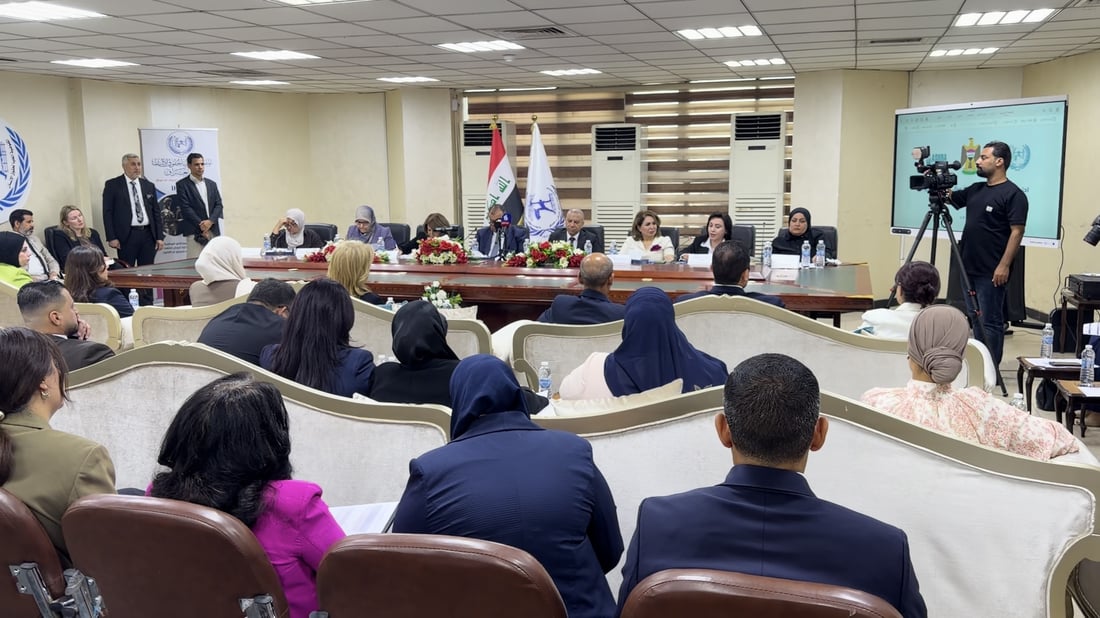
Participants attend a Baghdad meeting on reviving Iraq’s stalled domestic violence bill, Sept. 7, 2026. Photo by 964media.
Rights body pushes to revive domestic violence bill stalled six years
BAGHDAD — Iraq’s High Commission for Human Rights convened representatives of the three branches of government, state institutions and civil society on Monday to press for the resubmission of a domestic violence bill drafted in 2020 and never enacted, and to get it back onto parliament’s agenda.
Participants discussed what has kept the draft Protection from Domestic Violence Law from passing and said approval remains possible in the current parliamentary term. Resistance has partly come from concerns among some political parties that the legislation could create problems within families, said Amir al-Kinani, an adviser to the president, who said the bill instead sets up mechanisms to protect family members from abuse.
The framework would create government-run shelters under the Labor and Social Affairs Ministry, a Family Protection Directorate within the Interior Ministry and courts dedicated to domestic violence cases under the Supreme Judicial Council, with a government committee coordinating national policy. It is not limited to women and children but covers all family members, including elderly women and men, said Saad al-Abdali, an adviser to the commission. The Presidency prepared the draft and submitted it to parliament, and Monday’s meeting was meant to produce recommendations and an advocacy campaign to return it to the legislative agenda.
The draft, made public in August 2020, defines domestic violence as an act, omission or threat within the family causing physical or psychological harm, with family covering spouses, children and grandchildren, parents of either spouse, siblings, people under guardianship and others living under family care. Victims or their legal representatives could report to an investigative judge, prosecutors, the Family Protection Directorate or the commission, and public employees, medical and educational workers, social service providers and specialised organisations would be required to report suspected abuse, with the identity of the reporting person protected.
A judge could issue a protection order within 24 hours for up to 30 days, renewable, barring an alleged abuser from approaching or contacting a victim, allowing weapons to be seized, letting a victim retrieve belongings from the family home and requiring attendance at rehabilitation programmes. The Labor Ministry would have to establish safe centres in Baghdad and other governorates, and approved organisations could run shelters. The draft also directs judges to refer parties to social workers to seek a family settlement and allows proceedings to stop if victim and accused reconcile — a provision Human Rights Watch criticised in 2020, saying the emphasis on reconciliation could weaken protection and access to justice while acknowledging the bill’s provisions on services, shelters and protection orders.
Abdali said the commission has documented rising cases and instances where women, girls and children were displaced from their homes and exposed to further abuse. Lawmaker Duha al-Sudkhan said parliament could still pass the law this term, citing fasliya marriages, in which women are given in marriage to settle tribal disputes, reciprocal kissa bi-kissa marriages, sexual harassment and online blackmail as continuing concerns.
Recorded case numbers vary by source and are not comparable. The Strategic Center for Human Rights put registered cases at 14,000 in 2024, most involving physical abuse, with women 73% of reported victims, men 27% and minors about 6%. The Iraqi Observatory for Human Rights recorded 36,289 in 2025, including 19,587 of husbands assaulting wives, 5,918 of wives assaulting husbands and 1,841 of parents assaulting children, while cautioning that many victims never report because of stigma and inadequate legal protection.
Provision has been uneven where it exists. A fully equipped women’s shelter in Kirkuk had stood unused for two years by March 2025 for lack of staff. “The shelter has no employees, and the domestic violence law has not yet been passed in parliament,” said Entisar Karim, head of the governorate’s Women, Family and Child Affairs Department.
Federal Iraq still has no dedicated domestic violence law. The Kurdistan Region criminalised domestic violence in 2011, 15 years ago. The 2020 federal draft provides fines and possible imprisonment for breaching protection orders, and penalties for public employees who obstruct a complaint or fail to register one.