
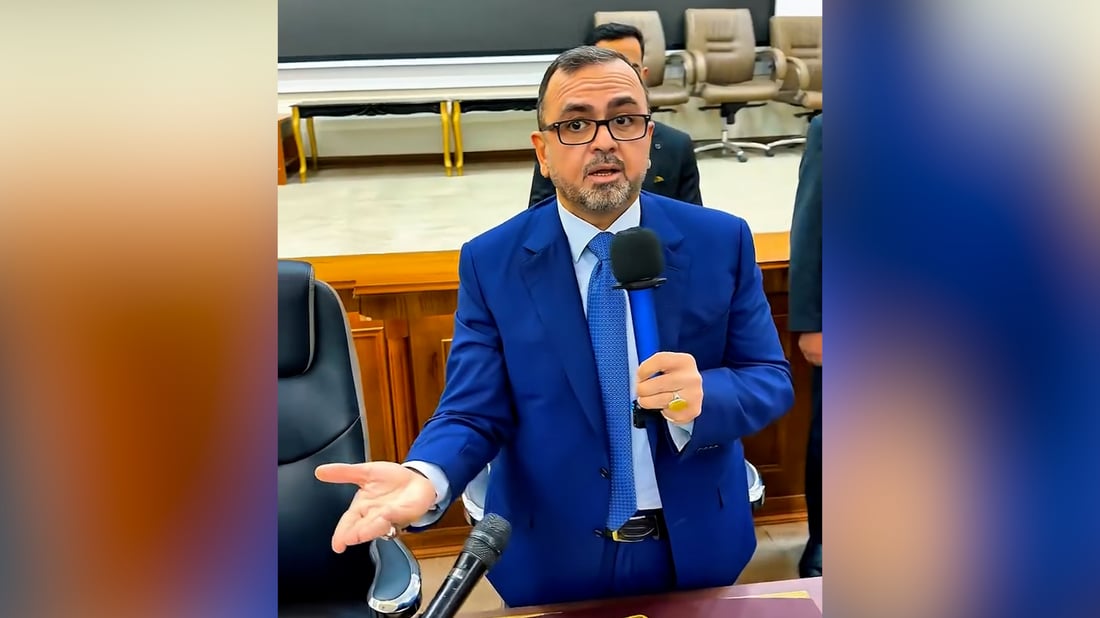
Photo caption: Iraqi Health Minister Abdul Hussein Al-Mousawi speaks in Baghdad after warning that the country’s financial crisis is disrupting medicine supplies and straining hospitals.
'There is no money'
Suppliers halt medicine deliveries as state drug importer gets 15% of usual funding
BAGHDAD — Suppliers have stopped delivering medicines already contracted for Iraq after the state drug importer received barely 15% of its allocated funding last month, Health Minister Abdul Hussein al-Mousawi said, warning that collapsing oil revenue has left the government unable to meet its obligations. “There is no money,” he said.
Mousawi told a meeting of senior Health Ministry officials that funding shortages had disrupted operations at the General Company for Marketing Drugs and Medical Appliances, known as Kimadia, which depends on government money to import medicines under supply contracts. He said no new pharmaceutical contracts had been signed in 2024 or 2025, leaving the company reliant on previously approved agreements. He described hospital infrastructure as deteriorating.
He said the government must find 10.8 trillion dinars a month for public-sector salaries, while oil export revenues over the past four or five months had not exceeded $1 billion to $1.5 billion. Mousawi used a parallel-market rate of about 1,500 dinars to the dollar in making the comparison; at the official rate the monthly salary bill is about $8.2 billion.
Oil Ministry figures support his revenue estimate. Iraq exported 32.1 million barrels of crude and condensates in May and June combined for about $2.34 billion, according to data from the state marketer SOMO — an average of roughly 526,000 barrels a day and about $1.17 billion a month, far below pre-conflict levels. On the minister’s own figures, oil revenue covers about 16% of the monthly salary bill.
Exports fell after the closure of the Strait of Hormuz cut shipments from Iraq’s southern terminals. Oil normally accounts for more than 90% of federal revenue, leaving public finances heavily exposed to any disruption.
Mousawi said the crisis should not be an excuse for inaction and that he was continuing to visit hospitals, private facilities and pharmacies in Baghdad and other governorates while pressing the government and the Finance Ministry. “I am personally concerned with putting pressure on the government, the Ministry of Finance, my staff and myself in order to create something out of nothing,” he said.
He also pointed to disparities in hospital spending, saying one hospital in central Baghdad ran efficiently on 45 million dinars a month through effective and honest management while another spent 2 billion to 2.5 billion dinars a month despite providing poor services.