
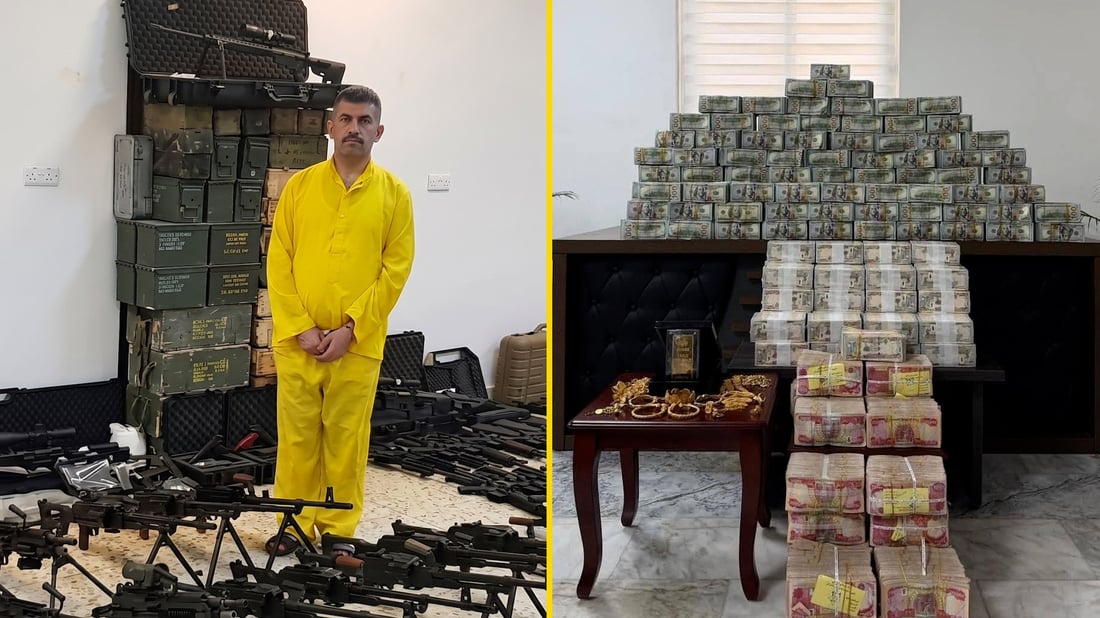
FILES: Adnan al-Jumaili under arrest, seized weapons, cash, and gold jewelry.
Court seizes another 27 billion dinars in oil ministry corruption case
BAGHDAD — Iraq’s Central Criminal Court for Combating Corruption said Sunday it had seized a further 27 billion dinars (about $20.5 million at the official rate) in the investigation into former Deputy Oil Minister for Refining Affairs Adnan al-Jumaili, recovering the money from Jumaili and several people connected to the case.
The judiciary’s media office said investigators traced the funds through what it called careful follow-up on financial proceeds from waste and irregularities in projects linked to Jumaili and others. “The amount was hidden with a number of individuals,” it said, adding that investigations continue to identify all those involved.
The seizure is the latest in the case. The Supreme Judicial Council announced 13 billion dinars (about $9.8 million), $400,000 in cash and 40 gold bars on Wednesday. Earlier in July, authorities said they had recovered 25 billion dinars (about $18.9 million), $200,000 and four kilograms of gold jewelry, and separately recovered 358 kilograms of gold with authorities in the Kurdistan Region plus another 17 kilograms in a separate operation, transferring 375 kilograms to the Central Bank of Iraq that day. All conversions are at the official rate.
Jumaili was dismissed in late May and arrested in Salah al-Din governorate over allegations of commissions and misuse of public funds through oil refining contracts. He headed the state-owned North Oil Company and North Refineries Company before becoming deputy minister.
The case sits within a broader anti-corruption campaign launched by Prime Minister Ali al-Zaidi’s government in late June that state media says has led to the arrest of dozens of current and former officials, lawmakers and political figures, described as the first phase of a wider effort against corruption networks.
The Supreme Judicial Council said earlier this month it was working with Zaidi on a legal framework that would prioritize recovering misappropriated state funds while allowing reduced legal measures for suspects who return money voluntarily. The council said it is not a blanket amnesty but an arrangement trading returned money and property for reduced penalties or release.
Zaidi told Wednesday’s Cabinet meeting that Coordination Framework leaders had pledged support for the campaign at a recent meeting, according to remarks published by his media office. He quoted them as saying: “We have no red lines or yellow lines before any corrupt person. Even if the corrupt individual is affiliated with us, we prefer that you begin with those around us if there are suspicions of corruption.” The Coordination Framework is the Shia alliance that forms the backbone of the governing coalition.