
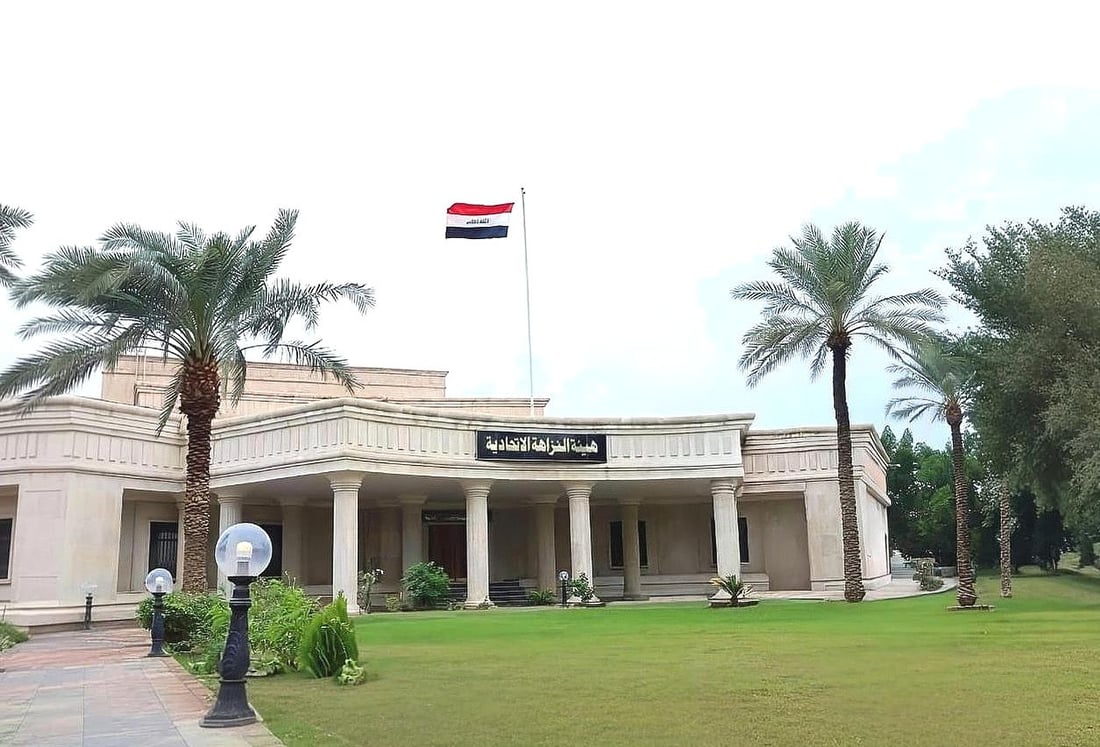
The headquarters of Iraq’s Federal Commission of Integrity in Baghdad.
Life sentence pending
Lebanon hands over former Wasit health employee convicted of embezzlement
BAGHDAD — Iraq has secured the extradition from Lebanon of a former Wasit Health Directorate employee sentenced in absentia to life in prison for taking part in the embezzlement of nearly 3.8 billion dinars ($2.86 million), the Federal Commission of Integrity said.
The commission said its Recovery Department prepared Alia Hassouni’s extradition file and submitted it to Lebanese authorities through official channels. Coordination between Lebanese and Iraqi authorities led to her arrest and transfer to Iraq through the Interior Ministry’s Arab and International Police Directorate, Iraq’s liaison office with Interpol.
According to the commission, Hassouni took part while working at the directorate in the embezzlement of 2.855 billion dinars ($2.16 million) in one case and 923.7 million dinars (about $700,000) in another, a combined 3.779 billion dinars.
The First Criminal Panel of the Wasit Criminal Court convicted her after reviewing testimony from the directorate’s legal representative and witnesses, the findings of an administrative investigation, other case records and what the court considered evidence arising from her flight.
She was sentenced to life imprisonment under Article 315 of the Iraqi Penal Code, as amended, along with Articles 47, 48 and 49 on participation in crimes. The court ordered her to repay the full amount to the Wasit Health Directorate and granted the directorate the right to seek compensation once the ruling becomes final.
The commission said the extradition followed international pursuit and coordination involving the Arab and International Police Directorate, judicial authorities, the Public Prosecution Service and the Iraqi Embassy in Lebanon.
The commission has stepped up efforts to pursue corruption suspects and public funds abroad. In December 2025, it said it had recovered more than $17.4 million in corruption proceeds through cooperation with foreign authorities and had expanded its access to Interpol databases and international financial-tracking systems.
It said in July that extradition and asset-recovery efforts still face obstacles because some countries decline Iraqi requests for legal, economic or humanitarian reasons. Last week, Iraq’s Fund for Assets Recovery said it had recovered $13 million in state funds held abroad and returned the money to the treasury.