
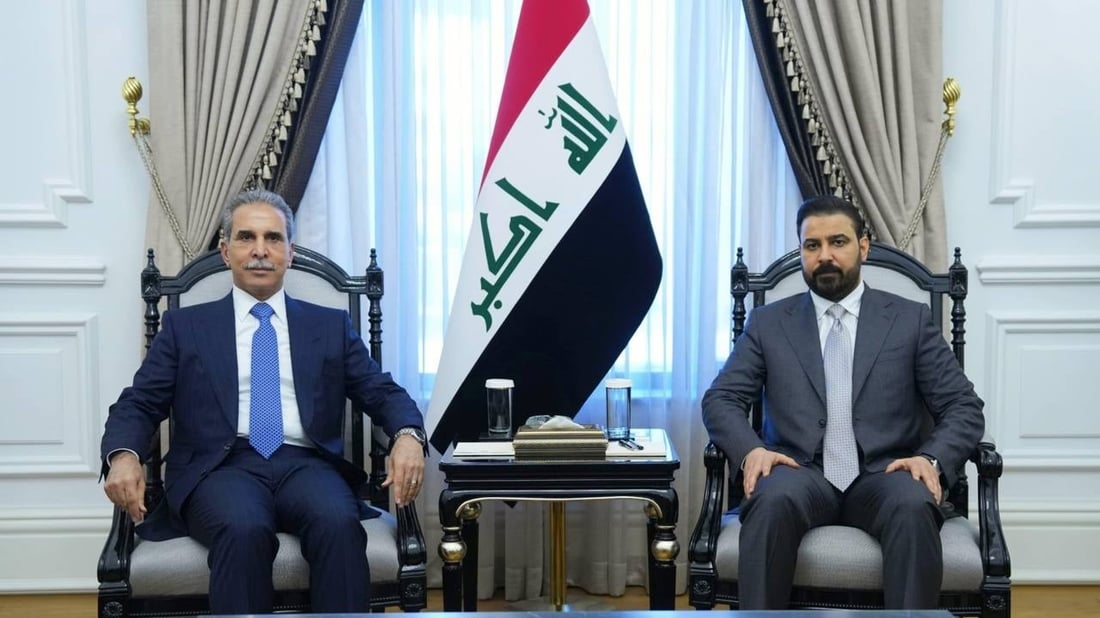
FILES: Prime Minister Ali Al-Zaidi (right) meets with Supreme Judicial Council President Faiq Zidan in Baghdad.
Judiciary and PM Zaidi weigh recovery-for-leniency deals in graft cases
BAGHDAD — Iraq’s Supreme Judicial Council said Friday it is working with Prime Minister Ali al-Zaidi to build a legal framework that would prioritize recovering misappropriated state funds while allowing reduced legal measures for corruption suspects who voluntarily return the money.
Consultations between Zaidi and Supreme Judicial Council President Faiq Zaidan are being translated into a roadmap targeting detainees in the June 28 anti-corruption operation, including detained Deputy Oil Minister Adnan al-Jumaili and several current and former members of parliament and government.
The council said the plan is not a blanket amnesty but a legal arrangement being developed jointly by the executive and judicial authorities, under which suspects would voluntarily return money and property in exchange for reduced penalties or release.
The council said the approach relies on provisions in the amended General Amnesty Law and extends the method used in the tax-deposits case of businessman Nur Zuheir, known publicly as the “Theft of the Century.” Although Zuheir later left Iraq and was sentenced in absentia to 10 years in prison, the judiciary said the approach recovered 365 billion dinars (about $277 million at the official rate) in cash along with confiscated property inside and outside Iraq.
The case, which involves the embezzlement of tax-deposit funds from the General Commission for Taxes, emerged publicly in 2022. In November 2024, the Karkh Criminal Court sentenced main defendant Zuheir to 10 years, Raed Jouhi, former head of the office of ex-Prime Minister Mustafa al-Kadhimi, to six years, and former parliamentary finance committee head Haitham al-Jubouri to three years.
The council said that through the courts specializing in corruption cases it seeks two linked objectives: holding perpetrators accountable and recovering state funds, the latter “by reducing legal measures or the penalties imposed on defendants,” within constitutional and legal limits. It said this began with the Zuheir tax-deposits case.
Foreign companies operating in Iraq deposit guarantees equivalent to 5% of a project’s value with the General Commission for Taxes to ensure completion, and may withdraw the sum within five years of finishing the work. The council said intermediary companies, including Zuheir’s al-Qanit and al-Mubdioun, used “improper procedures” to withdraw these deposits, prompting legal action against the owners and the employees who assisted them.
The judiciary said an agreement was reached between Zaidan and former Prime Minister Mohammed Shia al-Sudani, with the approval of the investigating judge, to release Zuheir on bail guaranteeing repayment in installments in exchange for a reduced sentence.
“An amount of 365 billion Iraqi dinars was recovered out of the total amount owed by his two companies, al-Qanit and al-Mubdioun, amounting to 1,618,370,882,000 IQD,” the statement said, adding that this represented part of a total of about 3.83 trillion dinars withdrawn from Rafidain Bank by all the companies involved. The recovered sum amounts to roughly a fifth of that total.
Zuheir later left Iraq and repayment stopped. He was referred to the Central Anti-Corruption Criminal Court, sentenced to 10 years in absentia, and an extradition file was prepared with international police contacted to secure his return.
After the amended General Amnesty Law took effect, Zuheir’s lawyer asked for his client to be included under it in exchange for completing repayment. The council said the Finance Ministry was asked for its opinion, since the minister’s approval is required on the repayment mechanism, and that no response had been received, leaving the request pending.
The judiciary said 12 employees of the General Commission for Taxes were imprisoned for helping Zuheir withdraw the funds through improper procedures and are serving their terms, though they too “may be covered” by the amnesty law after paying compensation set by the Finance Ministry.
On the North Refineries Company case involving al-Jumaili and several current and former members of parliament, the judiciary said the same approach would apply if the offenses were committed before the amnesty law took effect and the owed amounts are repaid to the affected ministry. If the crimes came afterward, it said, the defendants fall outside the amnesty law and face different procedures, which is why discussions with the prime minister are underway to build a roadmap “to achieve the two objectives referred to above: recovering state funds in exchange for reducing legal measures against those who voluntarily return those funds.”
The statement comes after Iraq’s Central Criminal Court for Combating Corruption seized an additional 14 billion dinars (about $10.6 million at the official rate) in the case against al-Jumaili, with investigators saying the cash was concealed inside a pit built for rainwater drainage. Earlier searches uncovered more than $121 million in cash that authorities said had been stored in plastic water bottles buried at Jumaili’s home in Tikrit.
Jumaili served as deputy oil minister for refining affairs after previously leading North Oil Company and North Refineries Company. He was dismissed in late May and arrested in Salah al-Din governorate on allegations of receiving large commissions and wasting public funds through oil refining contracts.
The case has expanded quickly since Jumaili’s detention over alleged financial irregularities in the oil sector. Security sources familiar with the investigation have said interviews with Jumaili produced more than 100 names, though not all face arrest warrants or proceedings. The inquiry also formed the basis for “Dawn Strike,” the operation inside Baghdad’s Green Zone in which Counter Terrorism Service units and army forces carried out coordinated raids on current and former officials. Zaidi has described the campaign as the first phase of a broader effort.