
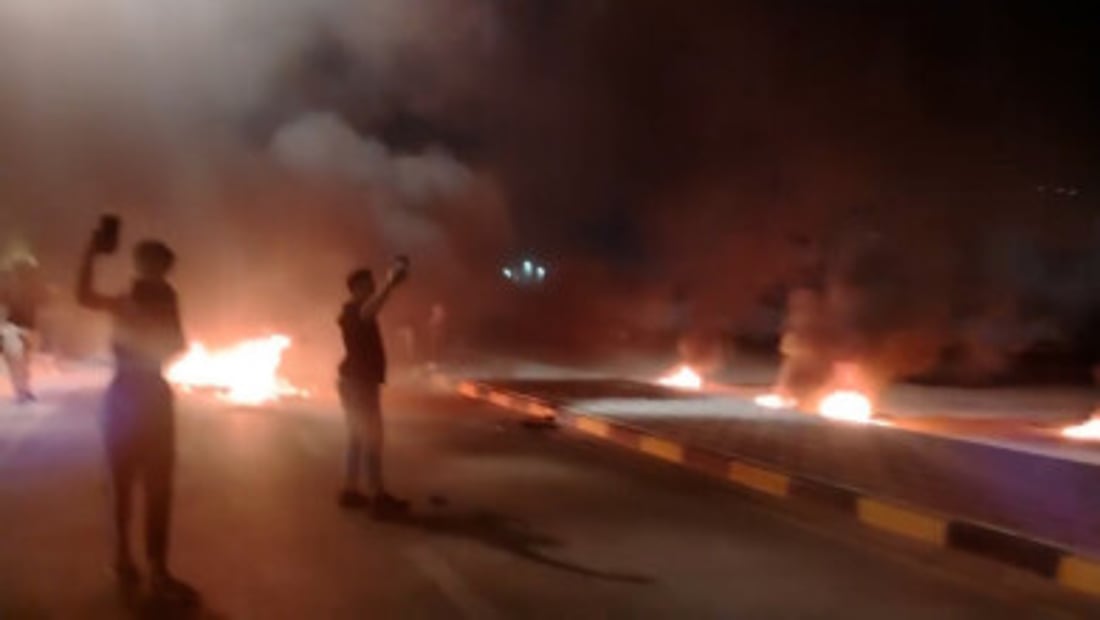
Protesters set fire to tires outside the Najaf Governorate headquarters during a demonstration over electricity shortages on July 21, 2026. (Photo: 964media)
Five injured as riot police disperse Najaf electricity protest
NAJAF — Five protesters were injured Tuesday night after riot police dispersed a demonstration outside the Najaf Governorate headquarters over worsening electricity supply, according to participants.
The protest escalated after demonstrators set fire to tires around the building, and riot police moved in to clear the crowd, protesters told 964media. They called on the federal and local governments to increase Najaf’s electricity allocation as supply hours decline.
Demonstrations over power shortages have spread across Iraq this month. On July 19, hundreds of residents from Najaf city and surrounding districts protested what they described as unequal distribution between areas and demanded a larger share for the governorate, blocking the Najaf-Kufa road in both directions before marching to the Governorate Council and the governorate headquarters. Residents in Fadhliya, Dhi Qar governorate, protested Saturday over repeated outages.
Iraq has faced chronic electricity shortages for decades, with demand peaking in summer as temperatures frequently exceed 50°C. Many households rely on private neighborhood generators to fill the gaps.
The Electricity Ministry apologized to the public on Sunday as supply hours fell nationwide, blaming reduced gas supplies linked to the regional conflict, rising summer demand, aging infrastructure and insufficient funding. The same day, a group of lawmakers moved to summon the electricity and oil ministers to review the state of the grid and the government’s response, also urging expanded investment in Iraq’s associated gas, still widely flared at oil fields, to fuel power stations domestically. The parliamentary presidency later approved the request to host the electricity minister.
Iraq relies on Iran for roughly one-third to 40% of the gas it uses to generate electricity. After attacks on Iran’s South Pars field earlier this year, deliveries fell sharply, forcing some stations onto alternative fuels, and in May the ministry said supply hours had declined across several governorates as imports fell and domestic output dropped.
In April, officials said they aimed to produce about 30,000 megawatts over the summer against expected peak demand of 55,000 to 60,000 MW, guaranteeing scheduled outages even if every available unit ran as planned. Current production is about 21,000 MW, according to the Electricity Ministry’s National Control Center. Nearly 60% of what Iraq generates never reaches consumers because of transmission and distribution losses, former ministry spokesperson Ahmed Mousa al-Abadi said this week, putting summer requirements at about 62,000 MW and arguing that repairing distribution should be the government’s first priority.