
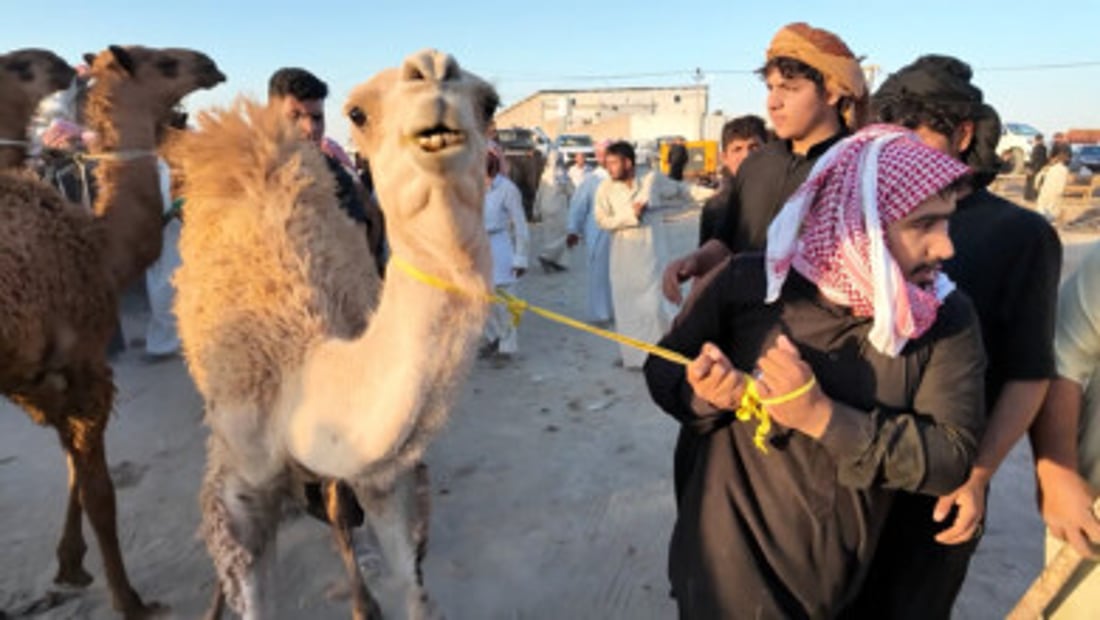
Camel prices climb at Najaf livestock market during Muharram
NAJAF — Activity has picked up at the livestock market in Najaf as demand for camels and other animals rises during Muharram, when Shiite processions buy livestock for meals served to pilgrims and visitors.
The camel auction, south of the Bahr al-Najaf area, is held every Monday and Thursday and draws traders from across Iraq. Vendors say Muharram demand has pushed prices for some camels as high as 5 million dinars (about $3,270 at the parallel rate).
Mustafa Jariou, manager of the Najaf Livestock Market, told 964media the auction draws buyers and sellers from most governorates. “Demand for livestock increases during Muharram because owners of Hussaini processions purchase animals for vows and cooking,” he said. “Camel prices start at around one million dinars and increase depending on weight, size and other characteristics.” One million dinars is about $650 at the parallel rate.
Muharram is the first month of the Islamic lunar calendar and holds particular significance for Shiite Muslims because it commemorates Imam Hussein, the grandson of the Prophet Muhammad, who was killed at the Battle of Karbala in 680. The 10th day, known as Ashura, is the focal point of mourning ceremonies. Jariou said the market receives traders from western, southern and central Iraq and has become one of the country’s largest camel markets.
Rasoul Taher, a camel trader from Maysan, said he brings animals from Amarah to Najaf because demand is stronger there. “We face difficulty selling camels in our governorate because demand for camel meat is lower,” he said.
Faisal al-Salami, a camel seller from the Najaf desert, said he takes part in the auction once a year and that prices vary with the size of the animals, some selling for more than 2 million dinars (about $1,310).
Butcher Yahya al-Rumahi, who has worked in the trade for about 30 years, said camel prices fluctuate with size and condition. “Large camels can sell for more than 3 million dinars,” he said, or about $1,960, adding that profit and loss depend on market activity. Demand for camel meat rises during religious seasons, increasing trade at the auction, he said.
Abbas Mohi, one of the market owners, said the livestock on offer are healthy and disease-free, and that bidding starts at reasonable prices before rising with demand.
Saleh Younis, a camel trader from Wasit, said traders struggle to move camels between governorates because authorities often do not issue permits for camel transport.