
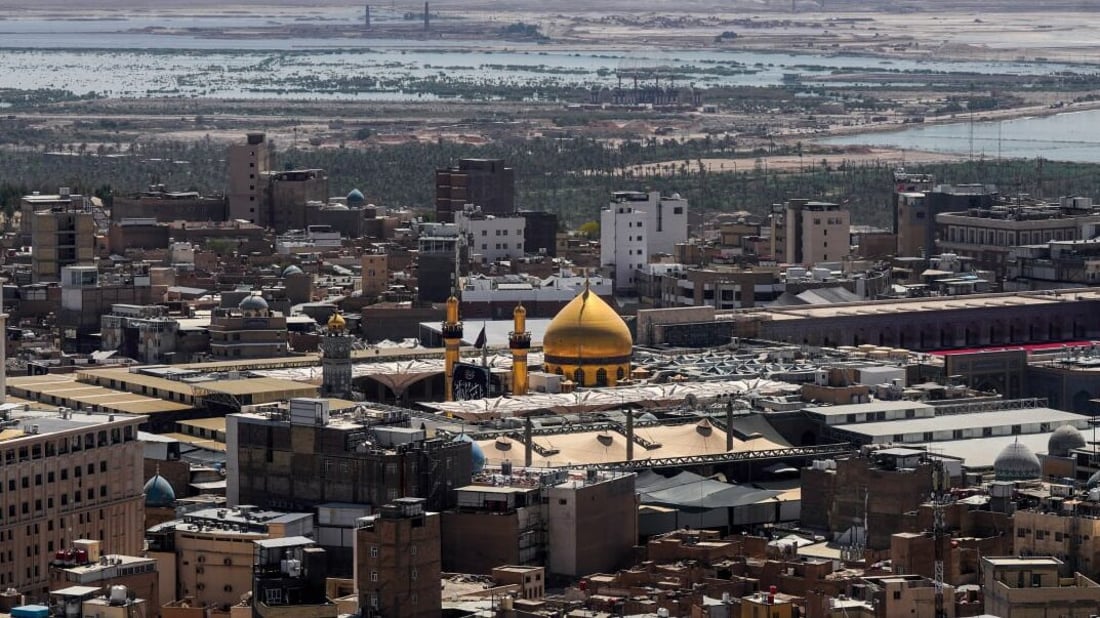
A view of Najaf city
Najaf moves to curb Euphrates pollution as sewage outpaces treatment capacity
NAJAF — Najaf authorities have announced measures to address wastewater treatment shortfalls and reduce pollution in the Euphrates, with officials saying new plants are planned to expand capacity and limit the discharge of untreated sewage.
Pollution of the Euphrates remains one of the governorate’s main environmental challenges, amid continued sewage discharges and rising loads on networks and treatment facilities. Nizar Abd Abbas, head of wastewater projects at the Najaf Sewerage Directorate, told the Iraqi News Agency that the directorate struggles to treat wastewater because of limited funding and treatment capacity that has not kept pace with urban expansion. He said its five plants in Najaf and Kufa have a combined design capacity of about 85,000 cubic meters per day, but incoming volumes exceed that.
Abd Abbas said high concentrations of sulfates and other pollutants contaminate water discharged into the Euphrates and drainage channels, attributing part of the problem to hospitals, hotels, restaurants and vehicle-washing workshops connected to networks without preliminary treatment. He said the directorate has closed northern and southern transmission lines that previously discharged near the river and redirected flows to plants in the Bahr and Barakiya areas, with the Bahr plant now operating. Further plants are planned in Najaf, Kufa and surrounding districts to end the discharge of untreated wastewater into rivers and canals. A lasting solution, he said, requires more funding, mandatory treatment units for hospitals and commercial facilities, and stronger oversight.
Jamal Abd Zaid, director of Najaf’s Environment Directorate, said untreated or partially treated sewage is among the main causes of pollution in the Euphrates and other waterways, with networks expanding in recent years without corresponding investment in treatment. He called for federal and local cooperation to accelerate new plants, and said the directorate has fined those responsible for discharges but that a lasting fix depends on upgrading infrastructure. Higher water levels in recent months have eased the impact through greater dilution, he said, but that is no permanent solution given ongoing water scarcity.
In late April, Iraq’s Environment Ministry called for sewage treatment plants in all cities as a condition for protecting the Tigris and Euphrates, saying more than two billion cubic meters of wastewater could be recovered annually with proper infrastructure.