
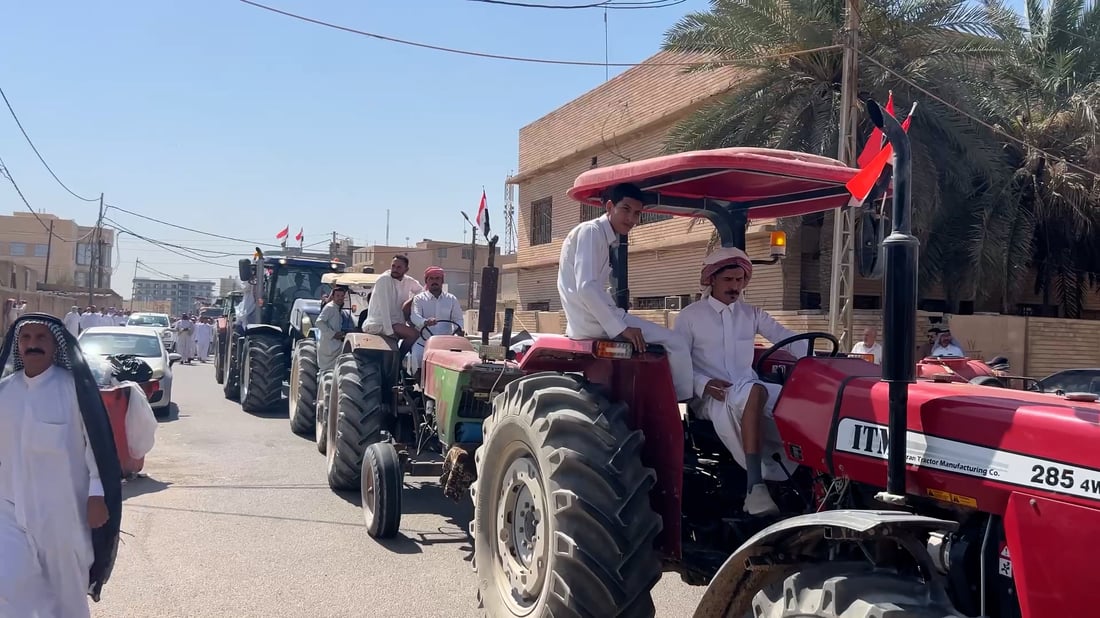
Farmers drive tractors during a protest in Kut, Wasit governorate, on June 14, 2026, demanding higher wheat procurement prices, payment of overdue government dues and relief from agricultural loan obligations as demonstrations spread across central and southern Iraq.
Iraqi farmers renew wheat price protests in Muthanna and Wasit
MUTHANNA/WASIT — Farmers in Muthanna and Wasit governorates renewed protests Sunday over lower wheat procurement prices, delayed government payments and mounting agricultural debts, reigniting a dispute that has spread across Iraq’s main grain-producing regions despite a strong harvest and government efforts to boost domestic production.
Dozens of farmers gathered outside the Muthanna governorate administration building in Samawa, arriving on tractors and other agricultural vehicles. Similar protests were reported in Kut, the center of Wasit, where demonstrators erected sit-in tents and warned of escalation after the expiry of a 48-hour deadline they had given the government.
The protesters want the procurement price restored to 850,000 dinars ($556) per ton from the current 700,000 dinars ($458), overdue payments for delivered crops released, and relief from agricultural loans and equipment installments. “Our demands focus on restoring the price to 850,000 dinars per ton, as we were surprised by its reduction to 700,000 dinars when the harvest began,” farmer Murad Salem told 964media. “The 150,000-dinar ($98) difference represents our only profit margin, from which we pay traders for fertilizers and equipment.”
Salem said many farmers were struggling with equipment programs. “We received agricultural sprayers priced between 50 million and 60 million dinars ($32,680-$39,216), while their actual market value does not exceed 20 million dinars ($13,072), and we are required to pay annual installments of up to 4 million dinars ($2,614),” he said. “The sit-in will remain open until the demands are met, and the next step will be heading to Baghdad and the Green Zone.”
Farmer Faleh al-Toubi said the government had announced a plan based on 850,000 dinars then retreated to 700,000 after the harvest, “which is a major injustice that requires an immediate solution through restoring the previous price, paying the dues, and postponing agricultural loans.”
The demonstrations follow a June 8 gathering of farmer representatives near Baghdad’s Jumhuriya Bridge, where they threatened broader protests across central and southern Iraq. Protest leaders described a mediation proposal from a representative of Prime Minister Ali al-Zaidi as their final chance to resolve the dispute through dialogue.
In both governorates, protesters invoked the symbolism of the agal, a traditional tribal headpiece that has become associated with the farmers’ movement since demonstrations earlier this year. Videos circulated Sunday from Kut showing a tribal elder losing his agal during unrest, prompting solidarity from farmers elsewhere. Wasit police rejected claims that security forces were responsible, saying the man fell amid jostling among protesters erecting a tent and that there was no confrontation with security personnel.
As officials sought to contain the dispute, Nawaf Abu Rukayya, a representative of Muthanna farmers, announced an agreement with the local government to form a joint delegation of farmers and officials to meet al-Zaidi in Baghdad. He said the agreement also included efforts to postpone loan collection and suspend sprayer installment demands until the federal budget is approved, with farmers giving the government 10 days to act before considering further escalation.
The dispute began in early May, when hundreds of farmers from Najaf, Diwaniyah, Muthanna, Karbala and Babil gathered in Baghdad over procurement policies and delayed payments. An altercation during those demonstrations led to the loss of a tribal elder’s agal, an incident that became a rallying symbol widely referred to locally as the “Agal Revolution.”
The government has procured 3.194 million tons of wheat so far this season against a target of about 5 million tons, paying 700,000 dinars per ton for wheat within approved agricultural plans and 500,000 dinars ($327) for quantities outside them, compared with 850,000 dinars last season. Farmers argue the reduction came as production costs stayed high and after many had committed to planting decisions, and have complained that limits on accepted quantities leave part of their harvest outside the higher-priced system.
In Ain al-Tamr, west of Karbala, officials recently said wheat yields ranged between 1,300 and 1,500 kilograms per dunam while the government acceptance limit remained 900 kilograms. In Anbar, authorities reported a strong harvest after raising the accepted quantity to 1,200 kilograms per dunam, receiving 306,000 tons by the end of May and expecting production to exceed last season’s on favorable rainfall.
The government has continued to emphasize support for domestic production. On Saturday, the Council of Ministers approved restrictions on wheat imports until the end of the marketing season, saying the measure would protect local farmers, while procurement continues in northern and western governorates and across the Kurdistan Region.