
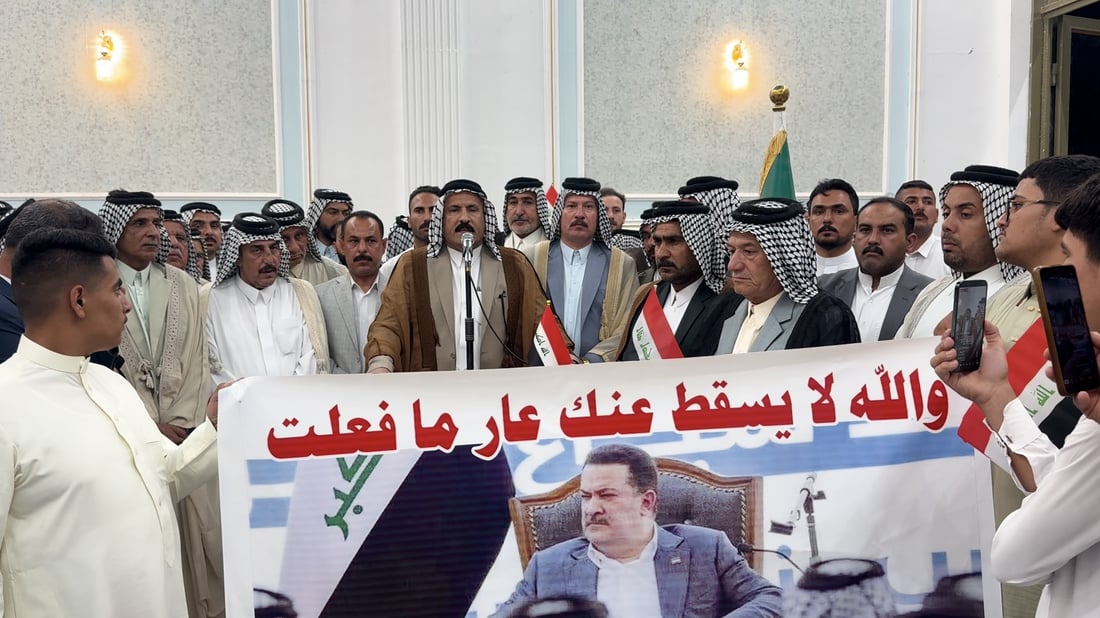
Farmers reject Sudani apology, demand new administration answer for Green Zone clashes
NAJAF — Representatives of farmers from five central and southern governorates rejected Saturday an apology delivered on behalf of outgoing Prime Minister Mohammed Shia al-Sudani over clashes between security forces and protesters outside Baghdad’s Green Zone earlier this month, calling on Prime Minister-designate Ali al-Zaidi to issue a formal apology and announcing that large demonstrations would resume Sunday.
The farmers gathered at a conference in Mishkhab district of Najaf governorate and said the caretaker government had sent “a delegation and well-known figures” from Baghdad to apologize during a meeting at the Palace of Culture, but representatives refused the gesture.
“We rejected the apology,” Moeen al-Fatlawi, a representative of Najaf farmers, told 964media. He said farmers want an apology from the incoming government accompanied by a parliamentary delegation “to express regret to the farmers who are still in hospital after the attacks during the May 3 demonstrations.” They also called for Interior Minister Abdul Amir al-Shammari to be held accountable over what they described as assaults on protesters, including the removal of a traditional tribal headband from one of the sheikhs present at the protest.
The headband became a focal point of anger. “The tribal headband fell not in humiliation but in dignity, just as it fell during the 1920 Revolution,” Fatlawi said. Farmer Abu Mustafa al-Ulayawi addressed Sudani directly: “The tribal headband is what built the Iraqi state. This is his father’s and grandfather’s tribal headband. You are leaving now, your fire remains.”
Beyond the apology, farmers presented a list of eight demands: cancelling the 2026 wheat pricing policy, paying 2025 dues without delay, securing marketing funds for the current season, compensating rice farmers for 2023 losses, covering damages caused by floods and accidents, including non-contracted farmland in the marketing plan, increasing agricultural yield allocations and postponing loan repayments and legal claims.
On pricing, Imad al-Badiri, deputy head of the General Union of Farmers, told 964media that the current wheat purchase price “does not serve the Iraqi farmer.” He said the state currently buys wheat for 700,000 dinars ($461) per ton within the agricultural plan and 500,000 dinars ($329) outside it, down from 950,000 dinars ($625) per ton last season. Fatlawi said farmers are demanding prices be restored to last year’s levels — 850,000 dinars ($559) per ton for modern irrigation systems and 800,000 dinars ($526) for clay-soil areas. Badiri noted that fertilizer costs have risen sharply this season, with urea reaching 1.1 million dinars ($724) per unit and DAP fertilizer 1.85 million dinars ($1,217).
Hundreds of farmers from Najaf, Diwaniyah, Samawah, Karbala and Babil traveled to Baghdad on May 3 to protest delayed payments and wheat pricing policies. Security forces used water cannons to stop demonstrators from crossing Al-Jumhuriya Bridge toward the Green Zone, injuring several. Following the clashes, Sudani ordered an investigation into the conduct of security forces and pledged to ensure full payment of farmers’ dues while maintaining Iraqi wheat procurement prices above global market rates. Parliament had also passed decisions in April requiring the government to pay farmers’ dues for last season’s wheat crop and suspend loan collections until the federal budget is approved.
Iraq’s wheat sector depends on a state purchasing system that sets fixed prices to support domestic production and food security. Delays in payments and pricing disputes have repeatedly triggered tensions between farmers and authorities, particularly in central and southern governorates where agriculture remains a primary source of income.