
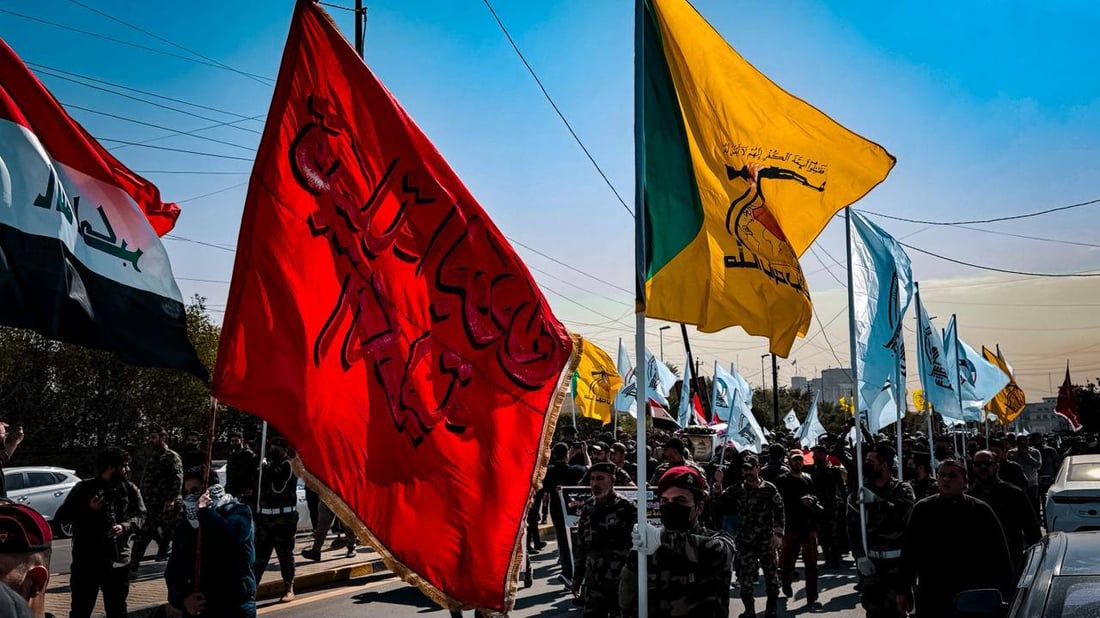
FILES: Supporters of Kataib Hezbollah carry the group's flags alongside the Iraqi national flag during a procession.
Armed factions
Kataib Hezbollah offers to buy and store weapons from groups joining state
BAGHDAD — Kataib Hezbollah said Saturday it is ‘prepared’ to take possession of specialized weapons from armed groups that choose to relinquish their arsenals to the state, offering to pay for equipment including drones and anti-armor missiles.
In a statement issued by the group’s security official, Abu Mujahid al-Assaf, Kataib Hezbollah welcomed what it described as steps by factions “outside the Islamic Resistance” framework to limit weapons to state control. “We are ready to receive some specialized weapons for which there are no experts within state institutions, such as drones, suicide drones, cruise missiles and anti-armor missiles,” al-Assaf said. “We are also prepared to pay for them.”
The group said it was willing to facilitate “coordination” between such groups and the PMF leadership, including “supervising the inventory, transfer and storage of weapons in a safe manner.” “We welcome every step taken by brothers not involved in the Islamic Resistance that aims to restrict weapons to the hands of the state, enhances security, stability and civil peace,” the statement said.
The announcement follows Shiite National Movement leader Muqtada al-Sadr’s decision to separate Saraya al-Salam, the armed faction affiliated with his movement, from his movement and integrate it into state institutions. Al-Sadr announced the move Wednesday, with Saraya al-Salam to come under the authority of the Iraqi state and the commander-in-chief of the armed forces. The faction was formed in 2014 following the rise of Islamic State and is officially part of the PMF. Sadr and his movement have not participated in Iraqi elections since 2022, when Sadrist lawmakers resigned en masse following a prolonged political deadlock over government formation, allowing rivals within the Coordination Framework to fill the vacant seats.
Earlier this month al-Sadr called on Prime Minister Ali al-Zaidi to reorganize armed factions under state-controlled structures and exclude parties with armed wings from the cabinet. Former Prime Minister Haider al-Abadi separately advised Zaidi against direct confrontation with factions, urging political dialogue and diplomatic mechanisms instead.
Kataib Hezbollah is one of the most powerful Iran-backed militias in Iraq and a key component of the Islamic Resistance in Iraq, and has been repeatedly linked to attacks on US and coalition targets. The US State Department’s Rewards for Justice program has offered rewards of up to $10 million each for information on three faction leaders: Harakat al-Nujaba founder Akram al-Kaabi, Kataib Hezbollah leader Ahmad al-Hamidawi and Kataib Sayyid al-Shuhada secretary-general Abu Ala al-Walaei.
Since the regional war began in late February, Iran-aligned factions under the Islamic Resistance in Iraq umbrella have carried out repeated drone, rocket and missile attacks on US military and diplomatic targets in Baghdad and the Kurdistan Region. The United States has simultaneously struck PMF-linked positions across multiple governorates, killing dozens of fighters. Earlier this month, US federal prosecutors announced that an Iraqi national accused of working with Kataib Hezbollah and Iran’s Islamic Revolutionary Guard Corps had been arrested and charged with terrorism-related offenses linked to attacks in Europe and alleged plots targeting US interests, including in New York City.