
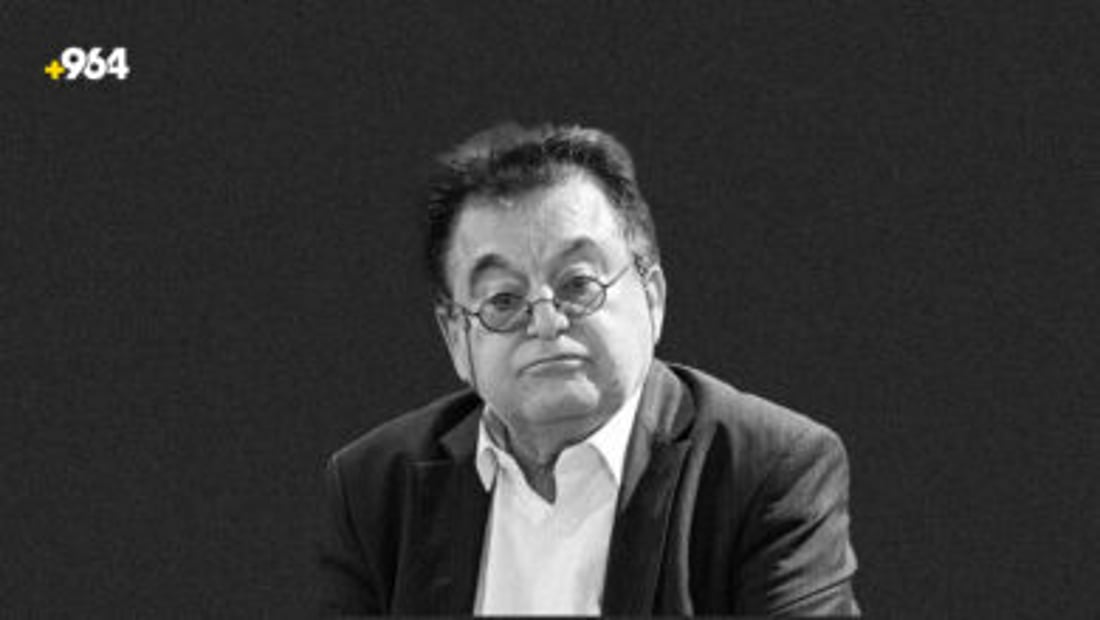
Photo: Renowned Kurdish writer and philosophy scholar Faruq Rafeq
Philosophy scholar Faruq Rafiq buried in Sulaymaniyah as Kurdistan mourns his passing
SULAYMANIYAH — The body of Kurdish writer and philosophy scholar Faruq Rafiq was transferred from Erbil to Sulaymaniyah and buried at Saiwan Cemetery on Wednesday, in a funeral attended by residents, relatives, intellectuals and local government officials. A wreath was placed on his coffin in Erbil and it was draped with the Kurdistan flag before the journey south.
Rafiq died Tuesday in Erbil at the age of 65. The cause of death has not yet been confirmed; a friend and relative, Dana Ismail, said Rafiq had some kidney issues but that it “was not in a way that posed a threat to his life,” adding that they are awaiting a medical report.
Kurdistan Region President Nechirvan Barzani said in a statement that Rafiq “made significant contributions to Kurdish literature and culture through his insightful thoughts and writings, particularly in the realms of philosophy and intellectual inquiry,” describing his passing as “a great loss of a vibrant and talented voice.” Renowned Kurdish academic Muhammad Kamal said: “The death of Faruq Rafiq, in addition to being an unexpected and sad event, is a major loss to our intellectual and philosophical life. However, he will remain immortal through his writings.”
Rafiq held a doctorate in philosophy and authored nearly 20 books, in addition to numerous essays, studies and lectures on philosophy and western thought. He served as editor-in-chief of Awez journal, a quarterly publication focused on philosophy and intellectual discourse, and had lived in Erbil for the past two years.
His published works span philosophy, political theory and poetry, and include “Pax Americana” and “Communal Concerns,” a two-volume essay collection, “The Reconciliation of Mind and Love,” “In the Hour Before Midnight,” a work of political criticism, “The Art of Love,” “Philosophy and Life” and “A Station of the Philosophical Expedition.” Among his other notable titles, “Tyranny: The Kingdom of Fear, Dehumanization and the Terrorizing of Reason,” published in 2000, addressed political issues and their theoretical dimensions, while “The Wasteland of Revolutionaries” examined politics and political activism in Kurdistan and the broader region, arguing that for a new form of politics to emerge, politics must first become a subject of reflection and research.
Rafiq was known for revisiting and revising his ideas at different stages of his life. For a long period he described himself as a defender of liberal education and was a critic of leftist thought, Marxism and political Islam. He consistently emphasized the importance of logic in intellectual life, arguing that many societal problems in the region stem from the absence of logic and errors in reasoning, and wrote extensively on logical fallacies as a foundation for any enlightenment effort.
Ismail said Rafiq left behind a number of unpublished manuscripts, including a five-volume series dedicated to interpreting the works of Plato, a book titled “Philosophy of Science” and a work on hermeneutics — the science of text interpretation — all of which are expected to be published in the near future.