
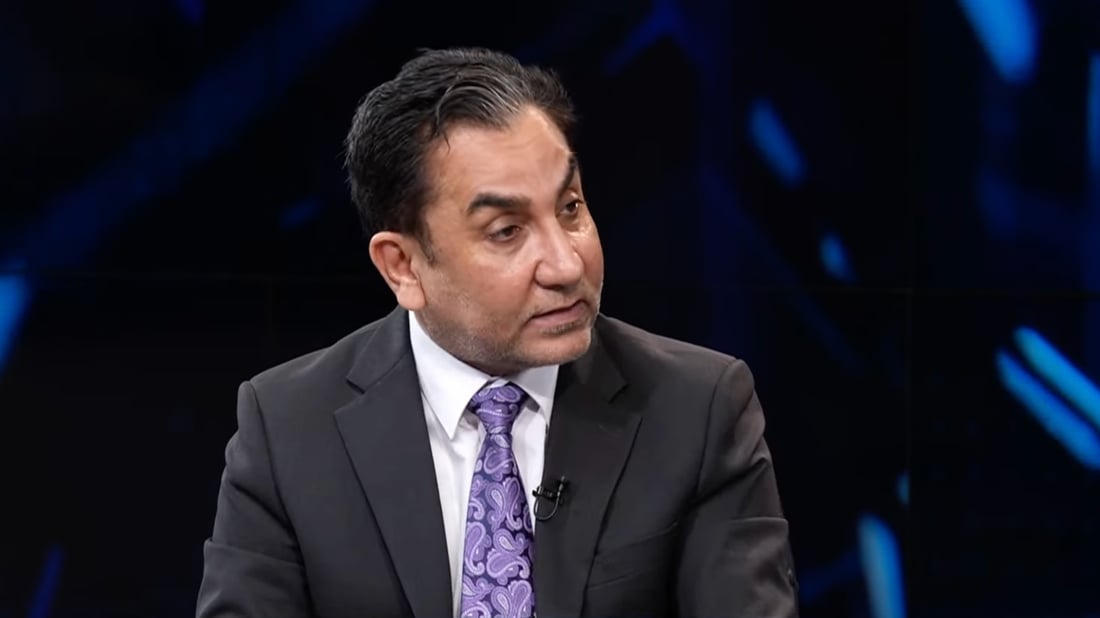
Hussein al-Shihani, a member of the Political Bureau of the Sadiqun Movement
Media Monitor
Sadiqun Movement official says it has not backed Maliki for PM
BAGHDAD — A senior figure in the Sadiqun Movement said the group has not agreed to support Nouri al-Maliki for prime minister either before or after U.S. President Donald Trump publicly opposed his return, insisting its position remains bound to criteria set by Iraq’s Shiite Coordination Framework.
Hussein al-Shihani, a member of the Political Bureau of the Sadiqun Movement, the political wing of Asa’ib Ahl al-Haq, said in an interview with Dijla TV that “the framework paper, which includes the specifications for the Prime Minister, was participated in by everyone within the Coordination Framework, including Mr. Nouri al-Maliki; this was the basis of our discussion.”
He rejected claims that the group had shifted its stance. “Today, I hear some voices from the brothers in the State of Law Coalition saying that ‘Asa’ib changed their mind.’ I tell them: we have not changed our mind,” al-Shihani said. “Our view remains committed to the specifications established on the basis of the framework paper, and until now, we have not agreed.”
He said participation in a future cabinet remains undecided. “We have not yet decided in the Political Bureau whether to participate in the new government,” al-Shihani said, adding that confidence could still be withheld “if unsuitable ministers are nominated.”
The remarks come after the Shiite Coordination Framework repeatedly reaffirmed its commitment to nominating al-Maliki, calling the choice of prime minister “a purely Iraqi constitutional matter” made “away from external dictates,” despite Trump saying the United States would not cooperate with Iraq if al-Maliki returned to office. Al-Maliki has rejected what he described as foreign interference and called for “respect” for the will of the Iraqi people.
Iraq held parliamentary elections on Nov. 11, 2025, after which the Coordination Framework declared itself the largest bloc in the Council of Representatives, a status that allows it to nominate a candidate for prime minister, as negotiations over government formation continue.
Some excerpts of Al-Shihani in an interview on Dijla TV:
The framework paper, which includes the specifications for the Prime Minister, was participated in by everyone within the Coordination Framework, including Mr. Nouri al-Maliki; this was the basis of our discussion. Today, I hear some voices from the brothers in the State of Law Coalition saying that ‘Asa’ib changed their mind.’ I tell them: we have not changed our mind. To make the scene clear to the public and general opinion, our view remains committed to the specifications established on the basis of the framework paper, and until now, we have not agreed.
The basic criteria in the framework paper are that it must respect the orientations of the Supreme Religious Authority, national consensus, and the stewardship of Iraq’s interests internationally. These are titles agreed upon by all members of the Framework, and at no time did we say, ‘Let’s cancel this paper because it has become useless or (expired).’ To whoever asks, ‘Why did you agree to al-Maliki when he was among the nine candidates?’ I say to him: those nine were nominated by the committee, and it was the responsibility of this committee to apply the components of the paper and exclude whoever it deemed unsuitable. This is all that happened.
The MPs of ‘Sadiqun’ will vote to form the government to prevent the bending of the Framework’s decision, unless new reasons emerge that warrant discussion or the withholding of confidence. Today, Asa’ib says ‘let us proceed’ because there are ‘brazen and reckless’ external dictates represented by Trump’s tweet; therefore, it is shameful—and our principles do not allow us—to bend as a part of the Framework. However, this does not mean we have reviewed the framework paper and specifications or retracted our rejection because we found a candidate suitable for the specifications.
If they said that they want to designate Mr. al-Maliki and need the signatures of the Framework leaders to submit them to His Excellency the new President of the Republic, His Eminence Sheikh Qais al-Khazali will not sign the designation. But if it proceeds by majority and the government is formed, and there are no new reasons calling for the withholding of confidence, we will grant confidence.
Our vote to grant confidence does not depend on our participation or lack thereof; all scenarios are on the table. We have not yet decided in the Political Bureau whether to participate in the new government. In the event that we agree to al-Maliki, we might not grant his government confidence if unsuitable ministers are nominated.
Furthermore, the American Chargé d’Affaires, Harris, informed al-Maliki of the necessity of respecting the United States’ decision or bearing the responsibility.