
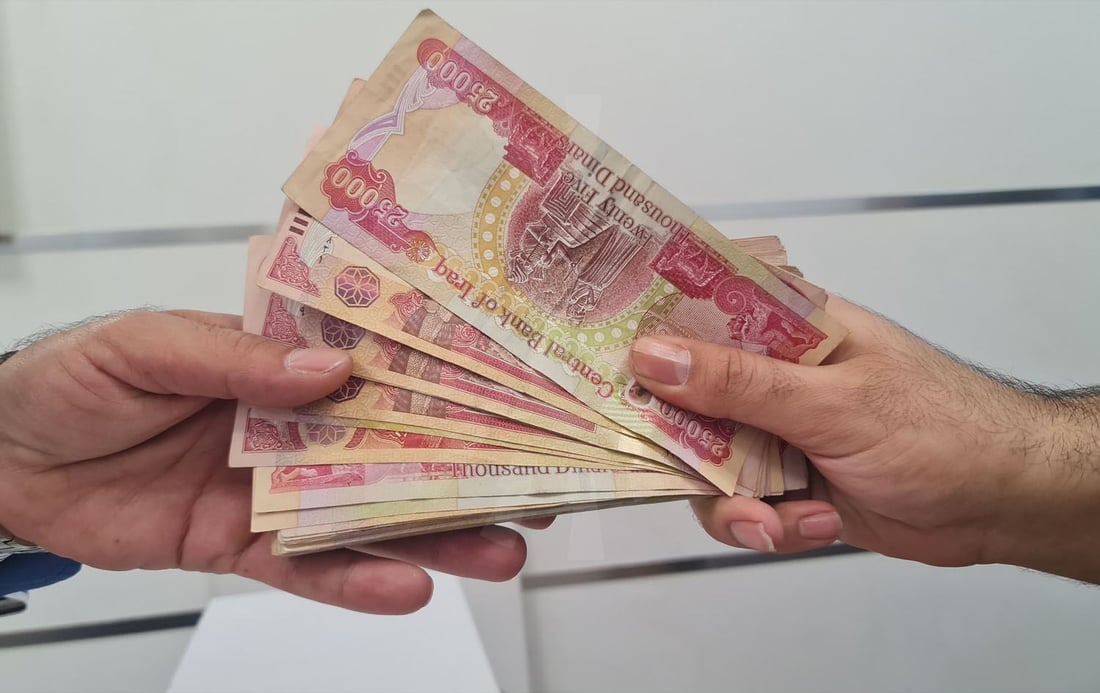
A person handing over a stack of Iraqi dinars, representing cash transactions or financial exchanges in Iraq. Photo by Blind T. Abdullah
'No structural problem'
Salary delays hit most ministries in Iraq as official cites ‘administrative’ holdup
BAGHDAD — Salary payments for employees in most Iraqi ministries were delayed this month, diverging from recent months when disbursements typically began in the early 20s, but government officials said salaries are fully secured and described the holdup as ‘administrative’ rather than financial.
Mazhar Mohammed Saleh Qasim, the prime minister’s adviser for financial affairs, told 964media there is no structural problem in the flow of public revenues, despite speculation the delays were caused by a lack of liquidity.
“There is no structural problem in the flow of public revenues in general,” Saleh said, noting that oil revenues, which account for about 90% of total public income, remain exposed to external pressures. He said these revenues are affected by “global geopolitical conditions and the resulting volatility in the regularity of the global energy market,” a challenge faced by all oil-exporting countries.
Saleh said public finances in 2026 are being managed under the amended Federal Financial Management Law No. 6 of 2019, which requires securing monthly resources on a priority basis to cover mandatory spending, including salaries, pensions and social welfare benefits. He said these obligations amount to nearly 8 trillion Iraqi dinars per month.
He added that such spending requires “precise financial management and strict organization of spending priorities,” particularly under the “1/12 rule,” which allows monthly spending equivalent to one-twelfth of actual current expenditures from the previous year, 2025.
Saleh said Article 29 of the law regulates temporary financing and liquidity management when spending under an approved federal budget is not possible, including in cases of delayed budget approval or a temporary shortfall in liquidity. In such cases, he said, the Ministry of Finance is authorized to take interim measures to ensure priority expenditures continue without delay.
Separately, Finance Minister Taif Sami instructed all state-owned banks to operate on Friday and Saturday, Jan. 30 and 31, to complete salary disbursements.
The Ministry of Finance said in a statement that it has begun “actual auditing procedures for state employee salary data to ensure they reach beneficiaries smoothly,” adding that “salaries are fully secured and specialized staff have already begun funding all spending units.”
“To ensure speed of completion and avoid any time gap, the ministry directed that Friday and Saturday be official working days for the relevant staff,” the statement said, calling on spending units to submit complete and accurate data to facilitate disbursement.
The ministry said the auditing process is linked to a Cabinet decision on calculating pension contributions and transferring them to the pension fund to strengthen its revenues, as well as applying tax deductions that are recorded as final revenue for the public treasury.
“If complete lists are received, funding will be released,” the statement said, adding that entities would bear responsibility for delays resulting from discrepancies between digital and paper records, with oversight bodies to be notified.